Buffet With a Body Count: What The White Lotus Reveals About Resort Food and Class Anxiety
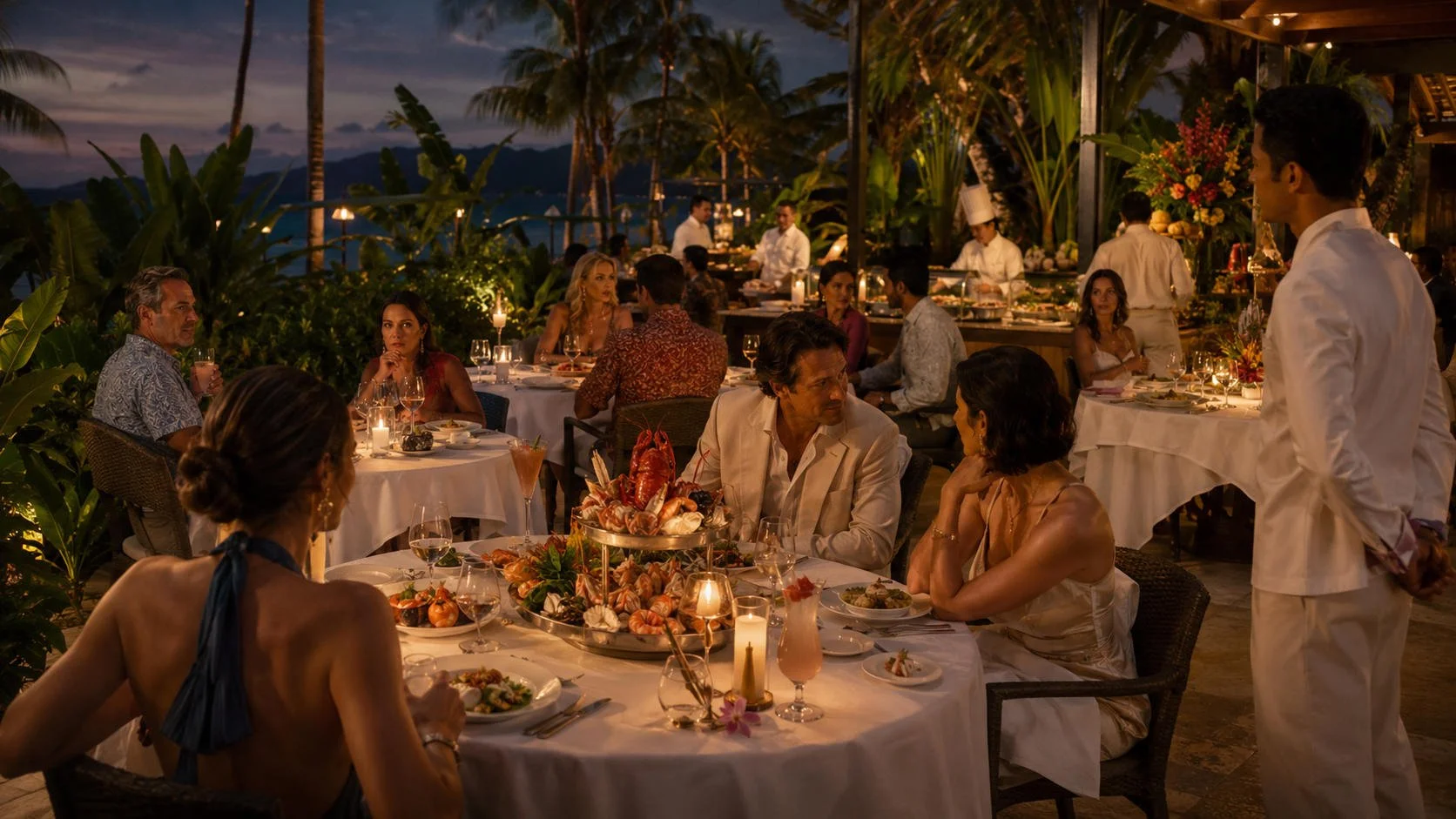
There you are, standing in linen shorts beside a tropical fruit display arranged like a minor religious offering, trying to decide whether taking a second croissant makes you look relaxed or poor. There is smoked salmon. There is papaya. There is a tiny spoon for jam so delicate it appears to have been designed for a duchess with hand fatigue. Somewhere nearby, a server is smiling with the calm of someone trained to witness human insecurity near chia pudding.
This is the world The White Lotus understands too well. The show is not about resort food in the obvious Food Network way. Nobody is lovingly explaining the terroir of the breakfast pineapple. Nobody is having a sensual awakening over ravioli. The food is there constantly, beautifully, expensively, and somehow almost never enjoyed. It is background, bait, weapon, status marker, emotional furniture, and proof that luxury does not remove anxiety. It plates it nicely.
HBO describes The White Lotus as an award-winning series following employees and guests at an exclusive resort over a transformative week; Season 3 specifically moved the satire to an exclusive Thai resort. The premise sounds like vacation porn until the show starts poking rich people with a shrimp fork and asking why they are so spiritually damp.
Resort Food Is Where Luxury Pretends to Be Effortless
The basic fantasy of resort food is that everything appears without friction. Coffee arrives. Fruit appears. Towels materialize. Cocktails glide across the pool deck. Someone refills water before the guest has fully registered thirst. The rich person’s deepest vacation dream is not merely abundance. It is abundance without visible labor, because visible labor ruins the vibe by suggesting the universe is not actually their personal butler.
The White Lotus makes that fantasy disgusting in exactly the right way. The meals are beautiful, but the beauty depends on workers hovering politely around guests who are busy unraveling in linen. Eater’s review of the first season argued that the show reveals how the “effortless glitz and glamour” of a luxury hotel is not effortless at all, and that what wealthy guests take for granted comes at the cost of workers’ ambitions and sanity. Lovely. Your mimosa has a backstory, and it is underpaid.
That is why resort dining on the show feels so tense. The table is never just a table. It is a stage where class gets performed badly by people who believe they are being subtle. Ordering, complaining, asking questions, ignoring the staff, overtipping, undertipping, pretending to care about local culture, refusing to leave the property — all of it becomes part of the meal.
Everyone Eats at the Resort Because Leaving Would Ruin the Cage
One of the funniest and most telling things about The White Lotus is that the guests keep eating at the hotel. They are in Hawaii, Sicily, Thailand — places with actual culinary cultures, restaurants, markets, street food, local cooks, and regional traditions — and yet they orbit the resort dining room like anxious moons.
Bon Appétit noticed the same thing about Season 2: the characters dine at the resort restaurant nearly every night and pick through a breakfast buffet each morning, despite being in Sicily, a region famous for wine, produce, and food worth leaving a hotel for. The article argues that this makes sense for a show about wealth and vacation colonialism, because the characters are not really seeking a world-expanding dining experience. They are seeking comfort with a view.
Exactly. The resort restaurant is not just convenient. It is protective glass. Leaving the hotel would require negotiating the outside world: language, local customs, unfamiliar menus, different service rhythms, maybe even prices that are not already absorbed into the fantasy of the stay. Terrifying. Better to sit under flattering lighting and ask whether the fish tastes “fishy,” a sentence that should legally disqualify someone from speaking near the ocean.
The hotel restaurant keeps everyone trapped together, which is useful dramatically and psychologically. It is a gilded cafeteria for people too rich to admit they are scared of choosing wrong.
Breakfast Buffets Are Class Anxiety in Croissant Form
The resort breakfast buffet is the purest White Lotus food symbol because it looks like abundance and feels like surveillance. You can have anything. That is the problem.
A buffet removes one form of anxiety — ordering — and replaces it with another: self-presentation. What kind of person are you at the buffet? Minimalist fruit-and-yogurt person? Omelet-station person? Croissant-and-bacon person? “I’m just having coffee” person, otherwise known as the vacation martyr? Plate-too-full person? Tiny-dessert-at-breakfast person? Person who takes photos of melon like it has entered witness protection?
The buffet pretends to be democratic. Everyone walks the same line. Everyone sees the same pastries. But the class anxiety is in the performance. The very rich know how to act like abundance is normal. The aspirational rich often act like abundance is something to be managed, optimized, documented, or morally justified. The truly relaxed person eats the second pastry and shuts up. The anxious person narrates it: “I’m being so bad.” At a resort. On vacation. Under a palm tree. Civilization has failed.
In Season 3, Condé Nast Traveler reported that Koh Thai Kitchen at Four Seasons Resort Koh Samui was heavily used for breakfast and lunch scenes, while dinner scenes used Ta Khai at Rosewood Phuket. So even the fictional resort’s food world is a luxury composite: one hotel’s breakfast, another hotel’s dinner, several properties stitched together into one seamless fantasy buffet for anxious viewers to mentally book and then financially fear.
The Resort Menu Lets Rich People Avoid Local Food While Performing Interest in It
Luxury resort food has a hilarious little balancing act. It must feel local enough to justify the destination but familiar enough that guests do not panic into plain pasta. So the menu becomes a diplomatic compromise between “authenticity” and “please don’t scare Todd from finance.”
That is why resort menus often feature local ingredients, local names, and local design cues while still maintaining the safety rails of global luxury dining: excellent bread, familiar proteins, elegant cocktails, salads that look like spa architecture, and desserts small enough to imply restraint while costing enough to imply importance.
This is exactly the kind of food world The White Lotus skewers. The resort lets guests feel exposed to place without actually surrendering control to it. They can eat Thai food in Thailand or Sicilian food in Sicily, but inside the resort’s aesthetic border control, where the spice level, plating, service language, and ambience have all been adjusted for the international anxious rich.
Four Seasons’ own materials lean into this luxury-local blend. Its San Domenico Palace in Taormina is described as a five-star hotel in a former 14th-century convent with Michelin-starred cuisine crafted from local ingredients, while Four Seasons Koh Samui markets “Thailand’s island life” through private beaches, pool villas, deck dining, and every imaginable comfort.
Translation: you are somewhere specific, but don’t worry, the napkins still understand wealth.
The Hotel Restaurant Is the New Status Battlefield
This is not just TV nonsense. Hotel dining has become central to how luxury properties sell themselves. Hilton’s 2025 trends report said dining experiences were the next highest travel budget priority after accommodations, that 50% of global travelers book restaurant reservations before flights, and that 60% of luxury travelers prioritize hotels with great restaurants. JLL’s 2025 Hotel Restaurant Report found that hotels with celebrity-chef restaurants or prestigious awards commanded 8.8% higher average daily rates and 18.6% higher RevPAR than peer properties.
So when The White Lotus lingers in restaurants, it is not just using food as scenery. It is showing the modern resort’s core product: not a room, not a beach, not even a spa, but the ability to feel tastefully insulated while consuming place.
The resort restaurant has become an anxiety machine because guests know the food is part of the value proposition. If the restaurant is great, they chose well. If the restaurant is mediocre, they paid too much. If they leave the resort and eat somewhere better, the resort’s spell weakens. If they never leave, they risk becoming exactly the kind of person the show is mocking: someone who travels thousands of miles to eat inside a branded bubble with a better view.
Rich People Are Not Relaxed. They Are Just Better Lit.
Temple University professor Kris Singh, discussing The White Lotus, said the show is distinctive because it thematizes high-end tourism and service labor inside a racialized, hierarchical space. She also noted that it captures popular ambivalence around wealth: the series critiques the 1% while offering a voyeuristic look at how they live, and shows wealthy people as anxious about holding on to capital rather than stress-free.
That is the entire food dynamic in one neat little resort napkin. The meals look relaxing, but nobody is relaxed. The rich are worried about status, sex, inheritance, marriage, children, aging, betrayal, desire, death, and whether ordering the wrong thing reveals too much. The food is abundant, but their appetite is broken by self-consciousness.
The poor fantasy of wealth is: “If I had that breakfast view, I would finally be calm.” The White Lotus replies: no, you would simply bring your horrible inner weather to a better omelet station.
That is the class anxiety reveal. Resort food does not erase insecurity. It gives insecurity better tableware.
Room Service Is Luxury’s Most Intimate Little Power Trip
Room service is one of the strangest resort food rituals because it turns the guest room into a private restaurant and the hallway into a servant corridor. It is indulgent, practical, and faintly absurd. Someone wheels eggs into your room because you put on a robe and decided public breakfast was too emotionally strenuous. Incredible. Grotesque. Where do I sign?
On The White Lotus, food delivered into private spaces often feels even more revealing than dining-room food. Public meals are performances. Room service is appetite without witnesses — except, of course, the worker who delivers it and must pretend not to notice the emotional debris in the room.
This is where class anxiety becomes physical. The tray is not just food. It is evidence: what you ordered, how much you ordered, whether you are alone, whether you are drunk, whether you are hiding, whether you are unraveling. The luxury is privacy; the anxiety is that service labor keeps seeing through it.
Resort Food Is Abundance With Boundaries
The best resort food always says: “You can have anything.” The fine print says: “Within the system.”
Breakfast has hours. The pool menu has categories. The tasting menu has supplements. The minibar has prices designed by someone with a grudge. The beach barbecue has a reservation list. The villa dining menu arrives like a promise and a threat. You are free, but the freedom is formatted.
That makes resort food perfect for The White Lotus, a show about people who think money bought them escape but discover it mostly bought them a more photogenic container for dread. The food is plentiful, but the social code is tight. You must know what to order, when to complain, how to pronounce the wine, how much to tip, whether to ask for substitutions, whether to send something back, whether to pretend you are adventurous, and how to look natural while spending more on lunch than some people spend on groceries.
Luxury is not the absence of rules. It is knowing the rules so well you can pretend they are not there.
The “White Lotus Effect” Makes the Anxiety Real
The show does not just satirize luxury travel. It sells it, accidentally and then not-so-accidentally. Four Seasons openly promotes “set-jetting” tied to The White Lotus, noting that Season 1 was filmed at Four Seasons Resort Maui at Wailea and Season 2 at San Domenico Palace, Taormina. The brand invites guests to “walk in” Tanya McQuoid’s footsteps, which is darkly funny considering Tanya’s footsteps are not exactly a wellness itinerary.
Season 3 intensified the tourism loop. Warner Bros. Discovery’s shooting-location list shows how many real Thai locations fed the fictional resort world, including Royal Osha in Bangkok, Café Del Mar in Phuket, Mandarin Oriental Bangkok’s hotel bar, a beachside BBQ and fire show at Am Samui Resort, and other Koh Samui, Phuket, and Bangkok sites.
So the show mocks luxury tourism, and then viewers book luxury tourism. Beautiful. The satire got monetized before the corpse cooled.
This is why resort food becomes class anxiety for viewers too. Watching the show, you want the breakfast. You want the pool bar. You want the open-air restaurant. You also know the show is laughing at the people who want exactly that. It is envy with a side of moral cover, the cultural equivalent of ordering fries “for the table” and eating most of them yourself.
Travel Is Splitting Into People Who Can Afford the View and People Who Watch It on HBO
The class anxiety lands harder now because travel itself has become more visibly divided. Reuters reported on May 28, 2026, that rising airfares and hotel rates are pushing budget-conscious Americans to delay or cancel summer trips while wealthy travelers keep vacation plans, with higher-end hotels continuing to show stronger growth even as economy hotel demand softens.
That context makes The White Lotus nastier and more addictive. Resort food is not just about rich people eating breakfast. It is about access. Who gets to sit at that table? Who serves it? Who watches? Who can afford to complain? Who can afford to be bored in paradise? Who gets to call local cuisine “authentic” after eating it inside a property designed to protect them from actual local life?
The resort breakfast buffet becomes a symbol of the travel economy itself: overflowing for some, inaccessible to many, serviced by workers whose own relationship to the destination is entirely different from the guests’.
The Food Is Wasted Because the Guests Are the Meal
One reason food on The White Lotus often feels weirdly ignored is that the guests are not really there to taste. They are there to reveal themselves. The meal is the interrogation room, just with better flowers.
At dinner, marriages crack. Friendships curdle. Family dynamics leak toxic gas. At breakfast, people regroup and pretend the previous night did not happen. Drinks loosen the mask. Room service hides the damage. The food is expensive wallpaper, but it is also the structure that forces characters to sit, look at one another, and fail socially in public.
This is why the show’s resort food can feel so simultaneously lush and dead. The plates are gorgeous, but the people eating them are spiritually microwaved. They cannot enjoy abundance because enjoyment requires presence, and these people are too busy managing status, resentment, desire, guilt, and whatever nonsense their adult children are doing by the pool.
The food is not wasted because it is bad. It is wasted because the guests are incapable of receiving it as anything but an accessory to their own drama.
How to Eat at a Resort Without Becoming a White Lotus Character
The useful lesson is not “avoid resort restaurants.” Please. Some are excellent. Some are genuinely tied to local ingredients and serious kitchens. Some are worth the price. The lesson is to stop treating resort food like a personality exam.
Leave the property sometimes. Eat at local restaurants. Go to a market. Ask staff for recommendations without making them perform culture concierge theater for you. Tip well. Learn a few food words in the local language if appropriate. Order something because you want it, not because it photographs like you have taste.
At breakfast, take the second croissant or don’t. Nobody cares as much as your anxiety claims. At dinner, don’t turn every menu into a test of sophistication. If you don’t know the wine, ask. If you don’t like something, be normal about it. If you want the burger at a five-star resort, order the burger and stop acting like the chef is going to come out and revoke your passport.
Most importantly, notice the labor. Not in the performative “thank you for your service, breakfast soldier” way. Just actually notice that luxury is made by people. The fruit did not cut itself. The room service tray did not levitate. The restaurant did not become serene by accident. Someone is managing your comfort while you wonder whether the papaya is ripe enough for your personal journey.
Resort Food Is Where Class Gets Plated
The White Lotus reveals that resort food is never just food. It is class performance with cutlery. It is abundance staged for people who cannot relax. It is local culture filtered through luxury. It is service labor disguised as magic. It is a buffet where everyone is pretending not to calculate status.
The show understands that the scariest thing about rich people at a resort is not that they eat better than everyone else. It is that they still cannot enjoy it. They sit in paradise, surrounded by fruit, linen, cocktails, ocean views, tasting menus, and staff trained to anticipate their needs, and somehow manage to turn breakfast into a silent referendum on power.
That is the joke. That is the horror. That is why the resort dining room is the perfect White Lotus stage.
The food is beautiful. The guests are rotten. The staff is watching. The bill is obscene. The papaya is innocent.
And somewhere, at the breakfast buffet, someone is taking one croissant too many and calling it self-care.