Why TikTok’s “What I Eat in a Day” Videos Are So Addictive
A “What I Eat in a Day” video should be boring. Deeply boring. Historically boring. It is, at its core, a stranger saying, “I had coffee, eggs, a bowl, a snack, dinner, and something sweet,” which is information only slightly more urgent than a printer manual.
And yet people watch them. Millions of them. Over and over. A woman opens a fridge. A man plates Greek yogurt. Someone pours coffee into a glass so aggressively iced it belongs in a jewelry case. A creator says, “I always start my morning with lemon water,” and suddenly your thumb freezes like you are witnessing classified breakfast intelligence.
The format is addictive because it is not really about food. It is about curiosity, control, comparison, identity, routine, aesthetics, aspiration, and the ancient human desire to know what everyone else is doing in their kitchen like a socially acceptable raccoon peering through blinds.
TikTok did not invent food voyeurism. People have always wanted to know what other people eat. Cookbooks, celebrity diets, grocery hauls, meal-prep blogs, fridge tours, magazine “day on a plate” spreads — same little gremlin impulse, different container. TikTok simply compressed it into 38 seconds, added soft music, made the eggs prettier, and let the algorithm shove ten more into your lap before your brain could say, “Wait, why am I watching lunch surveillance?”
“What I Eat in a Day” Is a Perfect TikTok Format
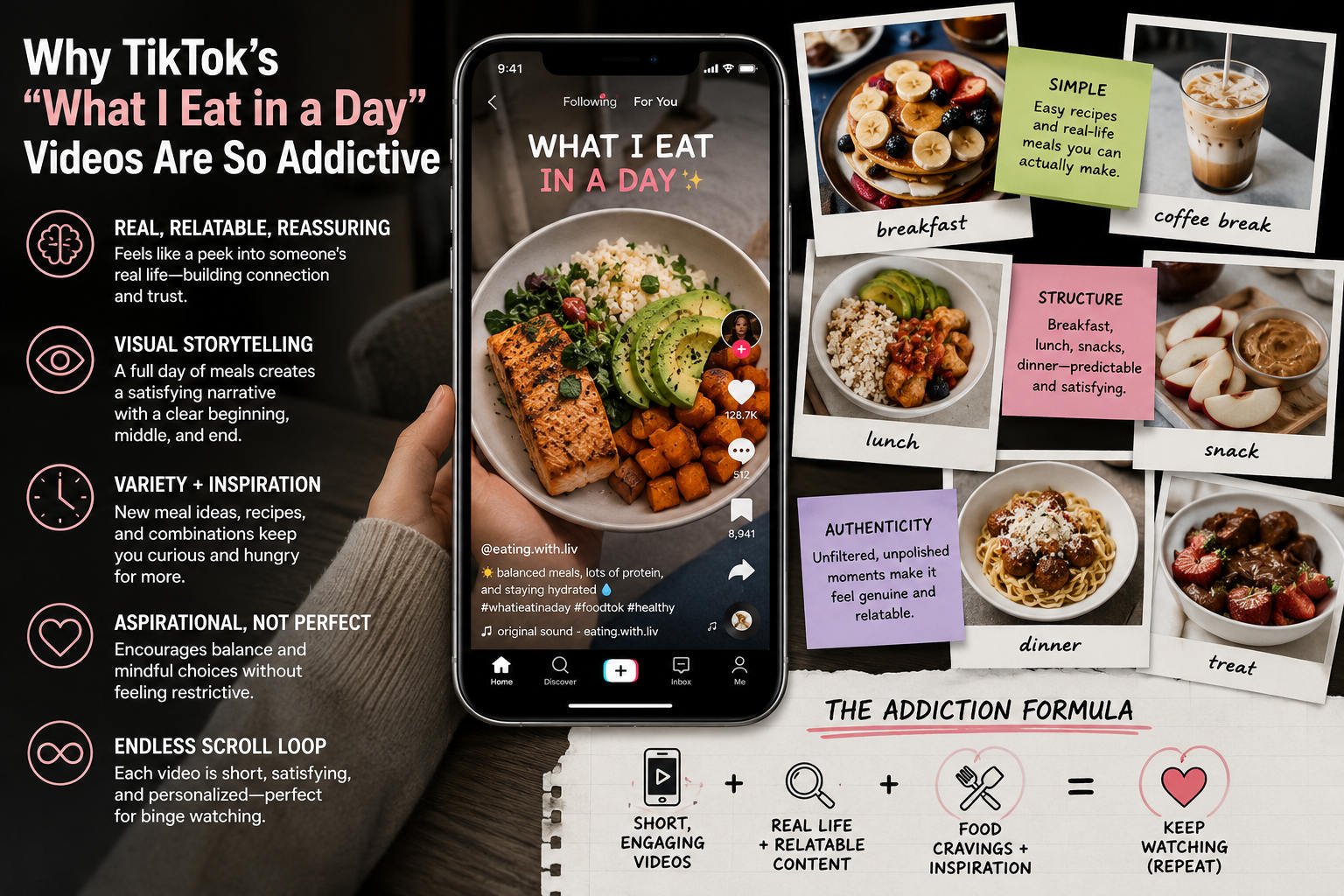
The format works because it gives TikTok exactly what TikTok likes: speed, repetition, clarity, and a tiny payoff every few seconds. Breakfast. Cut. Coffee. Cut. Snack. Cut. Lunch. Cut. Dinner. Cut. Dessert. Cut. Closing shot of matcha, abs, toddler, office desk, gym bag, or sunset, depending on which lifestyle department is currently manipulating you.
TikTok’s own recommendation documentation says the For You feed can be influenced by user interactions such as likes, shares, comments, videos watched in full or skipped, content information like sounds and hashtags, and user information like language, location, time zone, and device type. TikTok also says user interactions, including time spent watching a video, are generally weighted more heavily for most users. Translation: if you watch one entire “What I Eat in a Day” video because you needed to know whether the creator ate dinner, congratulations, you just taught the machine that you enjoy televised meal accounting.
That is why these videos multiply. You pause on one bowl of overnight oats, and the app says, “Ah, you are a breakfast anthropologist now.” Suddenly your feed is a parade of strangers eating cottage cheese, protein bagels, sushi bowls, “girl dinner,” “high-protein meal prep,” and one person who claims their dessert is frozen grapes, which is not dessert, it is produce wearing a tiny prison uniform.
The Hook Is Curiosity About “Normal”
The real question behind every “What I Eat in a Day” video is not “What did this person eat?” It is “Am I eating normally?” That is the cursed little engine under the hood.
People watch because food is private but also weirdly public. Everyone eats. Almost everyone has opinions about eating. Nobody fully knows whether their own eating is normal because “normal” changes depending on culture, money, body size, work schedule, family, hormones, health, stress, and whether groceries cost the GDP of a small island this week.
So a stranger’s food diary becomes evidence. Not reliable evidence. Not scientific evidence. More like evidence found in a bathroom stall by a detective with no training. But still, evidence. “She eats three meals and two snacks.” “He eats a huge breakfast.” “They don’t count calories.” “She eats dessert every night.” “He meal preps everything.” “She eats like a woodland Pilates instructor.” “He eats like a fraternity house became sentient.”
A 2023 study of 100 TikTok #WhatIEatInADay videos found two broad types: “Lifestyle” videos, which often included aesthetics, clean eating, weight-loss promotion, body-focused themes, and sometimes disordered eating content; and “Eating Only” videos, which focused more on food, upbeat music, highly palatable foods, irony, emojis, and excessive consumption. In other words, the format is not one thing. It is a buffet of comparison traps wearing different outfits.
The Videos Feel Intimate Without Requiring Actual Friendship
A “What I Eat in a Day” video feels personal because food is personal. You are not watching someone review a vacuum. You are watching them move through a day: waking up, making coffee, going to the gym, working, snacking, cooking dinner, maybe eating in bed like a gremlin with boundaries. It creates the illusion of closeness.
This is the genius and the rot. You feel like you know the creator because you know their coffee order, their favorite yogurt, and whether they use oat milk. This is not knowing someone. This is knowing their refrigerator lore. But the brain is a needy little golden retriever, so it accepts the scraps.
TikTok’s own trend reporting keeps emphasizing authenticity, community, comments, and creators showing up in ways that feel real. Its 2025 trend report says brands and creators are leaning into authentic voices, community engagement, behind-the-scenes moments, and creator-community relationships. Obviously, “authenticity” is now a marketing asset, because nothing says human connection like a deck presented to advertisers. Still, the point stands: TikTok rewards content that feels unpolished, personal, and close.
“What I Eat in a Day” videos are intimacy cosplay. You get the feeling of being in someone’s kitchen without the burden of helping clean up, which is honestly the strongest form of modern friendship.
The Format Turns Routine Into Entertainment
Most people’s food routines are repetitive. Coffee. Toast. Leftovers. Salad. Pasta. Takeout. Snack. Regret. Repeat until death or grocery delivery. But TikTok makes routine look cinematic.
The same yogurt bowl that would look tragic under your kitchen light suddenly becomes content when someone films it from above, adds berries, drizzles honey, and puts it in a ceramic bowl handmade by a woman named Fern. Your own lunch is “stuff in Tupperware.” Their lunch is “a balanced nourish bowl.” Very different. One has chickpeas. The other has branding.
This is why the videos are soothing. They impose order on the chaos of eating. A full day gets divided into tidy scenes. Breakfast happens. Lunch happens. Dinner happens. Snacks happen. Everything has a bowl, a caption, a little spoon tap, and a soundtrack. Life appears manageable for 45 seconds. Your actual life may be a dishwasher full of mugs and a calendar built by demons, but this person’s day has sections. Delicious, infuriating sections.
TikTok’s 2026 trend forecast describes “curiosity” as a major discovery behavior and says users often arrive with one intention but discover unexpected tips, hacks, and stories along the way. That is exactly how these videos work: you arrive for the meal idea, then accidentally tour someone’s morning routine, workout, pantry, relationship, apartment, and psychological relationship with chia seeds.
The Aesthetic Makes Food Feel Like a Personality
On TikTok, food is rarely just food. It is identity with sauce. A matcha says one thing. A Diet Coke says another. A farmer’s market haul says another. A “high-protein buffalo chicken bowl” says another. A sad desk salad says “HR is nearby.” A beautiful breakfast spread says “I have time, money, and at least one functioning linen napkin.” Disgusting, but effective.
“What I Eat in a Day” videos are addictive because they let viewers decode a person through food. Is this creator disciplined? Relaxed? Rich? Athletic? Chaotic? Gentle? Crunchy? Wellness-coded? Gym-coded? Mom-coded? Student-coded? “I live in New York and spend $19 on lunch because rent has already broken me” coded?
Food has always carried identity, but social platforms make it legible at high speed. A review of food-related social media research published in Nutrients noted that food-related media now includes food photos, blogs, videos of people eating, mukbangs, and “What I Eat in a Day” videos, and that the existing research suggests a potential relationship between food-related social media, body image, and disordered eating, though findings are mixed and the field still needs more experimental work.
That mixed evidence matters. Not every food video is poison. Some are useful. Some are funny. Some normalize eating enough food. Some help people cook. Some make lunch less grim. But the format is powerful because it turns eating into self-presentation, and self-presentation is where the internet goes to become a haunted pageant.
The Comparison Machine Never Closes
The addictive part is not just watching. It is comparing.
You compare your breakfast to theirs. Your portions to theirs. Your grocery budget to theirs. Your body to theirs. Your kitchen to theirs. Your discipline to theirs. Your “I ate cereal for dinner” Tuesday to their salmon bowl with microgreens, which they probably called “quick and easy” because influencers love lying directly into a ring light.
Researchers studying WIEIAD TikTok videos have specifically used social comparison theory to explain why these videos may affect viewers’ body image and diet intentions. One study notes that upward comparison can happen when viewers compare themselves to someone they see as more desirable, while downward comparison can happen when viewers see themselves as better off; the researchers examined how low-calorie and high-calorie food diary videos shaped body dissatisfaction, body appreciation, mood, and intention to diet.
That is the psychological casino. Sometimes you watch and feel inspired. Sometimes you watch and feel superior. Sometimes you watch and feel inadequate. Sometimes you watch and think, “Maybe I too should meal prep quinoa.” Then you remember quinoa tastes like tiny damp beads of moral judgment and close the app for six minutes.
The Body Cue Problem Is Where It Gets Messy
A “What I Eat in a Day” video becomes more loaded when the creator’s body is part of the pitch. Sometimes it is explicit: “What I eat to stay lean.” Sometimes it is implied: thin body, flat stomach shot, gym clip, calorie count, “clean” food, and a caption pretending this is just innocent meal inspiration. Oh good, diet culture has put on a claw clip and learned soft lighting.
A 2025 Frontiers in Human Dynamics study found that participants who viewed WIEIAD videos with body cues reported lower eating intentions and higher body dissatisfaction; the study also found that thin-ideal cues led to higher body dissatisfaction than muscular-ideal cues, and that people with higher body-shape concerns were more affected. That does not mean every viewer will be harmed by every video, but it does mean the “just sharing my meals” defense can become flimsy when the video is really selling a body as the receipt.
This is where the format stops being cute little lunch content and starts becoming a calorie courtroom. The viewer is no longer just thinking, “That pasta looks good.” They are thinking, “If I eat like her, will I look like her?” And that is how a yogurt bowl becomes a tiny cult leader.
TikTok Food Content Has a Credibility Problem, Because Of Course It Does
Another reason WIEIAD videos are addictive is that they look instructional even when they are not. A creator says what they eat in a day, and the format quietly suggests, “This is a template.” But a food diary is not a meal plan. It is not nutrition advice. It is not medical guidance. It is one person’s curated day, filmed through incentives that reward aesthetics, engagement, and comments from strangers named “fitgirly444.”
A PLOS One analysis of 1,000 TikTok videos from popular nutrition, food, and weight-related hashtags found that the content was overwhelmingly weight-normative, with themes including glorification of weight loss, food framed as a tool for health and thinness, and a lack of expert nutrition voices. That is a polite academic way of saying TikTok nutrition advice can be a blender full of vibes with no lid.
The problem is not that creators share meals. The problem is that viewers often treat meal-sharing like evidence of expertise. A person can make beautiful oatmeal and still know absolutely nothing about your nutritional needs. Shocking, I know. The sliced banana looked so credentialed.
The Algorithm Rewards Completion, and These Videos Are Built for Completion
“What I Eat in a Day” videos have a built-in narrative arc. You want to see the whole day. Breakfast is not enough. You need lunch. Lunch is not enough. You need dinner. Dinner is not enough. Did they eat dessert? Did they snack? Did the protein coffee return? Did the creator end the day with a square of dark chocolate and a smug little tea? You must know, apparently, because your brain has become a low-stakes detective wearing an apron.
That makes the videos ideal for watch time. The format creates tiny suspense without needing plot. Every meal is a chapter. Every cut restarts attention. Every bite shot says, “Keep watching; the next thing might be interesting.” Most of the time, the next thing is yogurt. Still, the machinery works.
TikTok says user interactions such as watching a video in full or skipping it can influence recommendations, and time spent watching is generally weighted heavily for most users. So a video format that encourages completion is not just satisfying; it is algorithmically convenient, which is a horrible phrase but sadly accurate.
The Comments Make It Worse, Naturally
The comment section turns the video into a group audit. People ask for recipes. People argue about calories. People praise the creator’s discipline. People accuse them of eating too little. People accuse them of eating too much. People ask what brand of protein powder they use, because apparently modern identity can be purchased in a tub.
TikTok’s 2025 trend report says comments are becoming a place where brands and audiences exchange feedback, with users expecting comments to shape understanding and engagement. In WIEIAD content, comments do the same thing but with more unsolicited nutrition policing and fewer brand managers pretending to be human.
The comments make viewers stay longer because they add a second layer of entertainment: not just “what did she eat,” but “how is the mob reacting to what she ate?” This is how the internet turns breakfast into litigation.
These Videos Are Addictive Because They Offer Control in a Messy Food World
Food is stressful now. Groceries are expensive. Nutrition advice is contradictory. Diet culture has rebranded itself as “wellness,” “gut health,” “hormone balancing,” “clean eating,” and whatever else sounds less like an almond mom with Wi-Fi. People are tired and hungry and somehow expected to understand protein targets, seed oils, meal prep, intuitive eating, food noise, ultra-processed foods, electrolytes, and whether cottage cheese belongs in every recipe like a cursed dairy ghost.
A WIEIAD video offers a fantasy: one day, neatly solved. Someone else decided. Someone else planned. Someone else ate breakfast, lunch, dinner, snacks, and dessert in a way that looks coherent. You do not have to follow it. You can just stare at it and feel, briefly, that eating can be organized.
That is the real addiction. Not just food envy. Not just body comparison. Not just recipes. It is the dream of a day where food is handled.
Of course, the dream is edited. The skipped bites are invisible. The budget is unclear. The schedule may be fake. The creator might film multiple meals on one day. The “balanced dinner” might be followed by a snack not shown because it did not match the vibe. The video is not a diary. It is a performance dressed as evidence.
How to Watch Without Letting It Turn Your Brain Into Pudding
The goal is not to ban yourself from every food diary video like a Victorian moralist who fears pasta. Some WIEIAD videos can be harmless, useful, funny, or even reassuring. The goal is to stop treating them like nutrition commandments delivered by the Holy Order of Pretty Bowls.
Watch for ideas, not instructions. A recipe idea is useful. A stranger’s full day of eating is not your meal plan. Your hunger, schedule, body, budget, culture, health needs, and food preferences are not identical to someone who films yogurt from three angles before 9 a.m.
Be suspicious when the creator’s body is the selling point. If the real message is “eat like me to look like me,” close the video and go do literally anything else. Dust a shelf. Text a friend. Stare at a wall with dignity.
Use TikTok controls aggressively. TikTok says users can manage For You topics, adjust how much they want to see of categories like food and drinks or lifestyle, mark content as “not interested,” refresh the For You feed, and use other tools to shape recommendations. The app also said in 2025 that it works to interrupt frequent recommendation of some content types that may be fine occasionally but problematic when seen too often, including extreme fitness-related content.
And if these videos trigger obsessive comparison, food guilt, restriction, binge urges, shame, or body-checking, that is not “motivation.” That is your brain waving a little red flag while the algorithm hands it a protein bar. The National Eating Disorders Association notes that media exposure and pressure can contribute to body dissatisfaction and disordered eating, even though no single cause explains these issues.
TikTok Turned Lunch Into a Cliffhanger
TikTok’s “What I Eat in a Day” videos are addictive because they are tiny food diaries, lifestyle tours, comparison machines, recipe reels, body-image traps, routine fantasies, and algorithm snacks all at once. They are simple enough to watch casually and loaded enough to keep your brain chewing long after the video ends.
They answer questions you did not know you were asking. What do other people eat? How much? When? Do they snack? Do they eat dessert? Are they healthier than me? Richer? More disciplined? More relaxed? More normal? More unhinged but with better bowls?
The format is brilliant because it turns the most ordinary human behavior into a serialized mystery. Breakfast becomes character development. Lunch becomes plot. Dinner becomes resolution. Dessert becomes moral philosophy.
And TikTok, helpful little chaos slot machine that it is, notices you watched the whole thing and immediately serves another. Then another. Then another. Suddenly you have spent twenty minutes watching strangers assemble bowls while your own actual dinner remains theoretical.
That is the trap: someone else’s food feels easier, prettier, and more organized than your own. So you keep watching.
The oatmeal was never just oatmeal. It was content with a spoon.