What Kraft Mac & Cheese Teaches About Comfort Food and Growing Up Broke
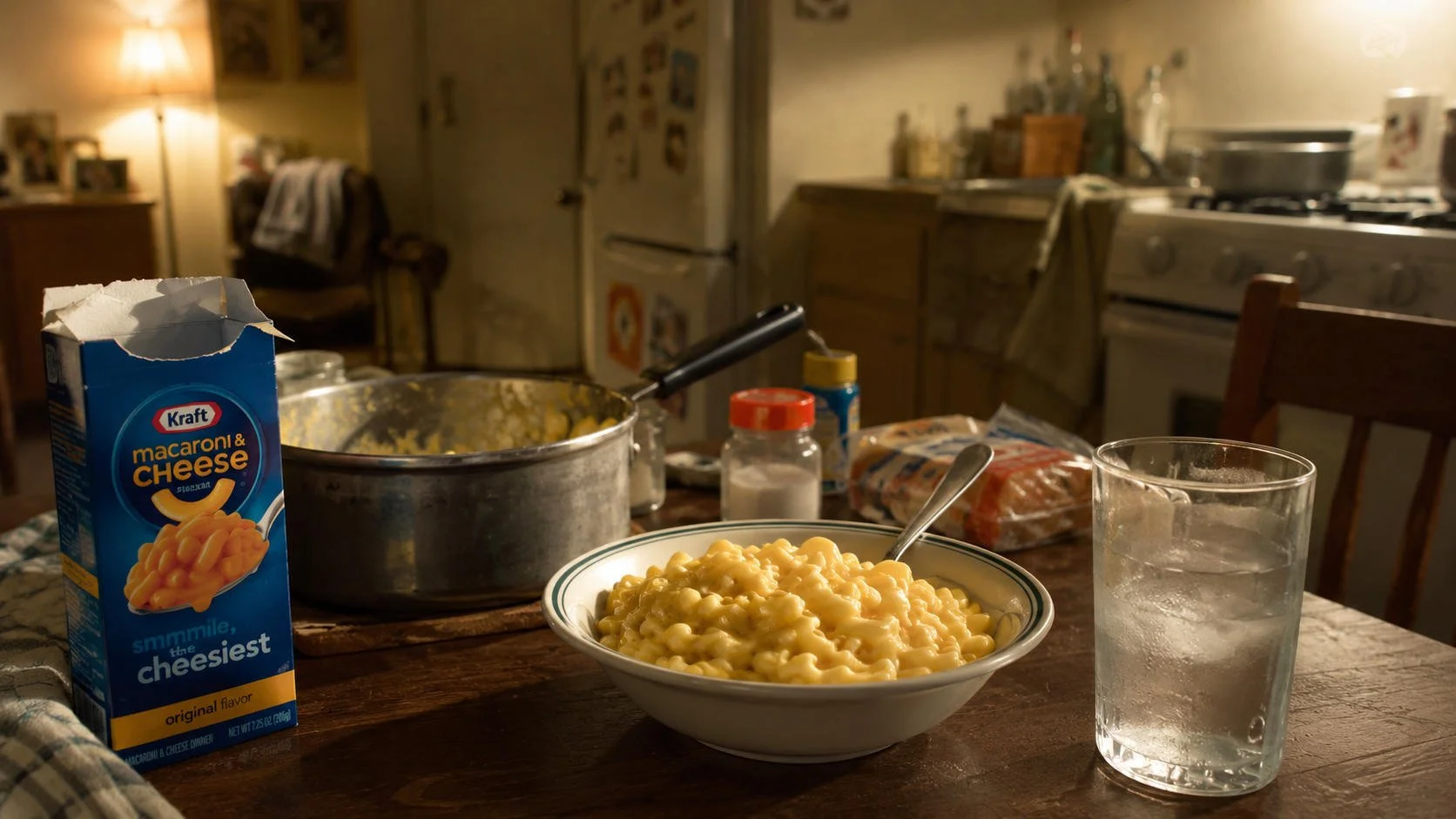
Kraft Mac & Cheese is not just pasta. Kraft is a tiny cardboard survival bunker with elbow noodles inside.
It is dinner, emergency plan, babysitter, apology, after-school snack, paycheck-stretching strategy, and proof that the American pantry has always been one crisis away from becoming a shrine to powdered cheese. The blue box sits there looking cheerful, like it has not personally witnessed rent week, late bills, single-parent exhaustion, and the kind of grocery budgeting where you stand in aisle five doing battlefield math over butter.
Kraft itself now sells the product as comfort, calling its classic blue box part of a lineup that ranges from “beloved Blue Box” to Deluxe bowls of “comfort.” That is corporate copy, yes, but it is also accidentally honest. Kraft Mac & Cheese is comfort food because for a lot of people, comfort was never roast chicken in a sunlit kitchen. Comfort was something cheap, hot, predictable, and orange enough to look like it had survived a small nuclear incident.
Kraft Mac & Cheese Was Built for Hard Times
Kraft Mac & Cheese did not become iconic because America was overflowing with leisure and artisanal breadcrumbs. It became iconic because people needed cheap food that worked. Kraft introduced boxed macaroni and cheese in 1937, during the Great Depression; Smithsonian notes that it served four people for 19 cents and sold 8 million boxes in its first year. That is not a cute origin story. That is poverty logistics wearing a noodle smile.
Then World War II made it even more useful. The National Park Service notes that Kraft macaroni and cheese grew during wartime because it was inexpensive, filling, quick, easy, and ration-friendly; the cheese powder was partially defatted and dehydrated, and shoppers could get two boxes for one ration point. Kraft sold 50 million boxes during the war. Basically, the blue box looked at economic disaster and said, “I have elbows and powder. Let’s depress everyone slightly less.”
That history matters because it explains why Kraft feels different from trend food. It was not born as lifestyle content. It was born as a solution to scarcity: cheap starch plus shelf-stable cheese flavor plus the promise that you could turn almost nothing into dinner.
The Real Ingredient Is Predictability
Growing up broke teaches you that food is not just taste. Food is reliability. Will it be there? Will everyone eat it? Will it keep? Will it fill people up? Can a tired adult make it without needing a cutting board, emotional support, or a $14 herb bundle named “finesse mix”?
Kraft answers yes to all the questions that matter when money is tight. It sits in the pantry. It does not wilt in three days like fresh produce doing a dramatic little death scene in the crisper drawer. It does not require skill. It does not need a recipe video narrated by someone whispering about “nourishment.” It requires boiling water, draining noodles, and mixing in milk, butter, and neon cheese dust like a wizard with student loans.
This is why people who grew up broke often have complicated feelings about it. Kraft Mac & Cheese can taste like childhood safety and childhood scarcity at the same time. It can remind you of a parent trying, a grandparent stretching groceries, a latchkey afternoon, or the night dinner was “whatever’s in the cabinet,” which is less a meal plan and more a financial weather report.
Comfort food research backs up the idea that comfort is often social, not just sensory. A 2015 study in Appetite described comfort food as triggering relationship-related thoughts and helping fulfill belonging needs for people with secure attachment. In normal-person language: comfort food often comforts because it reminds you of people, routines, and being cared for, not because powdered cheese contains tiny therapists.
Cheap Food Gets Judged by People Who Have Never Needed It
Nothing brings out society’s smug little hall monitors faster than poor people eating processed food. Suddenly everyone is a nutrition philosopher. “Why don’t they just cook from scratch?” Ah yes, the sacred scratch, found growing wild behind every apartment complex next to the free childcare tree and the unlimited-time bush.
The moral panic around cheap food often ignores the actual math. In 2024, 13.7% of U.S. households were food insecure at some point, according to USDA data; for households with incomes below the federal poverty line, that rate was 39.4%. Households with children were also hit hard, with 18.4% affected by food insecurity in 2024. These are not people failing a lifestyle quiz. These are people navigating limited money, time, transportation, storage, and energy while the grocery store quietly raises the price of existing.
And grocery pressure did not politely vanish. USDA’s Food Price Outlook reported that grocery-store food prices were 2.9% higher in April 2026 than in April 2025, while restaurant food was up 3.6%. Fresh vegetables were especially ugly, with retail fresh vegetable prices 11.5% higher year over year in April 2026 and fresh tomatoes nearly 40% higher. So when someone says “just buy fresh ingredients,” please understand they may be giving advice from a universe where tomatoes have not become tiny red luxury balloons.
The Blue Box Is a Parenting Tool, Not Just a Product
For broke families, dinner is not merely about what is ideal. It is about what will actually happen before everyone collapses into the couch like a pile of unpaid bills.
Kraft Mac & Cheese works because children usually eat it. This is not a small thing. A food can be nutritious, affordable, and theoretically wonderful, but if the kid rejects it with the full legal force of toddler disgust, congratulations, you have made compost with ambition. The blue box lowers risk. It is familiar. It is soft. It is salty. It is orange. It does not contain visible suspicious “bits,” which children treat like federal contraband.
That matters when money is tight because wasted food is not just annoying. It is expensive. A rejected dinner in a secure household is a nuisance. A rejected dinner in a broke household is a small economic crime committed by a person who still believes socks are optional.
Kraft becomes a household tool because it solves several problems at once: cheap base, fast preparation, high kid acceptance, long shelf life, and enough flexibility to absorb whatever else exists in the kitchen. Add hot dogs. Add peas. Add tuna. Add leftover chicken. Add black pepper if the adults want to pretend the meal has a passport. It is not gourmet. It is dinner. Dinner is already doing enough.
Growing Up Broke Makes You Understand “Enough”
People who did not grow up broke often talk about food as expression: identity, wellness, pleasure, culture, creativity, aesthetics. All true. Lovely. Put it on a ceramic plate and photograph it near a linen napkin.
But growing up broke also teaches food as triage. Food answers: are we full enough? Is there enough for tomorrow? Can this stretch? Can I eat the smaller portion without the kids noticing? Can one box become dinner if we add bread? Can cereal count as a meal if nobody says it too loudly?
Kraft Mac & Cheese teaches “enough” because it rarely pretends to be abundance. It is not a feast. It is a stopgap with better branding. A box may technically say servings, but anyone who has been broke understands serving sizes are more like corporate fiction written by elves who have never met a hungry teenager. Still, the box gives structure. You can count it. You can plan around it. You can buy two when they are on sale and feel, briefly, like the pantry has stopped heckling you.
That sense of control is underrated. Poverty is exhausting partly because it steals certainty. A box of Kraft gives one tiny certainty: there is something we can make.
Powdered Cheese Is Food Technology With Emotional Consequences
The reason Kraft Mac & Cheese works is not magic. It is food science in a paper packet. Smithsonian traces the processed-cheese breakthrough to efforts to improve shelf life and melting, noting that Swiss chemists Walter Gerber and Fritz Stettler used sodium citrate with Emmenthaler in 1913 and that James L. Kraft received a processed-cheese patent in 1916. The whole point was making cheese more stable, less spoilage-prone, and better behaved when melted.
That is the unglamorous brilliance of the blue box. It takes perishable comfort and makes it shelf-stable. Fresh cheese is lovely, obviously. It also costs money, molds, requires refrigeration, and has the audacity to expire. Powdered cheese waits. It is pantry cheese. Apocalypse cheese. Cheese that has accepted its mission and abandoned all pretense.
Food snobs love to sneer at this, because sneering is free and therefore accessible even to people with bad opinions. But shelf stability matters. Shelf-stable food is what lets households buy ahead, ride out bad weeks, and keep backup meals for nights when everything else has gone sideways.
Kraft Tastes Like Childhood Because It Was There
Nostalgia is not rational. Nobody thinks Kraft Mac & Cheese is the greatest culinary achievement in human history unless they are 6, stoned, or writing marketing copy under duress. But nostalgia does not care if something is objectively great. Nostalgia cares if something was there when you needed it.
That is why the blue box can taste better in memory than it does in a bowl at age 34. Childhood turns ordinary food into emotional infrastructure. The spoon, the couch, the plastic bowl, the late afternoon cartoons, the parent in the kitchen, the feeling of being fed even when the household was quietly running on fumes — that is the flavor. The cheese powder is just orange punctuation.
Newer research on food nostalgia has similarly found that nostalgia tied to food can increase comfort through social connectedness. Again: the point is not that Kraft has mystical healing powers. The point is that familiar foods can carry memories of being cared for, even when the caring happened under financial stress and nobody had the bandwidth to make it poetic.
The Shame Is Part of the Story
Here is the ugly little seasoning packet nobody wants to open: cheap comfort food often comes with shame.
People who grew up broke learn which foods are “respectable” and which foods are “poor.” They learn what gets packed in lunches and what gets hidden. They learn that other kids have branded snacks, fresh fruit, deli turkey, tiny yogurts, and drinks with little straws, while their own lunch may look like the clearance aisle assembled a biography. They learn that food is class language long before anyone explains class.
Kraft Mac & Cheese sits in the middle of that. It is both beloved and low-status. It is iconic enough to be nostalgic, but cheap enough to be judged. It can appear on a dorm room shelf, a family dinner table, a broke adult’s payday-eve menu, or a “guilty pleasure” list written by someone who has never had to feel guilty about much besides brunch reservations.
That phrase — guilty pleasure — is especially stupid here. Poor people do not need their survival foods rebranded as guilty pleasures by adults who discovered carbs during a wellness rebellion. For some people, Kraft was not rebellion. It was Tuesday.
The Brand Grew Up Because Its Customers Did
Kraft knows it is selling memory, not just noodles. In 2022, Kraft Heinz officially changed the product name from “Kraft Macaroni and Cheese” to “Kraft Mac & Cheese,” saying the shortened name reflected how fans already talked about the brand. It also redesigned the box around the familiar blue color and noodle smile. Translation: the corporation noticed everyone already called it mac and cheese and decided to monetize the nickname like a little branding goblin.
The company has also tried to keep the product familiar while responding to ingredient concerns. Kraft announced in 2015 that Original Kraft Macaroni & Cheese in the U.S. would remove artificial preservatives and synthetic colors starting in January 2016, replacing synthetic colors with ingredients derived from paprika, annatto, and turmeric while aiming to preserve the classic taste.
That is a revealing move. Kraft could not simply become a different food. The whole product depends on tasting like memory. Change too much and adults revolt, because apparently nothing destabilizes the American psyche like a slightly altered cheese powder.
How to Make the Blue Box Work Harder
Kraft Mac & Cheese does not need to remain nutritionally lonely. It can be stretched, improved, and made more filling without turning dinner into a shame lecture conducted by kale.
Add frozen peas, broccoli, spinach, or mixed vegetables during the last few minutes of boiling the pasta. Frozen vegetables are often cheaper, last longer, and do not rot in the fridge like tiny moral failures. Add canned tuna, canned chicken, leftover rotisserie chicken, beans, hot dogs, or scrambled egg for protein. Use a splash of pasta water if you are short on milk. Add mustard powder, black pepper, hot sauce, garlic powder, or paprika if you want flavor without buying a whole artisan identity.
If you need to stretch one box, add extra plain pasta and loosen the sauce with milk, pasta water, or a little butter if you have it. Will it be as cheesy? No. Will it feed more people? Yes. That is the point. Poverty cooking is not always about maximizing flavor. Sometimes it is about convincing one dinner to become two dinners through the power of starch and denial.
The best upgrade, honestly, is emotional: stop apologizing for eating it. Add something green if you can. Add protein if you can. Eat it plain if that is what the night allows. The pantry is not a courtroom.
What Kraft Really Teaches About Comfort Food
Kraft Mac & Cheese teaches that comfort food is not always the food you would choose in a perfect life. Sometimes comfort food is the food that showed up in an imperfect one.
It teaches that convenience is not laziness when someone is tired, broke, overworked, or raising kids in a system that thinks “family dinner” magically happens after a full day of economic dodgeball. It teaches that cheap food can carry love, even when the love had to be made in a scratched pot with margarine. It teaches that taste memories are not built from luxury. They are built from repetition, safety, heat, salt, and someone trying.
It also teaches that growing up broke makes you suspicious of food advice that assumes unlimited money, time, equipment, transportation, storage, and patience. “Just cook from scratch” sounds nice until scratch requires upfront money, fresh ingredients, planning, child cooperation, and a kitchen that is not already full of stress ghosts.
Final Verdict: The Blue Box Is Not Fancy. That Is the Point.
Kraft Mac & Cheese is not the best mac and cheese. It is not the healthiest dinner. It is not the richest, sharpest, creamiest, most refined version of pasta and cheese humanity can produce. Please. A homemade baked mac and cheese with real cheddar and a browned top would beat it in a fair fight and then steal its lunch money.
But Kraft is not trying to be that. Kraft is trying to be there.
That is what it teaches about comfort food and growing up broke: the meal that matters is often the meal that survives the budget, the schedule, the picky kid, the empty fridge, the tired parent, the late shift, and the week before payday. Comfort is not always abundance. Sometimes comfort is knowing there is a blue box in the cabinet and dinner will not require another decision you cannot afford to make.
The orange powder may not be elegant. The noodles may not be artisanal. The sauce may look like it was colored by a cartoon sun having a breakdown.
Still, for millions of people, that bowl means something. It means hot food. It means enough for now. It means childhood. It means survival with a spoon.
And honestly, that is a lot to ask from a box that costs less than most bad decisions.