
20 Red Flags and Signs You Work in a Toxic Workplace
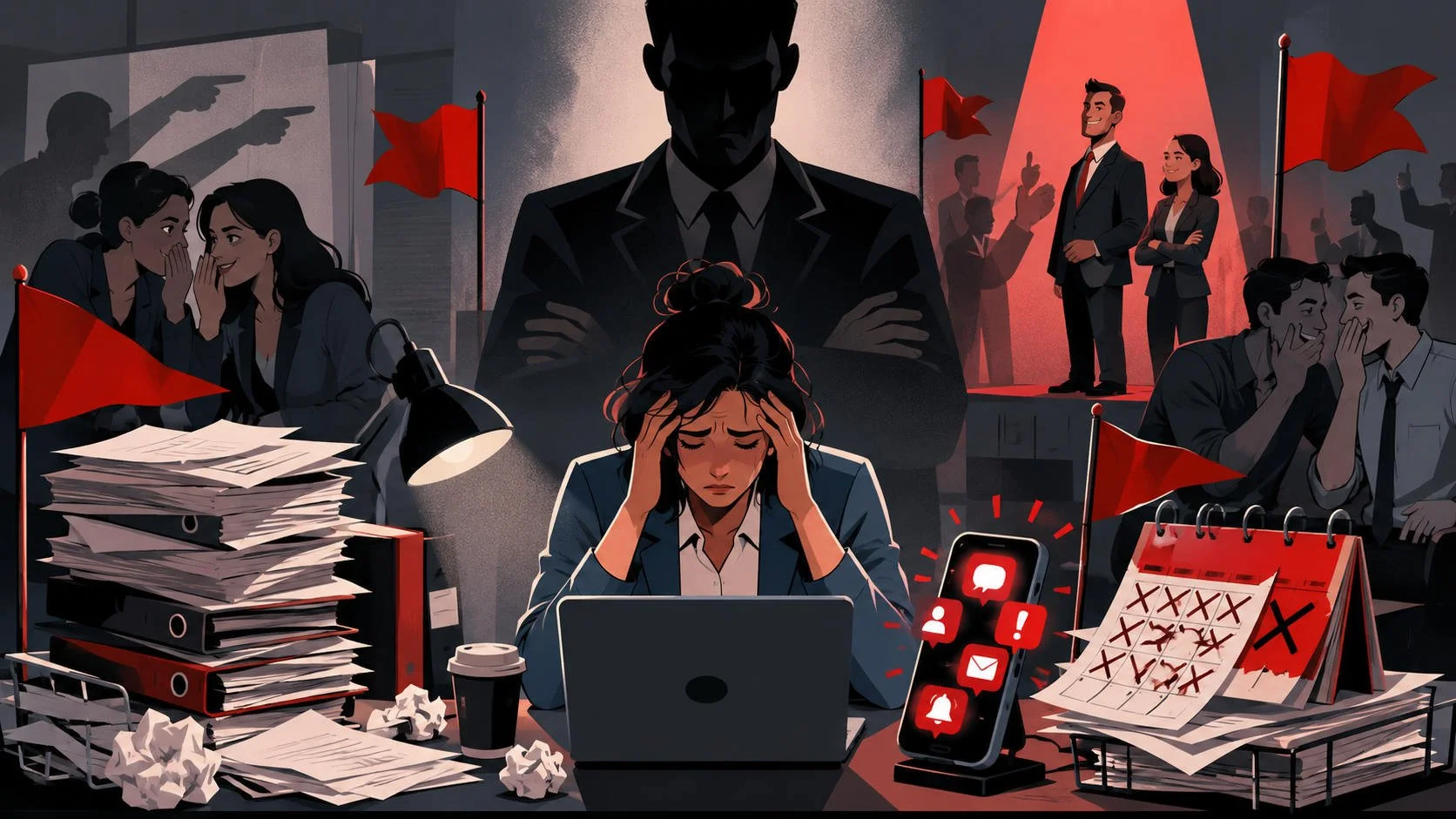
Every job has bad days.
Every workplace has annoying people, frustrating meetings, unclear instructions, personality clashes, and stressful weeks. Sometimes a boss gives feedback you do not want to hear. Sometimes a company makes an unpopular decision. Sometimes a project becomes chaotic because the business is changing fast.
That does not automatically mean the workplace is toxic.
A toxic workplace is different.
A toxic workplace is an environment where disrespect, fear, exclusion, manipulation, burnout, bullying, unethical behavior, retaliation, or chronic dysfunction becomes normal. The problem is not one bad meeting. It is the pattern. People stop trusting each other. Employees hide mistakes. Managers use fear instead of clarity. High performers leave. New people quickly learn what not to say. Everyone knows there are problems, but nobody believes the company will fix them.
MIT Sloan researchers analyzed more than 1.3 million Glassdoor reviews from U.S. employees of large companies and identified five culture attributes that most strongly poisoned corporate culture in employees’ eyes: disrespectful, noninclusive, unethical, cutthroat, and abusive. They called these the “Toxic Five.”
The damage is real. MIT Sloan also found that toxic corporate culture was the strongest predictor of employee attrition during the first six months of the Great Resignation, and was about 10 times more powerful than compensation in predicting turnover.
The point of this article is not to help you label every unpleasant workplace “toxic.”
The point is to help you tell the difference between a hard job, a bad week, a difficult manager, and a workplace that may be harming your health, career, confidence, and long-term stability.
This is not legal advice, medical advice, or a diagnosis of your employer. It is a pattern-recognition guide.
What is a toxic workplace?
A toxic workplace is a work environment where harmful behavior is tolerated, repeated, rewarded, ignored, or built into the way the organization operates.
That behavior may include:
Bullying
Humiliation
Retaliation
Discrimination
Harassment
Chronic overwork
Impossible expectations
Manipulation
Favoritism
Gossip
Unethical pressure
Fear-based management
Lack of accountability
Lack of psychological safety
Punishment for speaking up
Exclusion from opportunities
Management that says the right things but protects the wrong behavior
The U.S. Surgeon General’s workplace mental health framework says physical and psychological safety is a foundation of workplace well-being, and that people cannot perform well if they feel physically or psychologically unsafe.
That is the simplest test:
Does this workplace help people do good work, or does it make people protect themselves from the workplace?
A healthy workplace does not have to be easy.
But it should be basically respectful, safe, fair, clear, and accountable.

Toxic does not always mean illegal
This matters.
A workplace can be toxic without violating the law.
A manager can be cruel without creating a legally actionable hostile work environment. A company can be chaotic without breaking employment law. A team can be unfair, cliquey, or emotionally draining without meeting the legal threshold for harassment, discrimination, or retaliation.
The EEOC says petty slights, annoyances, and isolated incidents generally do not rise to the level of unlawful harassment unless they are extremely serious. To be unlawful, conduct must create a work environment that would be intimidating, hostile, or offensive to reasonable people.
That does not mean you should ignore toxic behavior.
It means you should separate three questions:
Is this unpleasant?
Is this toxic?
Is this illegal or reportable under company policy or local law?
Those are related, but they are not the same.
If you are dealing with discrimination, harassment, threats, violence, wage issues, retaliation, disability accommodations, safety hazards, or other legal concerns, consider getting advice from a qualified professional or relevant agency in your jurisdiction.
Quick checklist: 20 red flags and signs you work in a toxic workplace
Use this list as a starting point.
Not proof.
Not a diagnosis.
Not a reason to panic.
Just a way to organize what you are seeing.
A workplace may be toxic when several of these signs appear together:
You feel anxious before work even when the work itself is manageable.
Disrespect is normalized.
People are punished for speaking up.
Mistakes turn into blame, shame, or public humiliation.
The workload is impossible by design.
Boundaries are ignored or mocked.
Bullying, yelling, intimidation, or humiliation are tolerated.
Gossip and reputation attacks drive decisions.
Managers take credit and shift blame.
Favoritism, nepotism, or cliques control opportunity.
Exclusion, discrimination, or harassment are minimized.
Ethics are treated as obstacles.
Coworkers are encouraged to compete in cutthroat ways.
Communication is chaotic, secretive, or manipulative.
Expectations constantly change.
High performers leave and nobody is surprised.
Promotions, raises, and feedback feel unfair or opaque.
Your health is deteriorating and the workplace dismisses it.
HR or reporting channels feel performative or unsafe.
Fear of retaliation shapes what people say and do.
One red flag may be explainable.
Several red flags may be a pattern.
A pattern is still not proof, but it is information.
1. You feel anxious before work even when the work itself is manageable
One of the first signs of a toxic workplace is that your body reacts before your brain has finished explaining the problem.
You may notice:
Sunday-night dread
Stomach tension before meetings
Trouble sleeping before workdays
Anxiety when your boss messages you
Feeling watched or judged constantly
Relief when a meeting gets canceled
Fear of opening email or Slack
A sense that you are always “in trouble”
Feeling emotionally drained before the work even starts
This is different from normal stress.
A hard project can make you tired. A toxic workplace makes you feel unsafe.
NIOSH says mental health worsens with chronic exposure to occupational stress, and that harmful physical and emotional responses can occur when job requirements do not match a worker’s capabilities, resources, or needs.
A common false positive:
A new job, big presentation, difficult client, or temporary deadline can create anxiety without the workplace being toxic.
The key question:
Am I stressed because the work is challenging, or because the environment feels unsafe?
2. Disrespect is normalized
Disrespect is one of the clearest toxic workplace signals.
It may look like:
Interrupting people constantly
Mocking questions
Rolling eyes in meetings
Talking down to junior employees
Ignoring certain people’s ideas until someone else repeats them
Publicly embarrassing employees
Treating support staff as disposable
Making people feel stupid for needing clarification
Using sarcasm as a management style
Dismissing people’s time, effort, or expertise
MIT Sloan found that feeling disrespected had the largest negative impact on how employees rated their corporate culture of any single topic in the study.
This matters because respect is not a perk.
It is the baseline.
A company can have great pay, snacks, benefits, and brand prestige. But if people are regularly belittled, dismissed, or humiliated, the culture is not healthy.
A common false positive:
Direct feedback is not automatically disrespect. A manager can be firm, specific, and demanding without being demeaning.
The key question:
Do people here treat each other like adults, or like obstacles?
3. People are punished for speaking up
A toxic workplace often has a hidden rule:
You are allowed to notice problems, but you are not allowed to name them.
This may look like:
People who raise concerns are labeled “negative”
Employees are told to “be a team player” instead of being heard
Feedback is requested but punished
Managers say they want honesty, then retaliate against honest people
Employees stop reporting problems because “nothing happens”
Whistleblowers are isolated
People learn to stay quiet in meetings
Problems are discussed privately but never publicly
Exit interviews become the only place people tell the truth
The EEOC says retaliation occurs when an employer takes a materially adverse action because someone engaged in protected EEO activity, such as participating in an EEO process or opposing discrimination. The EEOC also explains that materially adverse actions can include conduct that might deter a reasonable employee from complaining about discrimination.
Not every punished comment is legally protected activity.
But culturally, a workplace where reasonable concerns are punished becomes dangerous fast.
A common false positive:
A company does not have to accept every suggestion, and not every disagreement is retaliation.
The key question:
Can people raise real problems without becoming the problem?
4. Mistakes turn into blame, shame, or public humiliation
Healthy workplaces investigate mistakes.
Toxic workplaces hunt for targets.
You may see:
Public callouts
“Who did this?” instead of “What happened?”
Blame moving downhill
Managers protecting themselves by sacrificing employees
People hiding errors
Employees afraid to ask for help
Postmortems that become punishment sessions
Leaders who never admit their own role in failures
Small mistakes treated as character flaws
Employees spending more time covering themselves than fixing the issue
This destroys learning.
When people are afraid to admit mistakes, the company gets worse information. Problems stay hidden longer. Teams become defensive. Smart employees stop taking initiative because initiative creates risk.
A common false positive:
Serious mistakes sometimes require accountability. Accountability becomes toxic when it is humiliating, selective, political, or disconnected from actual responsibility.
The key question:
When something goes wrong, does the workplace look for causes or scapegoats?
5. The workload is impossible by design
A heavy workload is not always toxic.
Some jobs are intense. Some industries have busy seasons. Some roles carry high responsibility.
The red flag is when the workload is structurally impossible and management pretends it is normal.
You may notice:
The job requires more hours than anyone admits
Deadlines are unrealistic by default
Roles are understaffed on purpose
Vacant positions are never backfilled
People are praised for sacrificing sleep, weekends, or health
“Urgent” becomes the normal setting
Employees are blamed for not finishing work no reasonable person could finish
Managers respond to overload with motivational language instead of resources
Burnout is treated as a personal weakness
The World Health Organization describes burnout as an occupational phenomenon resulting from chronic workplace stress that has not been successfully managed, with dimensions including exhaustion, mental distance or cynicism toward the job, and reduced professional efficacy.
A common false positive:
A temporary crunch during a launch, audit, crisis, or seasonal rush is not automatically toxic if leadership acknowledges it, supports people, and lets them recover.
The key question:
Is the workload temporarily high, or permanently impossible?
6. Boundaries are ignored or mocked
A toxic workplace often treats boundaries as disloyalty.
You may hear:
“We’re a family here”
“Everyone needs to be available”
“That’s just how this industry works”
“If you cared, you’d make it happen”
“You can take vacation after things calm down”
“Real leaders answer messages at night”
“We need team players, not clock-watchers”
Boundary problems may include:
After-hours messages that require immediate response
Weekend work treated as normal
Vacations interrupted
Sick days questioned or punished
Lunch breaks skipped by default
Personal emergencies treated as inconveniences
Flexible work promised but not respected
Workers punished for needing predictable schedules
The Surgeon General’s workplace framework says insufficient rest can endanger physical, emotional, and mental health, and that respecting boundaries between work and non-work time can support worker well-being.
A common false positive:
Some roles require on-call coverage, shift work, client deadlines, or emergency response. The question is whether the expectations are clear, compensated, rotated fairly, and sustainable.
The key question:
Does this workplace respect recovery, or does it consume people until they leave?
7. Bullying, yelling, intimidation, or humiliation are tolerated
Bullying is one of the strongest red flags.
It may look like:
Yelling
Profanity
Belittling
Threats
Intimidation
Mocking
Public humiliation
Persistent criticism
Social isolation
Sabotaging someone’s work
Assigning impossible deadlines to make someone fail
Withholding necessary information
Removing responsibilities without cause
Blocking training, leave, or promotion
Intruding on privacy
Tampering with someone’s belongings or equipment
The Canadian Centre for Occupational Health and Safety says workplace bullying usually involves repeated incidents or a pattern of behavior intended to intimidate, offend, degrade, or humiliate a person or group. It lists examples including malicious rumors, social exclusion, intimidation, undermining work, impossible deadlines, yelling, belittling opinions, and unwarranted punishment.
OSHA defines workplace violence broadly as acts or threats of physical violence, harassment, intimidation, or other threatening behavior that occur at the worksite, ranging from threats and verbal abuse to physical assaults.
A common false positive:
Constructive feedback, fair discipline, reasonable performance management, and legitimate differences of opinion are not automatically bullying. CCOHS makes this distinction clearly.
The key question:
Would a reasonable person see this as firm management, or as intimidation?
8. Gossip and reputation attacks drive decisions
Every workplace has some gossip.
A toxic workplace uses gossip as infrastructure.
You may see:
People warned about coworkers before meeting them
Managers sharing confidential information
Rumors used to block promotions
Private conversations weaponized
People forming alliances for protection
Employees afraid to be seen with the “wrong” person
Cliques controlling social access
Reputation becoming more important than performance
Leaders tolerating gossip because it helps them control the room
Gossip becomes toxic when it affects assignments, trust, promotions, performance reviews, or job security.
A common false positive:
Informal conversation is normal. People will discuss workplace issues. The red flag is when gossip replaces direct communication and fair process.
The key question:
Are people evaluated by their work, or by the story others tell about them?
9. Managers take credit and shift blame
A toxic manager protects their status by extracting credit and exporting responsibility.
You may see:
Your work presented as their work
Your ideas repeated without attribution
Praise flowing upward, blame flowing downward
Managers disappearing during crises
Leaders taking credit for team wins and blaming employees for team failures
Employees asked to “own” decisions they did not make
Written records edited to protect leadership
People punished for problems caused by unrealistic leadership decisions
This is not just annoying.
It teaches employees that integrity is optional. It also discourages initiative because doing good work does not lead to recognition, and mistakes may be used against you even when you did not control the decision.
A common false positive:
Senior leaders often present team outcomes externally. That is normal if they also recognize contributors internally and accept responsibility for failures.
The key question:
Do leaders share credit and own responsibility, or hoard credit and outsource blame?
10. Favoritism, nepotism, or cliques control opportunity
A toxic workplace often has two systems.
The official system says performance matters.
The real system rewards closeness to power.
You may notice:
Promotions go to favorites
High-visibility projects go to insiders
Certain people are protected from consequences
Rules apply differently depending on who broke them
Social access matters more than work quality
Friends and relatives are hired or advanced without clear merit
Some employees get coaching while others get criticism
Managers confuse loyalty with competence
People outside the clique stop trying
The Surgeon General’s framework says transparent career pathways and advancement opportunities help foster inclusion and diversity, and that organizations should support workers by addressing systematic barriers in the workplace.
A common false positive:
Different employees may receive different opportunities because of skill, availability, seniority, performance, or business need. Favoritism becomes a red flag when the reasons are hidden, inconsistent, or obviously political.
The key question:
Can a person advance here without being part of the inner circle?
11. Exclusion, discrimination, or harassment are minimized
A workplace may be toxic when exclusion is treated as personality conflict instead of a serious cultural problem.
This may look like:
Certain people are talked over repeatedly
Some workers are left out of meetings they should attend
Jokes target race, sex, age, disability, religion, gender identity, pregnancy, nationality, body size, or other personal traits
People are told they are “too sensitive”
Complaints are reframed as attitude problems
The company celebrates inclusion externally but ignores exclusion internally
Employees from marginalized groups are expected to educate everyone while also doing their jobs
Harassment is minimized because the offender is “important”
MIT Sloan identified noninclusion as one of the Toxic Five culture attributes. The researchers also warned that average culture scores can hide serious problems that affect smaller groups of employees in profound ways.
A common false positive:
Not every awkward comment, missed meeting, or interpersonal conflict is discrimination or harassment. The pattern, context, protected characteristics, power dynamics, and response all matter.
The key question:
When someone is excluded or mistreated, does the workplace repair the harm or protect the comfort of the people causing it?
12. Ethics are treated as obstacles
A toxic workplace may pressure people to bend rules, hide information, mislead customers, manipulate numbers, or look the other way.
You may hear:
“Just make it work”
“Don’t put that in writing”
“Everyone in the industry does it”
“The client doesn’t need to know”
“We can fix it after the quarter”
“Legal is being too conservative”
“Don’t ask questions you don’t want answers to”
“This is how we hit the target”
MIT Sloan found that unethical behavior was one of the Toxic Five attributes. In employee reviews, unethical behavior included language around ethics, integrity, dishonesty, lying, misleading, deception, false promises, and regulatory compliance concerns.
This is one of the most serious red flags because it can put your reputation, license, job, finances, or legal position at risk.
A common false positive:
Companies sometimes make judgment calls in uncertain situations. That is different from pressuring employees to deceive, conceal, falsify, or violate clear rules.
The key question:
Would I be comfortable explaining this decision to a regulator, judge, customer, journalist, or future employer?
13. Coworkers are encouraged to compete in cutthroat ways
Healthy competition can motivate people.
Cutthroat competition makes people unsafe.
You may see:
Coworkers sabotaging each other
People hiding information to look better
Employees stealing credit
Backstabbing rewarded as ambition
Public ranking systems used to shame people
Managers pitting employees against each other
Collaboration punished because it helps a “competitor”
People throwing coworkers under the bus to survive
A culture where trust is seen as naïve
MIT Sloan defined cutthroat culture as situations where employees describe colleagues actively undermining one another, using language like “dog-eat-dog,” “Darwinian,” “throw one another under the bus,” “stab each other in the back,” or “sabotage one another.”
A common false positive:
Sales roles, sports-like teams, internal contests, and performance rankings are not automatically toxic. They become toxic when they reward sabotage over performance.
The key question:
Do people win by doing excellent work, or by making others lose?

14. Communication is chaotic, secretive, or manipulative
Toxic workplaces often use confusion as control.
You may notice:
Important decisions are announced late
Information is shared selectively
Managers contradict themselves
Employees hear major news through rumors
Expectations are vague until something goes wrong
People are blamed for not knowing things they were never told
Leaders avoid direct answers
Meetings happen before the real meeting or after the real meeting
Written communication says one thing while verbal instructions say another
The Surgeon General’s framework says clear and consistent communication between workers and leaders is foundational to building trust. It also says trust begins with listening to worker concerns and explaining why key decisions are made.
A common false positive:
Fast-growing companies can have messy communication. The red flag is when confusion consistently protects leadership, disadvantages employees, or prevents accountability.
The key question:
Is communication messy because the work is complex, or because opacity benefits the people in power?
15. Expectations constantly change
In a toxic workplace, you can do what was asked and still be told you failed.
This may look like:
Goals changing after the work is complete
Priorities shifting without acknowledgement
Managers denying previous instructions
Performance standards changing by person
Success criteria never being written down
Employees being judged by expectations they did not know existed
“Urgent” tasks disappearing after ruining your week
Projects being restarted repeatedly because leaders cannot decide
Your job description expanding without support, title change, or pay
This creates learned helplessness.
People stop trying to do excellent work and start trying to guess what will keep them safe.
A common false positive:
Priorities sometimes change because business conditions change. That is normal if leaders explain the change, reset expectations, and adjust resources.
The key question:
Can a reasonable person understand what success looks like here?
16. High performers leave and nobody is surprised
Toxic workplaces often reveal themselves through who leaves.
Watch for:
Strong employees quitting quietly
Longtime employees warning newcomers
People leaving without another job lined up
Exit announcements that sound polite but vague
Constant turnover in one department
The same manager repeatedly losing staff
New hires leaving within months
Former employees refusing to refer friends
Everyone saying, “I knew they’d leave”
MIT Sloan’s research found that toxic culture was a major predictor of attrition, and that culture mattered more than compensation in predicting which companies lost employees at higher rates than their industries.
High turnover does not always mean toxicity. Some industries naturally have churn. Some companies restructure. Some roles are stepping stones.
But when capable, ethical, high-performing people leave because they no longer trust the environment, pay attention.
A common false positive:
Turnover can be normal in seasonal work, entry-level roles, startups, contract work, or industries with high mobility.
The key question:
Are people leaving for better opportunities, or escaping the culture?
17. Promotions, raises, and feedback feel unfair or opaque
A toxic workplace often makes growth feel arbitrary.
You may see:
No clear promotion criteria
Feedback that arrives only when raises are discussed
Performance reviews that surprise people
Raises based on politics rather than contribution
Managers unable to explain decisions
Vague criticism that cannot be acted on
Goalposts moving after employees meet them
Employees told they are “not ready” with no development plan
People from certain groups repeatedly overlooked
Training and mentorship reserved for favorites
The Surgeon General’s framework says organizations should foster clear, equitable pathways for career advancement and ensure relevant, reciprocal feedback.
A common false positive:
Not everyone can be promoted at once. Fair processes can still lead to disappointment. The red flag is when the process is hidden, inconsistent, biased, or unchallengeable.
The key question:
Can people see a fair path forward, or are they expected to wait, guess, and hope?
18. Your health is deteriorating and the workplace dismisses it
A toxic workplace often follows you home.
You may notice:
Sleep problems
Headaches
Stomach issues
Panic before meetings
Irritability
Emotional exhaustion
Trouble concentrating
Loss of confidence
Cynicism
Detachment
Dread
Using weekends only to recover
Feeling like you are becoming a worse version of yourself
CCOHS says people targeted by workplace bullying may experience shock, anger, frustration, helplessness, loss of confidence, sleep problems, appetite changes, headaches, anxiety about going to work, difficulty concentrating, low morale, and reduced productivity.
OSHA says workplace stress and poor mental health can negatively affect job performance, productivity, work engagement, communication, physical capability, and daily functioning.
A common false positive:
Personal stress outside work can affect how work feels. But if symptoms intensify around work and ease when you are away, the workplace deserves attention.
The key question:
Is my job challenging me, or is my workplace changing my health and personality?
19. HR or reporting channels feel performative or unsafe
A toxic workplace may have policies, posters, training modules, and reporting systems that look good on paper but do not feel safe in practice.
You may see:
Complaints disappear
Investigations feel predetermined
HR protects the company but ignores the employee
The person who reports a problem is treated as the problem
Confidentiality is promised but not respected
Managers are warned informally before anything happens
Repeat offenders remain protected
Employees are discouraged from documenting issues
People say, “Don’t go to HR unless you’re ready to leave”
This does not mean HR is always bad. Good HR can help resolve problems, clarify policy, document issues, protect employees, and coach managers.
The red flag is when the official reporting system exists mainly to protect the organization from accountability.
CCOHS says workplace bullying and harassment prevention programs should include clear reporting processes, confidential reporting, no reprisals for workers who report, and procedures for investigating and resolving complaints.
A common false positive:
HR may not be able to share all details of an investigation. That does not automatically mean nothing happened.
The key question:
Do reporting channels make people safer, or do they teach people to stay silent?
20. Fear of retaliation shapes what people say and do
This is one of the strongest signs of toxicity.
People may not say “I’m afraid of retaliation.”
They say:
“Be careful”
“Don’t put that in writing”
“That manager has a long memory”
“Nothing good comes from speaking up”
“Just keep your head down”
“Wait until you have another job”
“They’ll find a way to get rid of you”
“That’s career suicide”
“You didn’t hear this from me”
Retaliation can include obvious actions like firing, demotion, discipline, or denial of promotion. But the EEOC also says other materially adverse actions may include threats, warnings, transfers, negative evaluations, lowered evaluations, more intense scrutiny without justification, removal of responsibilities, abusive verbal or physical behavior that would deter protected activity, and other actions that might dissuade a reasonable person from engaging in protected activity.
A common false positive:
Not every negative event after a complaint is retaliation. Timing, evidence, documentation, protected activity, and causal connection matter.
The key question:
Are people making normal professional choices, or survival choices?
Toxic workplace vs. hard workplace
A hard workplace can still be healthy.
A toxic workplace can look productive while it is quietly damaging people.
A hard but healthy workplace may have:
High standards
Direct feedback
Urgent projects
Accountability
Busy seasons
Conflict handled respectfully
Clear expectations
Recovery after crunch periods
Leaders who admit mistakes
People who can speak up
Rules that apply consistently
A toxic workplace often has:
Fear
Humiliation
Retaliation
Constant chaos
Hidden rules
Favoritism
Blame-shifting
Impossible expectations
Unsafe silence
Disrespect disguised as “candor”
Burnout disguised as “commitment”
Control disguised as “culture”
The difference is not whether the work is difficult.
The difference is whether people are treated with dignity while doing it.
What these signs do not prove
These red flags do not automatically prove that:
Your employer broke the law
Your boss is intentionally harming you
HR is corrupt
You should quit immediately
You should file a complaint
You are being discriminated against
You are being retaliated against
Every coworker is unsafe
The company cannot improve
Your career is ruined
You are weak for struggling
You are imagining everything
One bad incident defines the whole workplace
A toxic workplace pattern deserves attention.
But you still need facts, documentation, context, and careful judgment.
The responsible conclusion is not:
“This proves my workplace is evil.”
The responsible conclusion is:
“There are repeated signs that this workplace may be unhealthy or unsafe. I should document what is happening, consider possible explanations, protect myself, and decide what support or next steps I need.”
Common false positives
A bad week is not a toxic workplace
Every company has stressful weeks.
The question is whether stress is temporary and acknowledged, or permanent and denied.
A difficult boss is not always a toxic boss
A boss can be demanding, blunt, inexperienced, or disorganized without being abusive.
The red flag is a repeated pattern of disrespect, fear, manipulation, retaliation, or harm.
Constructive criticism is not bullying
CCOHS notes that objective comments intended to provide constructive feedback are generally not considered bullying. Reasonable management actions such as assigning work, evaluating performance, and managing discipline are not automatically harassment or bullying when done fairly.
High standards are not toxic by themselves
Excellence can be demanding.
Toxicity begins when high standards are paired with humiliation, impossible workloads, favoritism, shifting expectations, or no recovery.
Conflict is not always toxicity
Healthy workplaces have conflict.
The question is whether conflict is handled directly, respectfully, and fairly.
HR not taking your side does not automatically mean HR is corrupt
HR may have obligations to investigate, protect confidentiality, and apply policy. The red flag is when HR consistently minimizes harm, protects repeat offenders, or retaliates against reporters.
Remote work can still be toxic
Toxicity can happen through Slack, email, video meetings, surveillance software, exclusion from channels, after-hours pressure, public message threads, or lack of access to information.
A prestigious company can still be toxic
Brand reputation does not guarantee psychological safety.
Some people tolerate toxicity longer when the company name looks good on a resume.
The toxic workplace evidence ladder
Not all evidence is equal.
Level 1: Vibe
Examples:
“Something feels off.”
“I dread meetings.”
“People seem afraid.”
“The energy is weird.”
Strength:
Weak.
A vibe can tell you to pay attention. It cannot prove much by itself.
Level 2: Repeated pattern
Examples:
Your boss humiliates people in meetings every week.
Multiple employees warn you not to speak up.
The same manager has constant turnover.
Workloads are impossible every month, not just once.
Strength:
Moderate.
Patterns matter more than isolated incidents.
Level 3: Documented incidents
Examples:
Emails
Messages
Meeting notes
Calendar records
Performance reviews
Policy documents
Written instructions
Screenshots
Witness names
Dates and times
Strength:
Stronger.
Documentation helps separate memory, emotion, and interpretation from facts.
Level 4: Corroboration
Examples:
Coworkers saw the same behavior
Multiple people report similar incidents
Former employees describe the same pattern
Turnover data supports the concern
Written policies contradict actual practice
Strength:
Strong.
Corroboration helps show that the issue is not just a personality mismatch.
Level 5: Career or health impact
Examples:
Lost opportunities
Sudden negative reviews after speaking up
Anxiety or sleep problems tied to work
Doctor or therapist notes
Missed work
Transfer requests
Declining performance after repeated mistreatment
Strength:
Strong, but sensitive.
Health and career impacts should be handled carefully and privately.
Level 6: Formal evidence
Examples:
HR findings
Legal filings
Regulator complaints
Safety reports
Written admissions
Repeated policy violations
Documented retaliation
Prior complaints against the same person
Strength:
Very strong.
At this level, the issue may move from personal workplace concern to formal organizational, legal, or safety concern.
What to do if you think your workplace is toxic
Do not start with a dramatic confrontation.
Start with clarity.
1. Name the pattern
Write down what is actually happening.
Not:
“My boss is toxic.”
Better:
“My boss has publicly criticized me in four team meetings, changed deadlines without notice twice, denied giving instructions that are in email, and gave me a negative review two weeks after I raised a workload concern.”
Patterns are useful.
Labels are less useful.
2. Separate facts from interpretations
A fact might be:
“The meeting was scheduled for 9 p.m.”
“My manager said this in writing.”
“I was removed from the project the day after I made a complaint.”
“Three people resigned from the team in two months.”
An interpretation might be:
“They are trying to force me out.”
“This is retaliation.”
“They want me to fail.”
“The company does not care.”
Interpretations may be correct.
But facts are what help you think clearly.
3. Keep a factual record
Document:
Date
Time
Location
People involved
Exact words, when possible
What happened before
What happened after
Impact on your work
Witnesses
Related emails or messages
Company policy involved, if any
CCOHS recommends keeping a factual journal or diary of bullying events, including date, time, what happened, witness names, and outcomes.
4. Test whether the problem can be addressed safely
Sometimes a workplace is not toxic; it is poorly managed.
A clear conversation may help.
For example:
“Can we clarify the priority order?”
“Can we agree on response-time expectations after hours?”
“Can you give me the success criteria in writing?”
“Can we discuss workload and deadlines?”
“Can you explain what I need to do to be considered for promotion?”
If reasonable requests are mocked, punished, ignored, or used against you, that tells you something important.
5. Find support outside the toxic system
Talk to someone who is not dependent on the same power structure.
That may include:
A trusted former manager
A mentor
A therapist
A union representative
An employment lawyer
A career coach
A professional association
A trusted friend outside work
An employee assistance program, if safe and available
Do not rely only on coworkers who may also be afraid.
6. Use HR carefully and strategically
HR can be helpful, especially when there is clear policy, documentation, and a specific request.
Before going to HR, ask yourself:
What outcome do I want?
What policy was violated?
What facts can I document?
What have I already tried?
Am I reporting a safety issue, harassment, discrimination, retaliation, bullying, workload problem, or management conflict?
What risk could follow?
Do I need advice before making a formal complaint?
This does not mean you should avoid HR.
It means you should be prepared.
7. Protect your career options
Toxic workplaces can drain your confidence until you feel stuck.
Start rebuilding options early:
Update your resume
Save examples of your work, where legally and ethically permitted
Reconnect with your network
Track accomplishments
Ask for references from safe people
Review your finances
Look at internal transfers
Look at external roles
Consider whether staying is strategic or fear-based
You do not have to quit immediately to prepare.
Preparation gives you choices.
8. Take safety seriously
If there are threats, physical intimidation, stalking, violence, unsafe conditions, or severe harassment, do not treat it as a normal workplace conflict.
OSHA says workplace violence includes threats, harassment, intimidation, verbal abuse, physical assault, and homicide, and that employers can reduce risks through prevention programs, training, and prompt investigation.
If you feel in immediate danger, contact local emergency services or the appropriate workplace safety authority in your jurisdiction.
When to take a toxic workplace more seriously
Some situations deserve faster action.
Consider getting outside advice or formal support if:
You are being threatened
You are being physically intimidated
You are being sexually harassed
You are facing discrimination
You are being retaliated against after reporting something
Your wages are being withheld
You are asked to do something illegal or unethical
You are being denied legally protected leave or accommodations
Your mental or physical health is deteriorating
You are being isolated after raising concerns
You are being pressured to falsify documents, numbers, reports, or customer information
You are afraid to document because you think documentation itself will get you punished
The more serious the risk, the more important it is to get advice specific to your situation and location.
FAQ
What is the biggest sign of a toxic workplace?
The biggest sign is not one bad person.
It is fear.
If people are afraid to speak honestly, ask questions, admit mistakes, use benefits, take time off, report problems, or disagree respectfully, the workplace may be toxic.
Is a toxic workplace the same as a hostile work environment?
Not always.
“Toxic workplace” is a broad cultural phrase. “Hostile work environment” is a legal concept that depends on specific facts, protected characteristics, severity, pervasiveness, and jurisdiction. The EEOC says unlawful harassment must create a work environment that would be intimidating, hostile, or offensive to reasonable people.
Can one toxic boss make a whole workplace toxic?
Yes, especially if the organization protects that boss.
A bad manager becomes a culture problem when senior leaders ignore complaints, reward the behavior, or force employees to adapt to abuse.
Should I go to HR if my workplace is toxic?
Maybe.
Go to HR with facts, documentation, policy references, and a clear requested outcome. If the issue involves harassment, discrimination, retaliation, safety, wages, or legal rights, consider getting advice before or alongside making a formal report.
Should I quit a toxic job?
That depends on your finances, health, job market, risk level, and alternatives.
You do not need to prove the workplace is toxic before protecting yourself. Sometimes the most practical question is not “Are they wrong?” but “Can I stay here without serious harm?”
Can a toxic workplace change?
Yes, but only if leaders acknowledge the problem, protect people who speak up, hold repeat offenders accountable, fix incentives, and change how decisions are made.
A toxic workplace rarely changes because employees silently endure more.
What if I am the manager?
Look for your own warning signs:
People stop telling you bad news
Employees agree in public and disagree in private
Turnover rises
Feedback disappears
High performers disengage
Employees seem afraid of your reaction
You reward results while ignoring how people get them
The fastest way to reduce toxicity is to make it safer for people to tell you the truth.
Is burnout proof of a toxic workplace?
No.
Burnout can come from many sources, including workload, personal stress, industry demands, poor recovery, or chronic uncertainty. But burnout becomes a workplace red flag when the organization creates chronic stress and refuses to address the conditions causing it. WHO defines burnout as resulting from chronic workplace stress that has not been successfully managed.
Is gossip enough to call a workplace toxic?
Not by itself.
Gossip becomes toxic when it shapes promotions, assignments, exclusion, reputations, discipline, or job security.
What if everyone else seems fine?
They may not be fine.
They may be coping, hiding it, benefiting from the system, afraid to speak, or planning to leave.
Also, toxic workplaces often affect people unevenly. MIT Sloan warned that aggregate culture scores can miss issues that deeply affect smaller groups of employees.
Final takeaway
A toxic workplace is not just a place where work is hard.
It is a place where the environment makes people feel unsafe, disrespected, manipulated, excluded, or disposable.
The clearest warning signs are:
Fear of speaking up
Normalized disrespect
Retaliation
Bullying
Public humiliation
Impossible workloads
Boundary violations
Favoritism
Gossip
Exclusion
Unethical pressure
Cutthroat competition
Chaotic communication
Constantly shifting expectations
High turnover
Unfair advancement
Deteriorating health
Unsafe reporting channels
One sign may be explainable.
Several signs may be a pattern.
A pattern is still not legal proof.
But it is enough to start paying attention, documenting facts, protecting your health, and making a plan.
The responsible conclusion is not:
“This proves my workplace is toxic and everyone is bad.”
The responsible conclusion is:
“This workplace is showing repeated signs of dysfunction. I need to separate facts from interpretations, understand my options, and decide what level of risk I am willing to tolerate.”
A job can challenge you.
It should not steadily shrink you.