A dispatch from the future, published 7 days before the forecast deadline. What is Future News?
A federal judge has stayed Nidal Malik Hasan’s scheduled execution at Fort Hood. The Army had set the hour for 1 p.m. Central on December 3. For as long as the order is in force, the Army cannot carry out the death sentence for the 2009 attack that killed 13 people at the Texas post. The stay itself leaves his convictions in place. The last U.S. military execution after a court-martial took place in 1961.
The most revealing detail in the case was an April date from another man’s file. In 2008, a federal judge in Kansas stopped the Army from executing a prisoner named Ronald Gray. Gray’s first full petition challenging his confinement arrived the following April. Four months separated the judge’s decision to give Gray time from the document that would tell the judge whether Gray had a case. The same federal district would face that choice again over Hasan.
For families in Texas, even the interval between a hearing and a decision could be too long. On the day before Thanksgiving, an Army victim coordinator advised survivors and relatives that preparations were going ahead, according to the San Antonio Express-News. Some of those planning to be at Fort Hood could already be on their way before the hearing in Kansas ended. A judge could act in time to stop an execution and still be too late to spare someone that trip.
The Robert J. Dole United States Courthouse in Kansas City, Kansas, in a 2018 photograph by DavidMCEddy shared under CC BY-SA 4.0. The hearing on Hasan’s request was scheduled here.
How the Army arrived at December 3
By October, there was every reason to take the Army at its word. Almost seventeen years had passed since Hasan, then an Army psychiatrist, attacked people at Fort Hood on November 5, 2009. A court-martial convicted him of premeditated murder in 2013. The families had seen a trial, a death sentence and years of military appeals. In March 2025 the U.S. Supreme Court declined to hear his challenge to the court-martial. There was no further hearing to await on that appeal.
President Donald Trump approved the death sentence on October 2, 2026. On October 6, Acting Secretary of the Army Adam Telle directed that the execution take place at Fort Hood. In its October 7 announcement, the Army explained how it chose a date. Under its regulation the secretary had to select a day between 60 and 150 days after presidential approval. December 3 was day 62. Anyone reading the October notice could do the arithmetic. The Army had picked a day almost as early as its rules allowed.
That choice put a premium on a question the October announcement had little reason to answer. What time would a civilian court have if Hasan asked it to review the legal basis for holding him under a death sentence? The Army described the military appeal as complete, accurately. A prisoner in federal custody can also bring a habeas corpus petition, asking a civilian judge to examine whether the government is holding him in violation of federal law. For military prisoners, the scope of that review is narrow. It is nevertheless a proceeding in its own right.
Washington announced the date. Fort Hood was where the Army intended to carry out the sentence. The caption on Hasan’s November 24 motion named the commandant of the U.S. Disciplinary Barracks at Fort Leavenworth, Kansas, where he was held. A reader looking for the first public sign that the Texas execution might be stopped needed the Kansas docket.
The judge wanted to hear from Hasan
On November 25, U.S. District Judge Anthony W. Mattivi held a video conference. The government’s lawyers attended. So did lawyers proposing to serve as Hasan’s unpaid standby counsel. They renewed the request for a stay, and the government opposed it. When Mattivi came to write his two-page order, he recorded who had been missing from the call. Hasan himself had been absent.
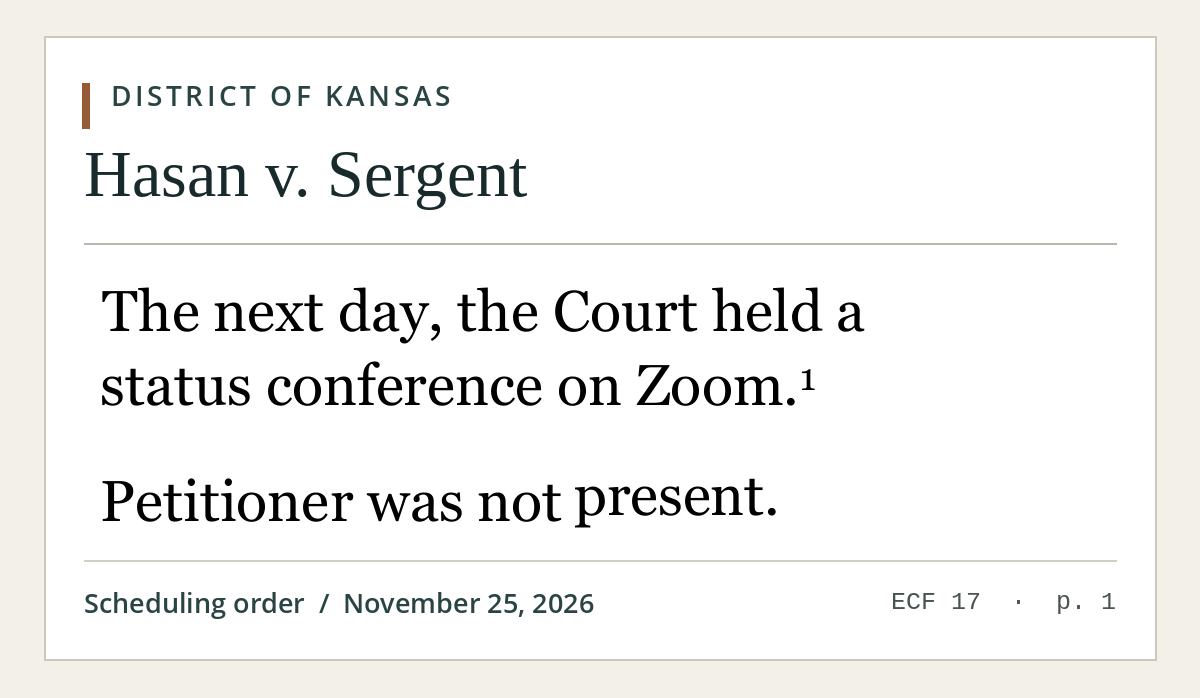
An excerpt from page 1 of the November 25 scheduling order. The judge had heard from both sides’ lawyers and wanted Hasan’s own answer about pursuing the case and who would speak for him.
Hasan’s arrangement with his lawyers took some untangling. He wanted to represent himself. He was willing to continue receiving help from his military counsel and to have lawyers from the American Civil Liberties Union on standby. Specialists from a federal public defender’s capital habeas unit had helped draft his motion. In a separate part of the conference, the lawyers conditionally asked for that unit to be appointed. Three kinds of help, all compatible with the fact that the prisoner had put his own name to the papers. Which of those lawyers, if any, did he want to put in charge of his case?
A judge needs to know who speaks for the prisoner. A lawyer retained to run a case can ordinarily speak for the client about how to present it. A lawyer standing by to advise a man who insists on running his own case occupies a different seat. Here the answer could also shape the timetable. A court would want to know whether the prisoner intended to proceed, whether experienced people were ready to help, and what work they could reasonably do before Thursday afternoon. Mattivi wanted Hasan’s own answers about proceeding and the role of counsel.
The dates he chose left just enough room for competing readings of his intentions. Under Mattivi’s briefing schedule, the government’s written response was due at noon Central on Friday, November 27, the day after Thanksgiving. Hasan could reply by noon Saturday. The judge ordered Hasan to appear in person Monday, November 30, at 10 a.m. in Kansas City, Kansas. From the scheduled start of the hearing to the Army’s appointed hour was 75 hours. A brisk judge could use that time to settle who spoke for Hasan and tell him to file promptly. A judge could also conclude that three days and three hours offered too little time for the work that mattered. The scheduling order put both possibilities on the calendar and promised a ruling on no particular day.
Ronald Gray got time. What did he get for it?
In July 2008, President George W. Bush approved Ronald Gray’s military death sentence. The Army set an execution for December 10. Gray had given notice in August that he intended to seek federal review. On November 25, with 15 days to go, he asked the Kansas federal court to appoint lawyers and stay the execution. Judge Richard D. Rogers granted a stay the following day. That made it a full two weeks before the Army’s date. The government sought reconsideration. On December 5, Rogers declined to lift the order.
Then came that April date. Gray filed his first full federal habeas petition on April 1, 2009. A reader who starts with the petition could easily get the sequence backward and assume a judge spotted a persuasive claim in it and intervened. It was the intervention that gave Gray’s lawyers time to produce the petition. When December 10 came and went, the judge had yet to see the finished challenge. Here was a federal court in Kansas willing to stop an execution at precisely the stage where Hasan was asking for help.
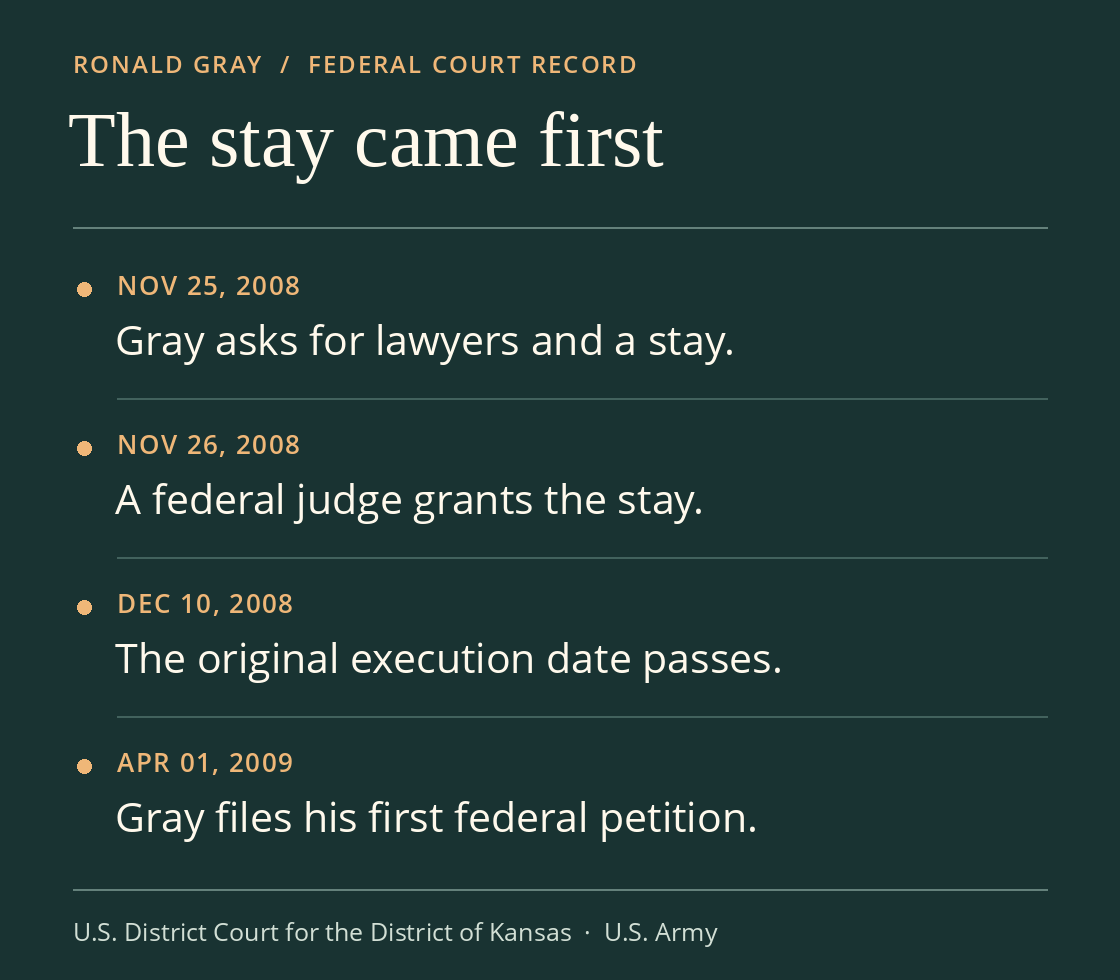
The judge granted Gray a stay on November 26, 2008, two weeks ahead of the Army’s scheduled execution date. The Army’s December 10 date passed before his first federal habeas petition arrived on April 1, 2009.
The less famous parts of Gray’s record are at least as instructive. His federal case eventually contained claims that had been through the military courts and claims that still needed to go there. The federal petition was dismissed without prejudice, leaving him room to file again. In December 2016, Judge J. Thomas Marten said the old stay was no longer in force and declined to issue another. Eight years of litigation had given Gray a substantial opportunity to present his position. A judge considering whether to give him more time faced very different circumstances from the judge who had given him a first opportunity.
There was even a coda in the month Hasan filed. On November 6, 2026, Judge Holly Teeter issued an amended opinion rejecting all 19 grounds in Gray’s later petition. She concluded the military courts had already given 12 of them full and fair consideration. Someone looking only at the November 2008 and November 2026 rulings might wonder how the federal court could have been so accommodating to Gray at one end and so unpersuaded at the other. Read the April filing between them and there is no mystery. A person can make very good use of time a judge gives him and still lose every argument he makes.
Nine days was late enough to matter
Gray had asked for a lawyer to take his case. Hasan was asking to conduct his own. Gray went to court 15 days before his execution. Hasan let 49 days pass after the acting Army secretary signed the execution order, then filed his request for a stay with nine days to go. He also attached material setting out two arguments he hoped to pursue. For anyone wondering how a judge could possibly have kept the Army’s date, the strongest evidence was in Hasan’s own papers. He knew what he wanted to argue and had found lawyers capable of helping him put it in writing.
The first argument came with a considerable handicap. At his court-martial Hasan had tried to justify shooting people at Fort Hood on the theory that he was defending people in Afghanistan from a future threat. The military judge excluded the proposed defense. On direct appeal, the Court of Appeals for the Armed Forces devoted several pages to the issue, examined the requirement of imminent harm and upheld the trial judge. A civilian federal judge in Kansas ordinarily gives considerable deference to a question the military courts have heard fully and fairly. Anyone opening the old opinion could see just how much attention this particular question had received.
His second argument raised a different problem of timing. In an exhibit filed with his motion, Hasan alleged that officials had improperly influenced the October 2026 decisions about his execution and had departed from the Army’s rules. The allegations were his. Their chronology was easy to establish. The Supreme Court had turned down his earlier appeal a year and a half before those officials acted. However thoroughly the military judges had reviewed the trial, they could hardly have addressed something the government had yet to do. A civilian judge could take that timing seriously while reserving every question about what the officials actually did, whether it was lawful and what might follow.
The years on one side and the days on the other invite a fair question. How much time did this man need? The detailed military lawyer available to Hasan knew the case, but his motion said that lawyer lacked federal habeas expertise. The federal lawyers who had the expertise said through the filing that they had no previous connection to the proceedings. One set of lawyers knew the prisoner’s case. Another knew the kind of case he now wanted to bring. A signature on a 12-page motion showed they could work together to meet one deadline. It told a judge considerably less about the state of the investigation behind a first full petition.
One of Hasan’s citations gets to the practical problem. In McFarland v. Scott, the Supreme Court considered a Texas prisoner who wanted a lawyer’s help preparing his first federal petition. Giving a man a lawyer would accomplish very little if the state could execute him before the lawyer did the work. The Court recognized discretion to grant a stay at that early stage. Hasan was a military prisoner asking to represent himself, and the federal statute at issue in McFarland refers to state proceedings. A Kansas judge could follow the logic of giving counsel time while still deciding for himself whether Hasan needed it.
There was room for a narrower response. A judge could hear Hasan personally, settle representation and set a short filing deadline. That would give his lawyers something they wanted while leaving the Army legally free to proceed. Conversely, even a brief judicial hold would prevent the Army from acting while the hold lasted. A court could later lift it. The prediction in this dispatch would be wrong if 1 p.m. Central on December 3 arrived without a civilian federal court stopping the execution itself. A change of date made solely by the Army would tell a different story. Look for the order in the Kansas court’s public filings under case 5:26-cv-03460-AWM. If a higher court intervenes, its own record, such as the Tenth Circuit’s docket, is where the order will appear.
The last soldier the Army executed also won a stay
Reuters reported that, among the four men on military death row when he filed, only Gray and Hasan had reached both presidential approval and a scheduled execution. That leaves one close contemporary case. The historical record offers a second case, this time involving the last soldier the U.S. military actually executed. His name was John A. Bennett. He, too, had won time from a federal judge in Kansas.
Bennett had faced an execution date in August 1957. His lawyer obtained an emergency stay in Topeka. The U.S. Court of Appeals for the Tenth Circuit later upheld the denial of his challenge, and the Army executed him on April 13, 1961. Nearly four years separated the execution date his lawyer got suspended from the day Bennett died. The legal rules and Bennett’s claims belonged to another era. For anyone trying to read Hasan’s eventual fate into the word “stay,” Bennett’s dates are worth remembering.
A more recent prisoner approached the same Kansas district court too early to get the protection he wanted. On September 26, 2025, Timothy Hennis asked for lawyers and sought to prevent the Army from issuing an execution warrant. At the time the president had yet to approve his sentence and the Army had issued no execution order. In his October 7 order, Judge Daniel D. Crabtree appointed a federal defender’s capital habeas unit, with help from military counsel. He declined to block a warrant and told Hennis he could ask again if the president approved the sentence and the Army ordered the execution.
It was the very same capital habeas unit that helped Hasan draft his motion a year later. Side by side, the two cases show what changed for the lawyers. Hennis had asked the judge to intervene before the executive branch had taken either step. By the time Hasan asked, both steps were complete, the Army had announced the hour and a school district in Texas had rearranged its calendar. Crabtree had left Hennis a place to come back to if the Army acted. Hasan had already reached the point at which Crabtree had told Hennis to come back.
A Thursday in Killeen
On November 12, almost two weeks before Hasan went to federal court, the Killeen Independent School District announced a December 3 closure covering all its schools and district facilities. It cited the extra traffic, press and activity it expected around the post. The notice dealt in the particular language of a school day. The district canceled the regular school day. It was still considering which competitions and varsity practices could proceed, with coaches or program sponsors to advise families. By the time two sets of lawyers signed on to a video call in Kansas, parents in Killeen had already been asked to figure out what to do with their children on a Thursday.
A court can tell the Army when it must stop. It takes a separate decision by a school district to change a school calendar, and a separate conversation in each family to decide what to do about a trip. The Army’s message on Thanksgiving Eve illustrates the difficulty. The government was opposing a stay. The command was still preparing for the execution. The people receiving the email had to make plans with both of those facts in hand. Neither one could tell a family when it was safe to count on a date.
Keely Vanacker of Kerrville and Kerry Cahill of New Orleans, daughters of Michael Cahill, had already chosen what they wanted December 3 to be about. Their father, a retired Army chief warrant officer, was working at Fort Hood as a civilian when Hasan killed him. The sisters told Texas Public Radio that soldiers serving abroad had written to them after their father died. Years later, former patients were still getting in touch.
The sisters planned a December 3 discussion about veterans’ mental health and suicide prevention. In the November 25 interview, Vanacker said their plans would go ahead however the court dealt with Hasan’s request. Kerry described what her father had been good at as “talking to people and meeting everybody where they were, and listening.” Seventeen years after he died, his daughters had put time on the calendar for exactly that.
Thanks for reading.
Follow @GripRoom on X (Twitter) for tomorrow’s news, today.