A dispatch from the future. What is Future News?
Wizards of the Coast announced no new bans in Modern on Monday, leaving Kozilek’s Command legal alongside Basking Broodscale, Blade of the Bloodchief and Emrakul, the Promised End. Anyone who owned the Eldrazi deck that won a Magic Online Challenge last week can take the same 75 cards to their next tournament. Anyone who would rather beat it might start with the list that won on Wednesday.
That deck belonged to a player called Gerardo94. There were four creatures in the main deck, all named Solitude. There were four copies of Orim’s Chant, a white instant that tells the other player they can’t cast any more spells this turn. There were also four copies of Silence, in case the point needed making twice. In the final of a 58-player Modern Challenge, Gerardo94 beat manohito on Broodscale, two games to one, and finished the day 9–0.
The runner-up had plenty of company. Two more Broodscale players finished fifth and sixth. An Eldrazi Tron player finished seventh. Half the playoff seats had gone to people with a use for Kozilek’s Command, a perfectly respectable argument for taking it away. Then there was the small matter of what happened to them in the playoffs. The three Broodscale players lost to three different decks. Only one of their opponents needed Orim’s Chant.
November 25 bracket · November 25 standings · Winning 75
Game two in Ghent
In October, 1,182 players came to Ghent for the European Regional Championship. By the time Alexander Rosdahl and Timothée Blondiaux sat down for the final, there was no possible outcome in which Broodscale lost the tournament. Both men had brought it. So had 18.6% of the room. Take out mirrors, byes and draws, and the deck still won 56% of its matches, the best result for an archetype with at least twenty pilots.
Rosdahl won the first game on turn four. He had a Basking Broodscale equipped with Blade of the Bloodchief and an Eldrazi Spawn token to sacrifice for one colorless mana. The Blade puts a counter on its wearer whenever a creature dies. Putting a counter on Broodscale makes another Spawn. Sell that one for another mana and the whole arrangement starts again. Rosdahl had brought along a Glaring Fleshraker, which deals a point of damage to the opponent each time one of those tokens arrives. He could pick a number considerably larger than Blondiaux’s life total and spare them both the arithmetic.
Game two is the one to remember if you want to know how Kozilek’s Command got mixed up in all this. Blondiaux used Sowing Mycospawn and Command to help cast Emrakul on turn five. Emrakul lets you control your opponent during their next turn. Rosdahl got to see what Blondiaux thought he ought to do with his creatures. The attacks went badly enough that Rosdahl conceded. In the decider, Rosdahl assembled his loop on turn three, this time without a Fleshraker to finish the job. Blondiaux kept putting blockers in front of the enormous lizard. Eventually he ran short of volunteers.
Consider the sideboarding conversation that final would have prompted on the way home. What do you want in your opening hand against Broodscale? After game one, cheap removal looks awfully attractive. Draw it in game two and the other fellow can leave his two-drop in his hand, make mana on your end step and cast a creature that borrows your next turn. The first line of play asks whether you have an answer right now. The second rewards the Eldrazi player for every turn you spend holding one up.
Command lets its owner make that choice late. It’s an instant with four modes, and you choose two. It can make Spawn, dig through the top of your library and draw a card, exile a creature small enough for the mana you put in, or clear cards out of graveyards. If the other player taps out, there may be an opening for the combo. If they pass with removal up, Command can make mana for next turn and go looking for something expensive to spend it on. Ghent supplied the rather rude demonstration of what “something expensive” meant.
Card text and rulings · October Modern review
Kaya Gregg had one white mana
There had already been a rather different final in Ottawa. More than 450 players entered the Canadian Regional Championship. Broodscale gained ground between the first and second days and put three pilots in the Top 8. Will Shayne took the deck all the way to the final, where Kaya Gregg was waiting with Azorius Chant. Gregg, who won the title, explained her choice to event coverage. In her words, “there’s only so much fun to have in a match and I wanted to have all of it.”
If you have ever kept two Islands untapped and felt reasonably secure about your future, Emrakul is a useful corrective. You can counter the creature spell. Its ability to commandeer your next turn triggered the moment it was cast, and the ability is still sitting there on the stack. You have spent a Counterspell, removed a very large creature and granted your opponent the privilege of inspecting your hand and operating your deck for a turn.
Orim’s Chant changes the appointment. Cast it in the Eldrazi player’s upkeep. They can respond with an instant, and Command is a particularly good one to have. Once Chant resolves, though, they can play their land and use their abilities and look at the Emrakul they were planning to cast. There’s no cast trigger. For one white mana the blue-white player has bought the next turn, complete with the right to make their own mistakes.
That arrangement would get expensive in cards if all the Chant player did on the borrowed turn was draw another Chant. The blue-white deck has a much less neighborly plan. Narset, Parter of Veils limits the opponent to drawing one card per turn. Day’s Undoing makes both players shuffle away their hands and graveyards, then draw seven. Put them together and the player who cast Day’s Undoing gets a fresh seven. Across the table, the carefully assembled hand disappears and Narset allows at most one replacement. The November 25 winning list had four Narsets and four copies of Day’s Undoing. An Eldrazi player can afford to wait a turn for Emrakul. It’s a different proposition if they have to go and find her again.
Five-Regional matchup study · Winning 75
Gregg’s win also had the advantage of being a result that Wizards specifically noticed. In its October 12 announcement, Modern designer Carmen Klomparens pointed to Ottawa and an online control victory. The team was uneasy about how much winning Eldrazi had done and reluctant to change a format in the middle of Regional Championship season. It wanted to see whether more players would pick up the successful answers. The season did eventually end. By then, the question about those other players had a fairly good answer.
Word got around about Chant
A Canadian title tells you one excellent player could do it. It says less about the wisdom of taking apart your Esper deck on Friday night and trying to do it yourself on Saturday. For that decision, Frank Karsten’s matchup records across five Regional Championships were considerably more useful. Azorius Chant went 149–76 against Broodscale. Over 225 decided matches, the blue-white players had won almost exactly twice as often as they lost.
A prospective convert still had to ask what happened during the rounds when nobody played a lizard. That’s where Sydney and Buenos Aires came in. Jason Yan won the Australian and New Zealand Regional Championship with Chant. Martín Dominguez took second in South America with it. Between them they claimed two of the four World Championship invitations on offer across that group of three Regionals. You could spend a weekend preparing for Broodscale and come home with a Worlds invitation even after people knew what was in your deck.
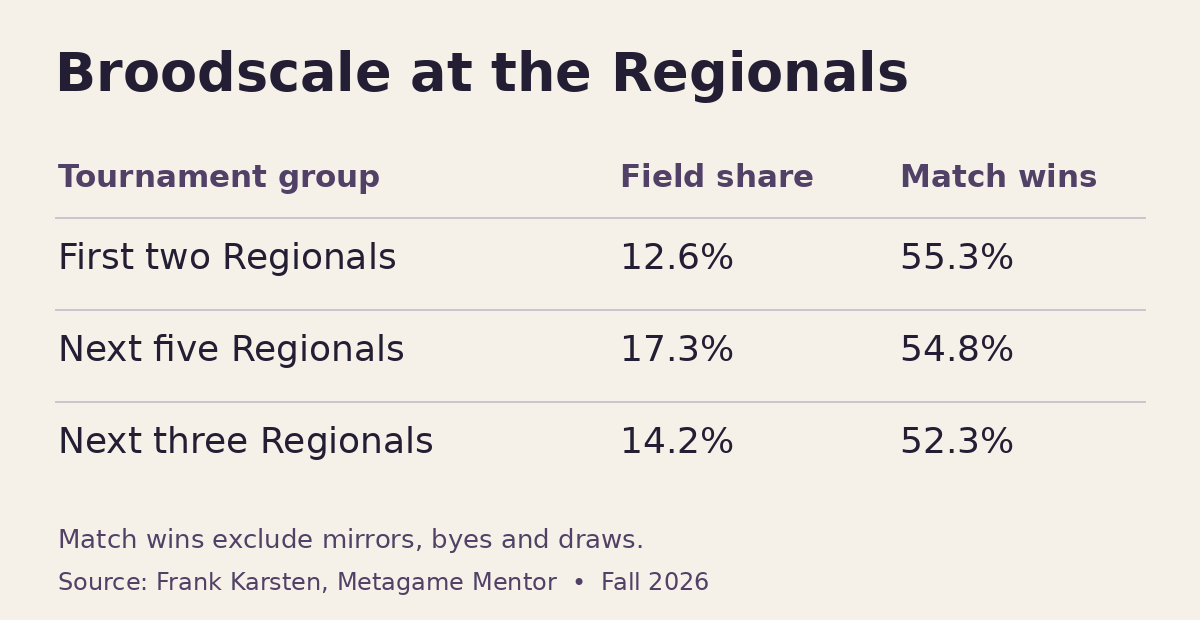
Meanwhile, registering Broodscale itself had begun to pay a little less well. Across the first two Regionals it was 12.6% of the field and won 55.3% of its matches. Across the next five it reached 17.3% and still won 54.8%. Those were alarming numbers to see together. More players had signed up, opponents had good reason to practice the matchup, and an Eldrazi pilot could still expect to do rather better than break even. The next three Regionals, in Southeast Asia, Australia/New Zealand and South America, broke the pattern. Broodscale’s share fell to 14.2%. Its match win rate came down to 52.3%. Karsten excluded matches between two pilots on the same deck, so a roomful of lizards trading wins among themselves didn’t account for the fall.
It’s tempting to give Gregg and the Chant players credit for the whole decline. The arithmetic is a little less generous. Chant went from 4.6% of the field to 7.2%. Imagine that in a hundred pairings, three perfectly even opponents were replaced by Chant pilots. Against each of those three, a Broodscale player’s expected wins would drop from half a match to about a third. Altogether that costs roughly half a win per hundred matches. Broodscale’s observed decline was two and a half wins per hundred. Pairings follow standings, these tournaments took place in different countries and nobody ran this as a controlled experiment. Still, to explain that whole drop, you’d want to know who else had turned up.
Five-Regional matchup study · Following three Regionals
Quite a few of the new arrivals had brought Swamps. Rakdos Delirium climbed from 1.4% to 8.8% of the field and posted a 58.3% match win rate in the later group, including a favorable Broodscale matchup. Its pilots had discovered a nice second use for Stitcher’s Supplier. The creature filled their graveyard when it came in. Sacrificing it to cast Flare of Malice filled the graveyard some more and made the opponent sacrifice one of their most expensive creatures or planeswalkers. The Rakdos player could tap out to advance their own board and still represent removal. For somebody who liked turning creatures sideways, it was a pretty appealing alternative to nine rounds of asking people to stop in their upkeep.
Rakdos lists and sideboard choices
There’s a small detail in Gerardo94’s list that says a good deal about where Modern had got to by late November. Four sideboard slots went to Sanctifier en-Vec. The creature has protection from black and red and sends black and red cards headed for the graveyard into exile. Karsten had observed white decks adopting it as Rakdos gained ground. Sideboards have fifteen slots. The player who beat Broodscale in Wednesday’s final had found room to spend more than a quarter of theirs on a card particularly good against the people who were particularly good against Broodscale.
Rakdos lists and sideboard choices · Winning 75
A very different weekend in Osaka
On November 22 in Osaka, Broodscale finished second, fourth and sixth behind Azorius Control. Had you spent the weekend watching that tournament, you might reasonably have gone home wondering how many more Eldrazi finals Modern needed. Had you played either the Danish or the Swedish Unity League Nationals the day before, you could have watched the entire Top 8 without seeing Broodscale once. In Taipei, at the last Regional Championship of the season, nine of the 81 available decklists were Broodscale. The best two finished seventh and ninth. Players telling stories about three tournaments could all have been telling the truth.
Osaka decklists · Denmark standings · Sweden standings · Taipei standings
Online, much depended on which evening you had free. Across thirteen published Modern Challenges from November 20 through 25, three different Broodscale pilots took trophies. On Monday the 23rd, the deck reached both finals. On Tuesday it put one pilot into 24 playoff places across three Challenges. On Wednesday it took three seats at a single final table. Those finishes don’t give us the fraction of all entrants on Broodscale who advanced, and online regulars can play again the following day. They do tell us that a championship-caliber player could still win with this deck. Any account of Monday’s ban decision that requires Broodscale to have quietly become bad will run into trouble here.
Challenge archive · November 23 second final · November 23–24 Challenge results · November 25 standings
Wednesday’s pairings tell us something the trophy count misses. Gerardo94 beat Grixis Persist in the quarters and Living End in the semifinal. On the other side of the bracket, manohito had beaten Eldrazi Tron and then Energy. The other two Broodscale pilots lost their quarterfinals to Energy and Living End. A perfectly recognizable Modern tournament had taken place around the ostensible emergency. An aggressive deck could beat the combo. Another combo deck could beat the combo. Azorius could beat all three rounds of opponents it actually drew.
November 25 bracket · November 25 standings
There was also a practical reason why eight copies of “you can’t cast spells” had earned their keep. Living End decks use cascade to cast their namesake card. A Chant player can respond to the cascade trigger. If Chant resolves first, the opponent can turn over Living End and look at it, but the rules still require them to cast it. The same one-mana spell that could buy a whole turn against Emrakul could interrupt a graveyard deck’s big turn on its way through the semifinal. Nobody needs to know whether Gerardo94 drew Chant in a particular game to appreciate why it was in the starting sixty.
Card text and rulings · November 25 bracket
Whose deck would a Command ban actually hit?
For a player sick of dying to the little green creature, Basking Broodscale itself had the strongest precedent. Wizards banned it from Pauper in March 2025 to remove that format’s combo deck. Modern had an additional candidate in Blade of the Bloodchief. The November 23 Challenge winner played just two copies of the equipment alongside four Urza’s Sagas. A land that can fetch the Blade directly from the library makes two copies go a long way. Removing either half would have broken the loop. Eldrazi players could still have ramped into Emrakul, and the Ghent final had already demonstrated what a satisfactory afternoon that could provide.
Pauper Broodscale and Modern Breach decisions · November 23 winning list · Ghent final
Removing Command would have presented the bill to a much wider group. Eldrazi Tron used the same instant to turn spare mana into cards, creatures or removal. In the later three-Regional group, Tron accounted for 3.8% of the field and won 46.7% of its matches. Picture the Tron player coming home from that stretch and being told to surrender their four Commands on account of the excellent weekend somebody else had enjoyed with a Forest. Modern has made those bargains before. The evidence in November made it hard to say what the format would get in return.
Following three Regionals · October Modern review
The strongest case for a ban was about the cost of beating the favorite. Wizards has taken that cost seriously in the past. When it banned Underworld Breach in Modern in 2025, it described players committing well over half their sideboards to a combo that could still fight through both graveyard and artifact hate. In May 2026, it removed Phlage, Titan of Fire’s Fury after the package with Arena of Glory had begun to crowd other choices out of aggressive and midrange decks. Lotus Field went in the same announcement. Its loops in Amulet Titan could make finishing a paper tournament round a distinctly practical problem. A list of different deck names in a Top 8 would have missed what bothered Wizards in each case.
Pauper Broodscale and Modern Breach decisions · May Modern bans
Broodscale certainly exacted a price. Anyone making room for four Chants and four Silences had made a substantial decision about what kind of Magic they wanted to play. Yet that choice had applications against other opponents. The people who preferred to attack had a black-red list going deep at Regionals. Even the other decks that briefly put up frightening numbers looked more ordinary over the right stretch of games. Simic Neoform won 64.3% in the later batch of Regionals, but it was just 1.1% of that field. Across Karsten’s longer sample, including the Pro Tour and several sets of Regionals, its win rate was 48.5%. Boros Energy had the loveliest souvenir from Buenos Aires, the trophy, and a rather less imposing 50.4% win rate across those three events. There was precious little in either statistic to recommend taking away another card on Monday.
Back in October, Wizards had two good reasons to give Modern time. The reluctance to change the rules midseason went away when the Regional Championships ended. The case for letting the players work on the problem got better almost every time a new set of results came in. By Thanksgiving week there were 225 matches to consult, a Canadian title and two Worlds invitations earned on opposite sides of the globe.
The enduring pleasure of Wednesday’s final is that manohito nearly spoiled the ending. Broodscale won a game. It made a full nine-round event come down to a third game for the title. Losing that match did very little to dent the reputation of Kozilek’s Command. What it did dent was the idea that somebody at Wizards had to reach into the card pool to give Modern players a fighting chance. For one white mana, they’d already bought themselves one.
Thanks for reading.
Follow @GripRoom on X (Twitter) for tomorrow’s news, today.