A dispatch from the future. What is Future News?
Taiwan voted Saturday to end its nuclear-free energy policy. A year ago, supporters of restarting the Maanshan nuclear plant beat their opponents by nearly three million votes and still lost the referendum. This time the question was broader. Voters backed using nuclear power to boost the economy and doing away with the government’s goal of a nuclear-free homeland. The ballot question · The 2025 result
There’s an explanation for that 2025 result halfway down the county tally sheet. Find Changhua. Run your finger down one line to Nantou. The two counties are neighbors. On the matter of nuclear power, you might reasonably have put the people of Changhua down as the enthusiasts. They gave Yes nearly four votes in five. Central Election Commission county returns
The extra ballot in Nantou
The question that August was whether Taiwan’s third nuclear plant could operate again once the authorities were satisfied it was safe. In Changhua, 222,117 people said Yes and 56,089 said No. Trouble was, there were 1,042,775 eligible voters in the county. All those Yes votes amounted to 21.3% of them. Official county tally
Next door in Nantou, the proposal had a smaller cheering section as a share of the vote. Just under 72% of valid ballots said Yes. But both of Nantou’s legislative districts were voting on recalls that Saturday. Turnout on the nuclear ballot reached 47.4% in Nantou against 26.96% in Changhua. Count up everyone who could have voted, including those who stayed home, and one in three eligible Nantou voters had marked Yes. Changhua, for all its enthusiasm, barely managed a fifth. Recall election results · County returns
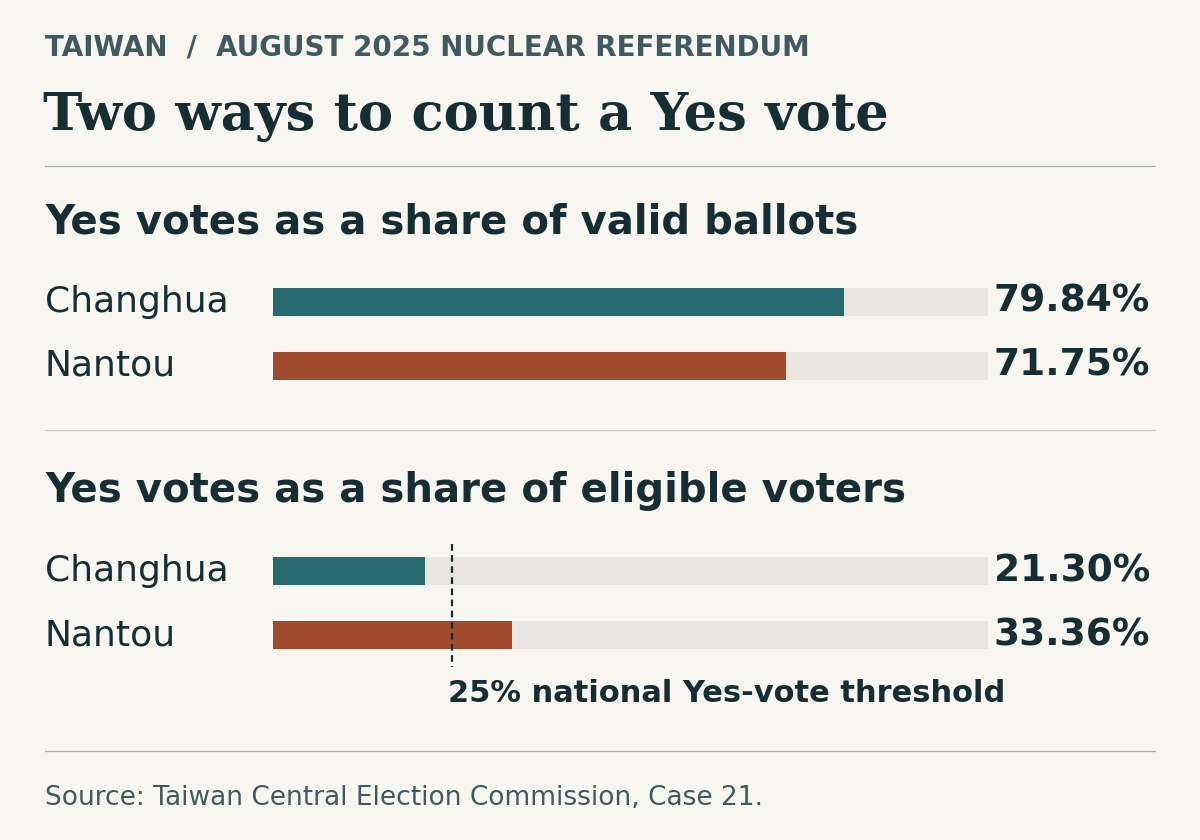
In the August 2025 nuclear referendum, Yes received 79.84% of valid votes in Changhua and 71.75% in Nantou. As a share of all eligible voters, Yes reached 21.30% in Changhua and 33.36% in Nantou. The dashed line marks the national 25% Yes-vote threshold. Passage was decided nationwide.
How many people in Nantou went out chiefly for the recall and picked up a nuclear ballot while they were there? The county returns don’t say.
Five million would have been 959 votes short
Saturday’s referendum shared a polling day with elections for mayors, councillors and thousands of other local officials. Voters could choose whether to pick up the extra sheet. Taipei had some experience with that. In 2022 the city counted 33,159 fewer ballots on a constitutional amendment than it counted in the mayor’s race that same day. This time the referendum also had voters the local races couldn’t reach. The 402,980 eligible 18- and 19-year-olds could vote on nuclear power before they were old enough to vote for mayor. Taipei counts, tables 1-4 and 1-5 · 2026 electorate
With 20,003,835 people eligible, the number to pencil in the margin was 5,000,959. That many Yes votes, at minimum, and more Yes votes than No. Say Yes had won 55% of valid ballots. If 45% of eligible voters had cast a valid ballot, Yes would have come up about 50,000 votes short. At 46%, the very same majority would have cleared the bar by about 60,000. A poll could have got the split exactly right and still called the wrong result. Referendum Act, Article 29 · Central Election Commission election portal
What Taiwan voted to change
Lai Ching-te had to explain a nuclear referendum once before. In 2018, voters struck down the requirement to phase out nuclear generation by 2025. Lai, then premier, said the government would keep working toward a nuclear-free Taiwan. Voters had erased the deadline. Eight years later, Lai was president and the goal itself was on the ballot. The cabinet’s December 2018 statement
Saturday’s result obliges the government to act on that choice. The nuclear-free goal is written into the Basic Environment Act and the Climate Change Response Act. Changing the text of those laws takes a separate act of the legislature. Referendum Act, Article 30 · Basic Environment Act, Article 23 · Climate Change Response Act, Article 5
The company that already had the job
For a Cameco shareholder, the date worth circling was February 13. That was when Taiwan’s power utility, Taipower, finalized a contract with Westinghouse to inspect Maanshan. Cameco reported owning 49% of Westinghouse at the end of September. Taipower had awarded that job nine months before election day. For a shareholder looking for fresh business, the document to watch for is a further order from Taipower to Westinghouse. Taiwan’s economy ministry, page 13 · Cameco’s third-quarter filing, note 7
The chipmaker TSMC sits on the customer side of that story. Its sustainability figures put its Taiwan electricity use at roughly 26 terawatt-hours in 2025. For scale, Maanshan’s second reactor supplied 7.18 terawatt-hours to the grid in 2024, a little over a quarter of that figure. Any power from a restart would feed a shared grid. In its annual filing, TSMC says some of the outages, dips and surges it has experienced have interrupted operations. TSMC’s Taiwan electricity figures · Maanshan’s operating record · TSMC’s annual filing
In September, Taiwan’s nuclear regulator approved Taipower’s plan for the checks needed to restart Maanshan. The economics minister put the earliest possible restart in 2028. Before either reactor can send another kilowatt-hour to the grid, the regulator has to review the safety work and issue an operating licence. There’s no box for that on a referendum ballot. Nuclear Safety Commission notice · The minister’s timetable
Thanks for reading.
Follow @GripRoom on X (Twitter) for tomorrow’s news, today.