Why Disney World Food Makes Parents Budget Like Accountants
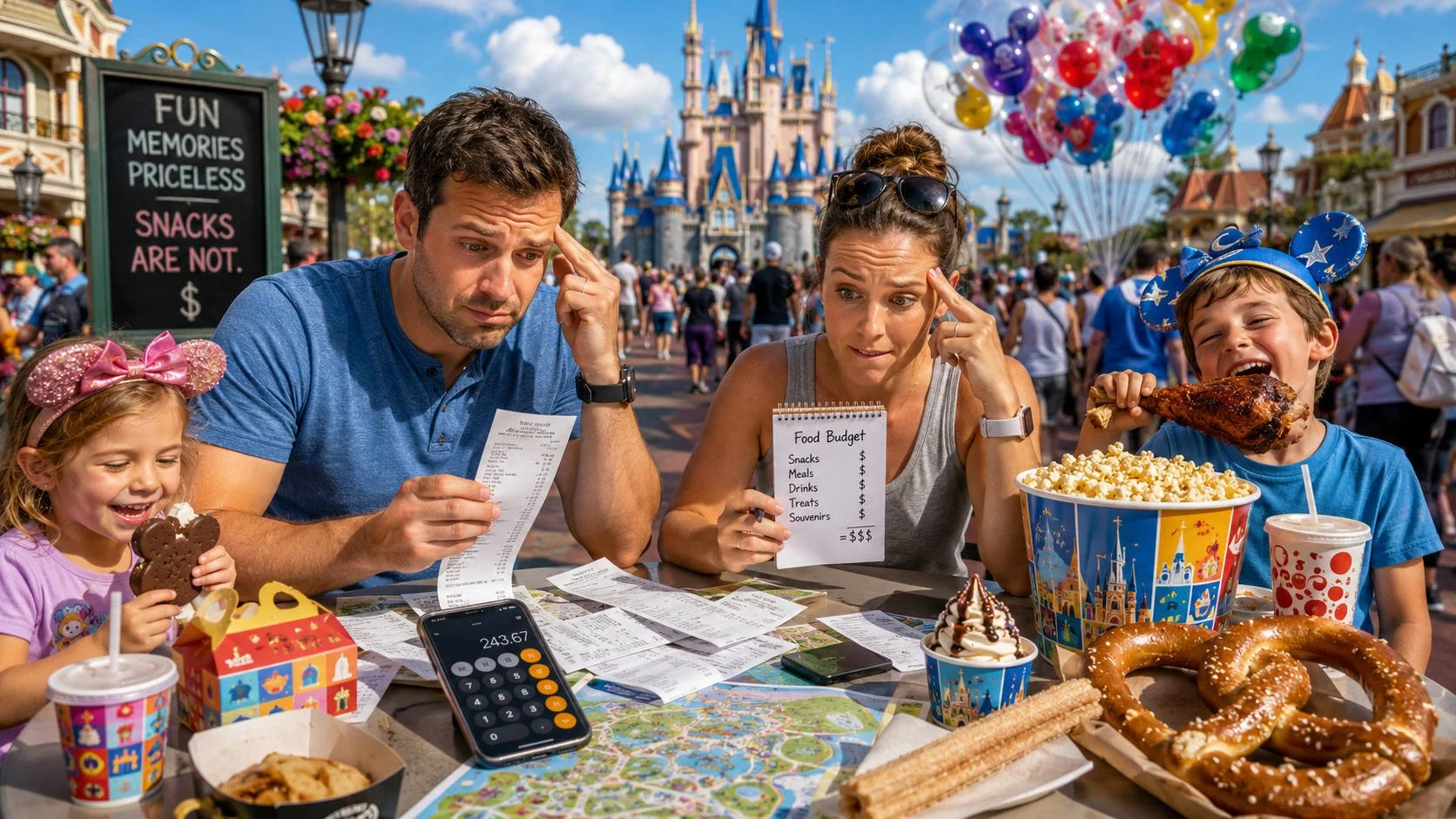
Disney World does something extraordinary to parents. It turns normal adults into spreadsheet goblins in moisture-wicking shirts. These are people who at home will casually buy a $9 oat milk because “we were out,” but in Magic Kingdom they start whispering, “If we split one pretzel and refill the water bottle, we can reallocate funds to the princess dinner,” like they are managing grain reserves during a medieval siege.
And honestly? They are right.
Disney food is not just food. It is timing, heat management, toddler diplomacy, character access, nostalgia, line avoidance, reservation strategy, hydration planning, and a financial instrument shaped like Mickey Mouse. You are not buying lunch. You are buying the temporary prevention of a family-wide collapse in Frontierland.
The official menus explain the panic beautifully. A Mickey Pretzel at The Lunching Pad is listed at $8.49, a DASANI bottled water at Magic Kingdom snack spots is $4.25, and an all-beef foot-long hot dog at Casey’s Corner is $13.49 before anyone starts adding chili, cheese, frozen lemonade, or the phrase “I’m still hungry,” which should be classified as a budgetary threat.
Disney World Food Is Expensive Because It Is Also Crowd Control
A parent at Disney World is not asking, “What sounds good?” That is amateur hour. A parent is asking, “What can everyone eat quickly, without crying, before our Lightning Lane window becomes a historical artifact?”
This is why Disney food budgeting feels like accounting. Every meal has hidden variables. How far is the restaurant from the next ride? Is mobile order available? Does the kid want fries, or has the kid entered the mysterious vacation phase where only grapes and rage are acceptable? Is this lunch, or is this lunch plus air-conditioning plus sitting down, which in Florida is basically a medical intervention?
Disney knows this. Mobile food ordering at Walt Disney World lets guests choose a participating location, select an arrival time, customize some items, pay in the app, and pick up when notified; Disney says mobile ordering is available at more than 60 locations across the resort. That is not just convenience. That is Disney handing parents a digital panic valve.
The parent who mobile-orders lunch at 10:47 a.m. is not neurotic. They are a battlefield commander with sunscreen in their eyes.
The Snack Budget Is Where Innocence Goes to Be Taxed
At home, a snack is a granola bar. At Disney World, a snack is a themed emotional event that costs almost as much as a small appliance warranty.
A Mickey Pretzel with cheese sauce is $8.49 at The Lunching Pad. A Mickey Premium Ice Cream Bar is $6.49 at Astrofizz. Frozen slushies are listed at $6.49. These are not outrageous in isolation. The problem is that Disney days are long, hot, overstimulating, and full of children who suddenly discover “snack hunger” every 46 feet.
This is how parents become accountants. One snack is cute. Four snacks across four people is a transaction that makes you stare into the distance like you just funded a minor bridge repair.
The move is not “no snacks,” because that is how revolutions begin. The move is a snack strategy. Pick one paid iconic snack per person or one shared snack moment per park day. The Mickey pretzel, the ice cream bar, the popcorn, the Dole Whip, whatever your family worships. Then pack the boring backup snacks: crackers, fruit pouches, granola bars, pretzels, trail mix, and whatever shelf-stable food keeps your child from becoming a haunted Victorian street urchin in line for Pirates.
Disney officially allows guests to bring outside food and nonalcoholic beverages into theme parks and water parks for self-consumption, as long as the items are not in glass containers, do not need heating or refrigeration, and do not have pungent odors. Translation: bring the snacks. Leave the room-temperature fish curry at home, you absolute menace.
Bottled Water Is the Line Item That Makes Parents Start Muttering
A $4.25 bottled water does not sound catastrophic until you multiply it by a family, a day, the Florida sun, and a child who drinks half the bottle, backwashes into it, then abandons it in a stroller cup holder like a tiny municipal crime. Disney menu pages list DASANI bottled water at $4.25 and smartwater at $6.25 at some snack locations.
This is why water planning is the least glamorous and most important food-budget move. Bring refillable bottles. Use water bottle refill stations. Disney maintains a page specifically for locating bottle-filling stations throughout Walt Disney World theme parks, water parks, Disney Springs, and more.
Cups of ice are also available at no charge at Food & Beverage locations, according to Disney’s property rules FAQ. That sentence may not sound magical, but to a parent in August, free ice is basically Tinker Bell with a utility belt.
Quick Service Is Where the Math Gets Real
Quick service sounds casual until you realize casual food still adds up like it studied finance.
At Cosmic Ray’s Starlight Café, a 1/3 lb Angus Bacon Cheeseburger with fries is listed at $13.99, and a Truffle-French Onion Burger with fries is $14.99. At Docking Bay 7 in Hollywood Studios, entrées include Endorian Fried Chicken Tip Yip at $16.29 and Shaak Pot Roast with Kublag Mash at $19.99. At Casey’s Corner, an all-beef foot-long hot dog is $13.49, while the chili-cheese foot-long is $15.49.
Now multiply. Two adults and two older kids eating $14 entrées is $56 before tax, drinks, snacks, dessert, or the child who decides fries are suddenly “too potato.” A family lunch can easily hit the cost of a respectable grocery run, except instead of leaving with multiple meals, you leave with ketchup packets and the vague memory of sitting down.
The useful parent move is to identify “anchor meals.” One real quick-service lunch or dinner per park day. Build around it. Do breakfast in the room if possible. Pack snacks. Use refillable bottles. Then enjoy the paid meal without acting like every chicken strip is a personal financial betrayal.
Kids’ Meals Are the Unsung Budget Heroes
For actual kids, kids’ meals can be shockingly strategic. Connections Eatery lists kids’ meals like cheese pizza at $8.29, PB&J Uncrustable at $7.29, and kids’ cheeseburger or chicken strips at $8.99, generally served with two sides and a small low-fat milk or small bottled water. Columbia Harbour House and Pecos Bill show similar kids’ menu structures with sides and drinks included.
That matters because adult entrées often do not include a drink, and the drink is where the budget gets ambushed wearing a Coca-Cola logo. Kids’ meals are not always exciting, but they are often complete. A kid who gets an entrée, two sides, and a drink for under $10 is not being deprived. They are being fiscally respected.
This is also why parents must know Disney’s age rules. Many Disney kids’ menus specify they are for children ages 9 and younger. Meanwhile, for dining plans, Disney treats ages 10 and up as adult guests, which is very funny if you have ever watched a 10-year-old eat three bites of a $16 entrée and then ask for popcorn.
Character Dining Is Not Dinner. It Is Dinner Plus a Photo Economy.
Character dining is where the family food budget stops being a budget and becomes a negotiation with memory.
Chef Mickey’s dinner buffet is listed at $69 per adult and $44 per child ages 3–9, plus tax and gratuity. Garden Grill dinner is listed at $62 per adult and $42 per child, plus tax and gratuity. Be Our Guest dinner pricing is listed at $72 per adult and $43 per child, plus tax and gratuity.
For a family of four with two adults and two kids, Chef Mickey’s dinner is $226 before tax and gratuity. Add tax, tip, maybe transportation time, maybe a child melting down five minutes before Mickey arrives, and suddenly you understand why parents discuss this meal with the gravity of refinancing a deck.
But character dining can still make sense. You are not just buying buffet access. You are buying character interaction without standing in a separate line. You are buying air-conditioning, seating, food, photos, and the thrill of watching a child react to a giant mouse while you silently calculate the cost per hug.
The trick is to pick one big character meal, not six. Do not turn the trip into a rotating buffet pilgrimage unless your financial advisor is Scrooge McDuck and he is feeling generous.
Dining Plans Make Parents Budget Before They Even Arrive
Disney dining plans are basically prepaid meal accounting with a castle logo. Disney says the 2026 Quick-Service Dining Plan includes two quick-service meals, one snack or nonalcoholic beverage, and a resort-refillable mug per night of stay for each guest age 3 and over. The standard Disney Dining Plan includes one quick-service meal, one table-service meal, one snack or nonalcoholic beverage, and a refillable mug per night.
The numbers are where parents start making little columns. A planDisney answer from November 2025 said 2026 vacation packages priced the Disney Dining Plan at $98.59 per adult per night of stay and the Quick-Service Dining Plan at $60.47 per adult per night, though Disney notes pricing and policies can change.
Disney also offered a 2026 deal where kids ages 3–9 could receive a free dining plan when adults ages 10 and up purchase a qualifying package with dining plans; the offer has caveats, including that children must order from children’s menus where available and dining plans exclude gratuities.
This is why parents turn into accountants. A dining plan is not “free food.” It is prepaid food credits with rules. Meals and snacks are based on nights of stay, unused credits roll over day to day, and unused meals or snacks expire at midnight on checkout day. That is not magic. That is inventory management with fireworks nearby.
Advance Dining Reservations Are Budgeting With an Alarm Clock
Disney food planning starts months before anyone smells a churro. Walt Disney World says dining reservations can be made starting 60 days in advance; Disney Resort hotel guests can book for their length of stay, up to 10 nights, starting 60 days before arrival, while other guests can book up to 60 days in advance. New booking windows typically open around 6 a.m.
This is deranged, but useful. Popular meals book early. Character dining, castle dining, fireworks-adjacent meals, and new themed restaurants do not wait for the family that says, “We’ll figure it out when we get there.” That family will figure it out, yes, while eating emergency pretzels and Googling “best quick service near me” with 9% battery.
Planning does not kill spontaneity. Disney killed spontaneity years ago and replaced it with app notifications.
Souvenir Food Containers Are Tiny Budget Landmines
Disney food also becomes expensive because some items are not really food. They are souvenirs holding food hostage.
Docking Bay 7 recently listed a Mandalorian and Grogu Jetpack Sipper at $34.79, including a fountain beverage, with a limit of two per person while supplies last. That is not a drink. That is a plastic artifact your child will beg for, carry for 12 minutes, and then assign to you like unpaid luggage.
The parent rule should be brutal and clear: one souvenir food container per trip, not per snack stand. One bucket, one sipper, one glowing cube, one novelty vessel shaped like intellectual property. Otherwise your vacation budget becomes a landfill with a straw.
The Real Disney Food Budget Formula
A sane Disney food budget has categories, because the second you make “food” one giant number, the snacks sneak through the fence.
Create separate buckets: breakfast, quick-service meals, table-service meals, snacks, drinks, character dining, alcohol if applicable, souvenir containers, and emergency meltdown food. Yes, emergency meltdown food needs a category. Anyone who says otherwise has never watched a child reject lunch because the chicken was “too square.”
A practical day might look like this: breakfast in the room, packed snacks, refillable water bottles, one quick-service lunch, one planned paid snack, and dinner either quick-service or back at the resort. Then schedule one or two bigger table-service or character meals across the trip, not every day unless your vacation theme is “liquidity event.”
Use mobile order to preview totals before committing. Use gift cards if you want a hard cap. Disney mobile order accepts Disney Gift Cards, Disney Rewards Redemption Cards, Apple Pay, credit cards, debit cards, and dining plan payments, so the app can function as both food queue and financial mirror.
The Trick Is Not Spending Nothing. The Trick Is Spending on Purpose.
The saddest Disney budget strategy is pure austerity. A family spends thousands getting to Walt Disney World, then spends the whole trip saying no to every snack like the child asked to buy a condo. That is not budgeting. That is resentment with a backpack.
The better strategy is intentional yeses. Yes to the Mickey pretzel. No to three random bottled drinks because we brought water. Yes to one character breakfast. No to an unplanned table-service dinner nobody actually wanted. Yes to Dole Whip. No to a $35 sipper unless it was budgeted and not obtained through emotional extortion.
Disney food is part of the trip. Pretending otherwise is silly. But letting it run wild is how parents end up staring at receipts in the hotel room like forensic accountants examining a churro-based crime spree.
Disney Food Turns Parents Into Accountants Because Magic Has Margins
Disney World food makes parents budget like accountants because every bite has context. The hot dog is not just a hot dog. It is lunch timing. The bottled water is not just water. It is heat management. The character buffet is not just food. It is a photo opportunity, a seated break, and a mortgage-adjacent emotional purchase. The dining plan is not just convenience. It is prepaid credit management with rules, rollover, expiration, and gratuity exclusions.
The parks are designed to make food feel like part of the story, and that is why it works. A Mickey pretzel tastes more important than a normal pretzel because it has ears and you are standing near a castle. Very sophisticated, the human brain.
So yes, parents budget. They should. They compare kids’ meals, snack prices, character dining, water plans, mobile order windows, and dining plan credits because Disney food can either become a joyful part of the vacation or a financial raccoon tearing through the backpack.
The winning move is not to defeat Disney food. You will not. The churro has institutional power.
The winning move is to decide where the magic is worth paying for, pack enough granola bars to survive the rest, and never let a souvenir sipper negotiate with a tired child on its own terms.