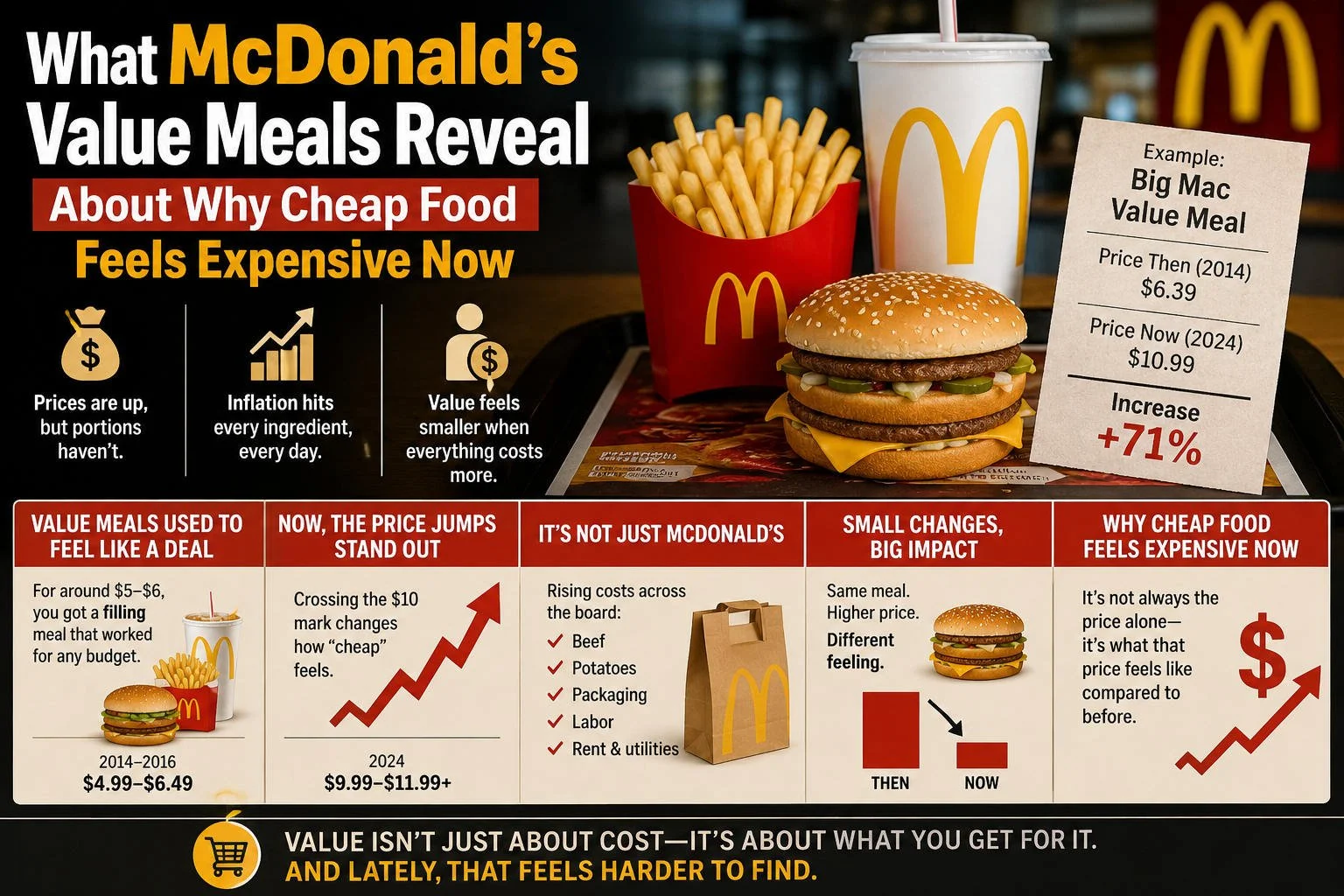
What McDonald’s Value Meals Reveal About Why Cheap Food Feels Expensive Now
First things first: a McDonald’s value meal is not a meal. It is an economic mood ring wrapped in a paper bag. It is a cheeseburger séance where Americans gather around the glowing menu board and ask, “Wasn’t this cheaper before, or has my paycheck been gently beaten with a garden rake?” The answer, somehow, is yes.
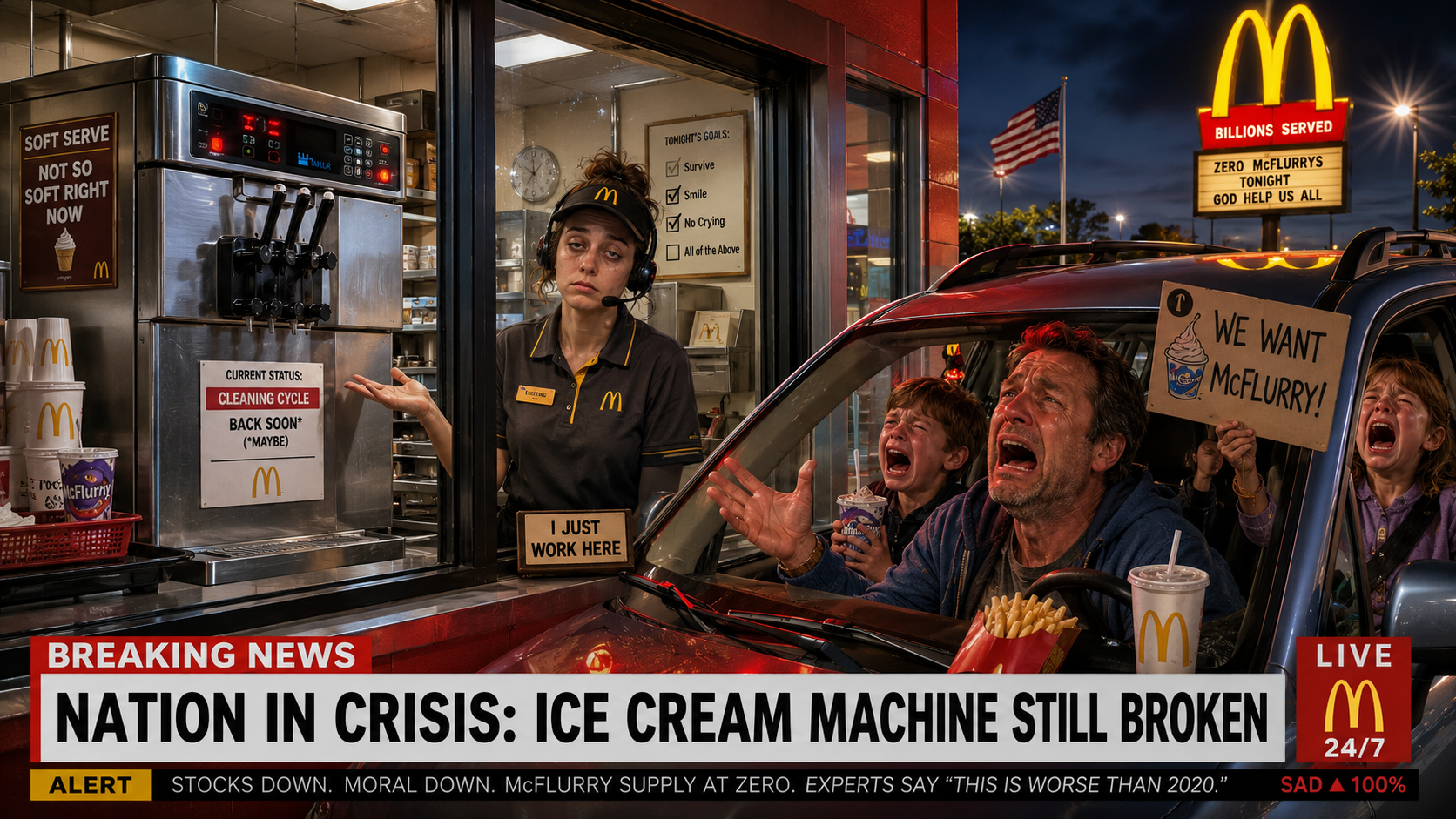
McDonald’s has spent the last two years loudly reintroducing “value,” which is a funny thing to reintroduce to a brand that was supposedly built on it, like a dentist announcing teeth. In June 2024, the chain launched a $5 Meal Deal with a McDouble or McChicken, small fries, four-piece McNuggets, and a small drink. Then came McValue in 2025, Extra Value Meals later that year, and in April 2026, a revamped McValue menu with at least 10 items under $3 plus a $4 breakfast meal. This is not a restaurant menu so much as a public apology with pickles.
McDonald’s Value Meals Are Back Because “Cheap” Broke
The value meal exists because fast food’s old promise got microwaved until the middle was lava and the edges were sadness. For decades, the deal was simple: you surrendered nutrition, ambiance, and the faint dream of self-respect in exchange for speed and price. Nobody went to McDonald’s because the dining room lighting made them feel like a Tuscan count. You went because it was fast, cheap, predictable, and the fries briefly convinced your brain that life had structure.
Now the “cheap” part needs a coupon, an app, a participating location, a franchisee in a generous mood, and maybe a small blood offering to the Grimace. McDonald’s itself notes that prices and participation vary, and that franchisees own and operate most U.S. restaurants and set their own pricing. That means “national value” is still filtered through local rent, labor costs, supply costs, and whatever math happens in the back office while the soda machine screams.
Fast Food Inflation Didn’t Just Raise Prices. It Reset Expectations.
The official inflation numbers are not imaginary, despite everyone’s uncle on Facebook announcing that the Consumer Price Index is a communist weather balloon. As of April 2026, the Bureau of Labor Statistics reported that food away from home was up 3.6% year over year, while limited-service meals — the bureaucratic term for “you ate in your car again, champ” — were up 3.2%. That sounds tame until you remember prices already climbed hard in the pandemic aftermath, so today’s “only 3.2% higher” is being stacked on top of yesterday’s wallet bruises.
The restaurant industry says the cost side is ugly too: food and labor costs for the average restaurant are each up 35% over the last five years, and average menu prices rose 31% between February 2020 and April 2025. In other words, the burger did not wake up one morning and decide to become a luxury good. The entire machine around it — wages, beef, paper, rent, utilities, insurance, delivery logistics, card fees, and probably the cost of the little sticker that says “sealed for your safety” — got more expensive.
The Big Mac Is Not $18 Everywhere, But the Damage Is Done
McDonald’s has pushed back against viral claims that its prices doubled everywhere. In a 2024 open letter, McDonald’s USA president Joe Erlinger said the average U.S. Big Mac price rose from $4.39 in 2019 to $5.29 in 2024, a 21% increase, and called the notorious $18 Big Mac meal an outlier rather than the national rule. Fair enough. But this is where corporate fact-checking runs into human feeling, which is basically a raccoon with a debit card.
People do not experience prices as averages. They experience prices as “my usual order is now $11.47 and the kiosk is asking me to round up for charity while I, too, require charity.” The average can be technically reasonable while the individual receipt still feels like it was printed by a slot machine that hates you.
The Menu Board Became a Psychological Crime Scene
McDonald’s executives understand that the menu board matters because it is where hope goes to get itemized. According to reporting on McDonald’s 2025 earnings call, CEO Chris Kempczinski said customers think McDonald’s lacks value when they see $10 combo meals at the drive-thru, and that the menu board is the biggest driver of the chain’s value perception. That is executive-speak for: “People see double digits next to fries and begin plotting revolution.”
This is why McDonald’s is now leaning into clear price points: $5 meal, $8 Big Mac meal, under-$3 menu, $4 breakfast bundle. A $2.99 Snack Wrap is not just a chicken tube. It is a flare gun fired into the sky saying, “Please come back, economically exhausted people, we have ranch.”
“Value” Now Means You Have to Work for the Discount
The old value menu was simple: cheap things sat there, openly, like civilized objects. Now value is frequently conditional. Use the app. Buy one thing to unlock another thing. Come during the promotion window. Choose from a limited set of items. Hope your location participates. Congratulations, you are not buying lunch; you are solving a children’s escape room sponsored by processed cheese.
McDonald’s McValue platform included app offers, local deals, the $5 Meal Deal, and a Buy One, Add One for $1 structure. The 2026 update simplified the pitch with under-$3 items, which is smart because consumers do not want lunch to require the cognitive load of refinancing a bungalow.
The real reveal is this: cheap food feels expensive when affordability stops being the default and becomes a side quest.
The Value Meal Is Also a Warning Light for the Whole Economy
Fast food is supposed to be where people trade down when everything else gets expensive. If sit-down restaurants are too pricey, you hit the drive-thru. If the drive-thru is too pricey, you eat at home. If eating at home is too pricey, you stand in front of the fridge making the same sound a haunted printer makes.
That trade-down ladder is exactly why McDonald’s value meals matter. In 2024, a LendingTree survey found that 78% of Americans viewed fast food as a luxury because it had become so expensive; 62% said they were eating it less due to rising prices, and 65% said they had felt sticker shock at a fast-food restaurant in the prior six months. That is not a “brand perception challenge.” That is the customer base holding up a receipt and whispering, “What in the McHell is this?”
McDonald’s has also had to woo lower-income diners back. The company reported stronger U.S. comparable sales after value pushes, including 6.8% U.S. comparable sales growth in Q4 2025 and 3.9% in Q1 2026. Value is working — but the fact that it needs this much engineering tells you the old fast-food bargain has cracked.
Why Cheap Food Feels Expensive Even When Deals Exist
Cheap food feels expensive now for five reasons.
First, prices rose and stayed up. Inflation cooled, but menus did not politely rewind like a VHS tape of 2018. Second, restaurants are paying more for labor and food, and those costs ooze into the menu like fryer grease under a door. Third, consumers are comparing fast food not to steakhouse prices but to memory, which is a dangerous little museum run by liars and childhood French fries. Fourth, the best prices are often buried in apps and promotions, which makes affordability feel conditional. Fifth, everyone’s whole budget is under pressure, so even a $6 meal arrives wearing the emotional weight of rent, gas, insurance, groceries, and the electric bill’s monthly hostage note.
USDA data helps explain the broader squeeze: food prices rose sharply in 2022, and while growth slowed in 2024 and 2025, food-away-from-home prices still rose faster than their historical average in both years. Beef, vegetables, beverages, and other categories have continued to show pressure in 2026, which is extremely convenient for nobody except economists who enjoy charts shaped like bad news.
How to Actually Get Value Without Being Played by the Clown
The useful lesson is not “never eat McDonald’s.” Please. We are a civilization, barely. The lesson is to stop treating the combo meal like it is automatically the cheapest choice just because it comes with a numbered button and a picture.
Check the total basket, not the mascot math. A la carte items from the under-$3 menu may beat a combo, especially if you do not need a drink large enough to baptize a Labrador. Use the app only like a coupon drawer, not like a casino; decide what deal you are using before you start adding random items because “rewards points” made your brain wear a tiny accountant hat. Avoid delivery when chasing value, because turning a $5 meal into a $14 doorstep ceremony is not convenience, it is financial slapstick. And keep an at-home backup meal around, because nothing defeats fast-food sticker shock like remembering you own pasta.
The Real Meaning of the McDonald’s Value Meal Comeback
McDonald’s value meals reveal that cheap food is no longer simply cheap. It has become negotiated cheap. Promotional cheap. App cheap. Participating-location cheap. “Limited time only” cheap. Cheap with an asterisk wearing another smaller asterisk as a hat.
The value meal is back because customers noticed the old bargain was wobbling. McDonald’s noticed customers noticed. Franchisees noticed McDonald’s noticed customers noticed. Then everyone gathered around the menu board, stared at the $10 combo meals, and agreed to invent several new ways to say, “Please don’t leave.”
Cheap food feels expensive now because the economy took the one place people associated with low-stakes convenience and made it feel like another bill to manage. That is the indignity. Not that a burger costs more. Everything costs more. The indignity is that even the humble fast-food run — the lazy dinner, the road-trip pit stop, the “fine, we’ll get nuggets” parental surrender — now requires strategy.
A value meal used to mean you were saving money. Now it means you successfully navigated the terms and conditions of a cheeseburger. Which is progress, apparently, in the same way a raccoon learning to use Apple Pay is progress.