What Crumbl Teaches About Franchising, Weekly Drops, and Food Hype
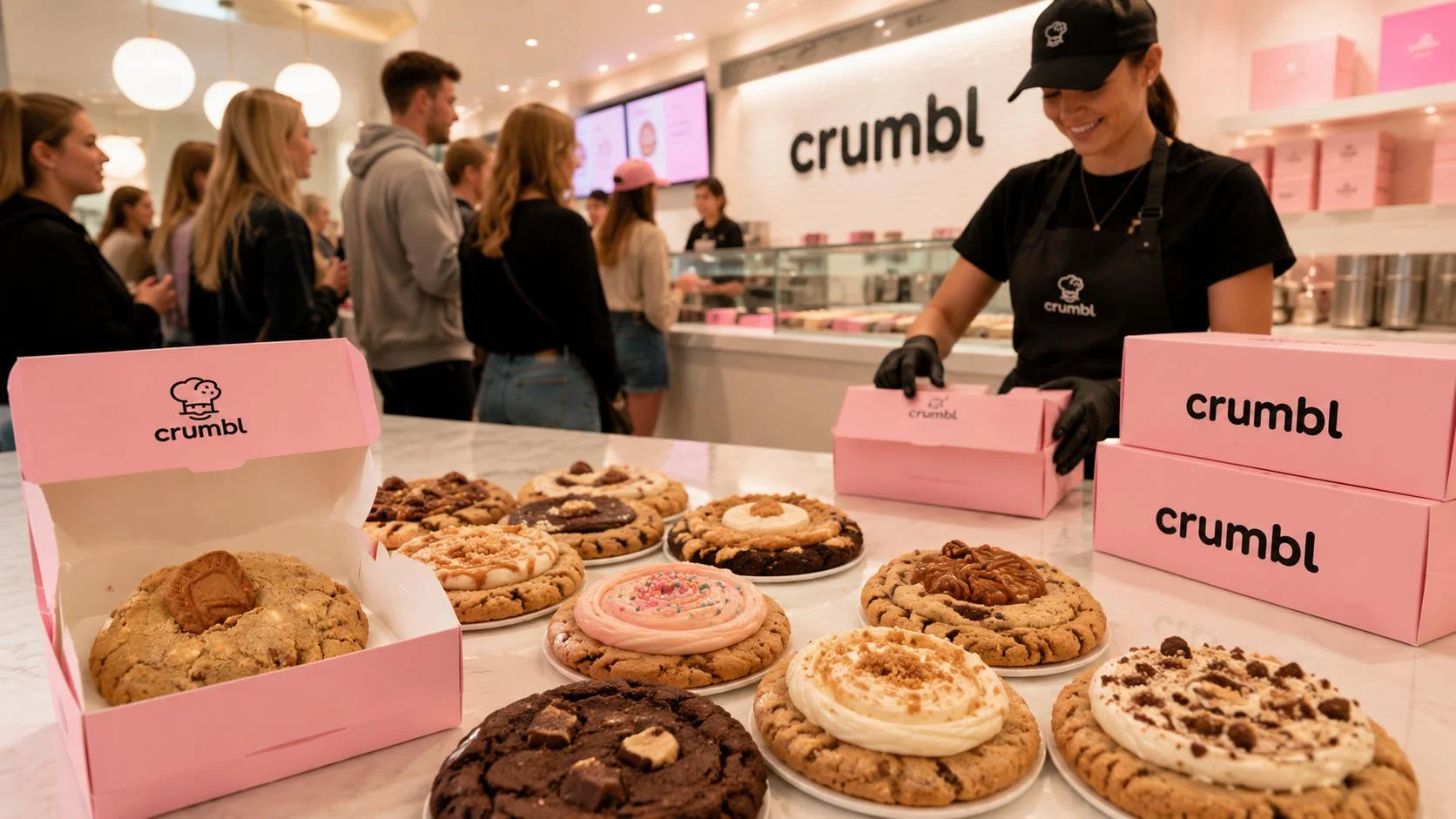
Crumbl is not really a cookie company. That would be too humble, too normal, too “grandma made oatmeal raisin and nobody had to open an app.”
Crumbl is a weekly dessert-content machine that happens to sell cookies large enough to make a nutrition label start sweating. It took the humble cookie, a food that previously required butter, sugar, and one adult saying “don’t eat them all,” and turned it into a rotating release cycle with TikTok reviews, limited-time urgency, franchise economics, app notifications, influencer rituals, and a pink box that looks like it was designed by Barbie’s private equity cousin.
And that is why Crumbl is such a useful case study. It is not just about cookies. It is about how modern food brands create hype, scale fast through franchising, and turn “new flavor this week” into a consumer habit.
Basically, Crumbl looked at dessert and said, “What if cookies had sneaker-drop energy?” And America, apparently in need of frosted carbohydrate theater, said, “Fine, yes, put the cornbread cookie in the box.”
Crumbl Turned Cookies Into a Weekly Event
Most bakeries have menus. Crumbl has episodes.
That is the first lesson. Crumbl did not build hype by selling the same cookie quietly forever like some flour-based monk. It built hype by making the menu move. The company’s own franchising page describes its model around a weekly rotating menu, open-concept kitchen, and iconic Pink Box, which is basically the Holy Trinity of modern dessert marketing if your god is engagement.
The weekly drop changes the psychology. A normal cookie says, “Buy me whenever.” A Crumbl cookie says, “Buy me now, idiot, I may disappear by Saturday.”
That is not hunger. That is urgency wearing frosting.
Crumbl’s Sunday menu reset is especially clever. The company says its new weekly menu is announced in the Crumbl app and on social media on Sunday evening, while stores remain closed Sundays and reopen Monday with the new lineup. So the brand gets a weekly ritual without even opening the ovens that day. Incredible. The store is closed and still making people think about cookies. That is marketing witchcraft with sprinkles.
Scarcity Makes Dessert Feel Like News
The rotating menu turns each flavor into a tiny limited-time event. That means Crumbl does not need every cookie to be a forever classic. It only needs each cookie to be interesting enough to get tasted, filmed, ranked, argued about, and possibly bought before it vanishes into the cookie witness protection program.
This is the food-hype loop:
Crumbl announces flavors.
Fans check the app.
Creators post reviews.
People argue online.
Someone says the cookie is overrated.
Someone else says it changed their life, which is alarming.
Everyone goes back next week because there is a new lineup.
This is not a bakery. This is a content subscription with frosting.
TikTok’s own business case study on Crumbl described how the brand used #crumblreview and #tasteweekly to encourage users to review weekly drops, with the #crumblreview hashtag drawing hundreds of millions of views at the time. That is the genius: Crumbl does not have to create all the marketing itself. It gives customers new material every week and lets them turn the parking lot into a dessert review studio.
The Cookie Review Became Free Labor With a Ring Light
Crumbl’s food hype works because it made the customer part of the launch cycle.
The product is not just the cookie. The product is the reaction.
Cutting the cookie. Showing the frosting. Pulling apart the stuffed center. Ranking the lineup. Saying “this one is a 6.7” like you are the Michelin Guide of buttercream. Filming the pink box in your car, because apparently the front seat is now a dessert criticism platform.
Every weekly lineup gives creators content. And creators give Crumbl reach. Crumbl does not merely sell dessert; it feeds the algorithm. Which, unfortunately, is now one of the major food groups.
This is why the flavors can be ridiculous. Cornbread. Key lime pie. Waffle. Wedding cake. Churro. Tres leches. Cookie dough. Brownie batter. Anything that sounds like another dessert got flattened into a cookie is perfect for content. Subtlety does not go viral. A giant frosted cookie that looks like a birthday party had a nervous breakdown does.
Crumbl Built a Franchise Model Around Standardized Chaos
Here is the part people miss: weekly flavor chaos only works if the system behind it is disciplined.
Crumbl expanded through franchising, and by the end of 2025 it had 1,101 locations and no corporate-owned stores, according to QSR Magazine’s reporting on its franchise disclosure materials. The same report said Crumbl had grown from 690 franchised stores at the start of 2023 to 1,101 by the end of 2025.
That is absurdly fast. It is the kind of growth that makes normal bakeries look like they are moving in geological time.
But franchising a weekly rotating dessert concept is not easy. Every store has to execute the same new items, packaging, presentation, app ordering, customer expectations, and social-media-ready visuals. That means Crumbl is selling franchisees more than recipes. It is selling them a system: training, menu cadence, technology, design, supply chain, branding, and the ability to participate in weekly national hype.
In other words, the cookie is local. The machine is centralized.
Very cozy. Very corporate. Very “your neighborhood bakery has a franchise disclosure document now.”
The Pink Box Is Not Packaging. It Is a Billboard With Cookies Inside.
The pink box is one of Crumbl’s smartest assets because it turns the purchase into a recognizable object. A generic white box says, “Here are baked goods.” A Crumbl pink box says, “I have participated in the weekly sugar economy.”
The box is photogenic, distinctive, and easy to spot on social media. It is not just packaging. It is a portable brand signal. People post the box before they even show the cookies, because apparently cardboard now has influencer value.
This matters in franchising because consistency is everything. A franchise brand needs customers to know what they are getting whether they are in Utah, Texas, Ontario, or anywhere else the pink box has colonized. Crumbl’s open kitchen, rotating menu, and box experience all create a repeatable theater of freshness and novelty. The company itself pitches the Pink Box as part of its franchise experience, not some accidental container that wandered in from a packaging supplier.
The box says: “This is not just dessert. This is an event.”
Exhausting? Yes.
Effective? Also yes.
The App Turns Cookie Curiosity Into a Habit
Crumbl’s app and rewards system are not decorative. They are part of the hype engine.
The company’s rewards page says customers earn Crumbs for purchases and can place pre-orders after the weekly drop during a Sunday evening window for a discount. That is the kind of detail that seems small until you realize it trains people to check the app exactly when the new lineup arrives.
This is not “loyalty” in the old punch-card sense. This is behavior design. App notifications, Sunday menu drops, rewards tiers, pre-order incentives, local flavor voting, reviews, and repeat ordering all turn Crumbl from a place you visit into a ritual you monitor.
A normal bakery hopes you remember it exists.
Crumbl sends the cookie bat signal.
Crumbl’s 2026 Menu Shift Shows the Hype Machine Needed Training Wheels
The most interesting thing Crumbl has done lately is admit, in corporate-friendly language, that weekly novelty alone can be a little much.
Crumbl’s own Classics Menu blog says the company updated its menu because the rotating menu made planning ahead harder for celebrations and gifting. It says customers wanted both reliable favorites and the excitement of weekly discovery, so Crumbl moved toward a mix of classics or seasonal classics plus rotating weekly flavors.
Translation: people love novelty until they are trying to order for a birthday party and the menu says, “Surprise, this week’s lineup is Experimental Marshmallow Potato Cake.”
The Classics strategy is smart. It gives casual customers a safety net while preserving the weekly hype cycle. You get dependable favorites for normal human planning and rotating flavors for people who treat dessert like a collectible card game.
This is the balance every hype brand eventually has to learn: too much novelty becomes confusion. Too much consistency becomes boredom. Crumbl is trying to keep both engines running without turning the menu into a slot machine with frosting.
The Franchise Numbers Show Hype Has a Hangover
Crumbl’s growth is impressive, but hype is not magic. It still has to survive unit economics, store saturation, labor, rent, food costs, franchisee performance, and the basic fact that people do not need a $5 cookie every day unless their personality has been replaced by cream cheese frosting.
QSR Magazine reported that Crumbl’s average unit volume has moved around sharply: $1.84 million in 2022, $1.16 million in 2023, $1.35 million in 2024, and $1.093 million median sales in 2025. The report also noted store openings, closures, terminations, and that only about 45% of reporting stores met or surpassed the average gross sales number in 2025.
That is the less cute side of the pink box. Viral demand can launch a franchise brand, but every new store still needs enough local demand to justify rent, labor, equipment, royalties, marketing fees, and the emotional burden of explaining why the cookie is sold out.
Crumbl is a food-hype success story. It is also a reminder that food hype can peak, normalize, and get financially awkward once the novelty fog clears and everyone has to look at the P&L under fluorescent lighting.
Private Equity Smelled the Frosting
Of course investment firms got interested. A fast-growing franchise system with national brand recognition, social-media heat, royalty streams, and a pink box that turns customers into unpaid marketers? Private equity would crawl through a vent for that.
Reuters reported in January 2025 that Crumbl’s owners were exploring a sale that could value the chain at nearly $2 billion including debt, with potential interest from private equity firms. Reuters also noted that the chain had built a large social media following and reached more than 1,000 locations across North America.
This tells you what Crumbl really became: not just a cookie chain, but a scalable consumer platform. That is a disgusting phrase, and I apologize, but it is accurate. The cookie is the product. The franchise network is the distribution. The app is the habit loop. Social media is the amplifier. The pink box is the icon. The weekly menu is the content calendar.
Somewhere, a cookie became an asset class.
Crumbl Teaches That Food Hype Needs a Clock
The weekly cadence is the key. Crumbl does not rely on random product drops. It trains the audience to expect novelty on a schedule.
That is powerful because predictable surprise is basically catnip for modern consumers. People know when to look, but not exactly what they will find. It is the same reason people watch weekly TV episodes, check sneaker drops, follow limited-edition beauty launches, or return to seasonal Starbucks drinks like pumpkin spice is a municipal holiday.
The clock matters.
A one-time limited item creates a spike.
A weekly drop creates a habit.
Crumbl’s genius is that it made the drop itself part of the brand. The cookie changes, but the ritual stays. The specific flavor is temporary. The behavior is permanent, or at least that is the dream before everyone discovers bloodwork.
It Also Teaches That Hype Needs Critics
Crumbl’s hype is not built only by fans saying everything is amazing. It is also built by complaints, rankings, disappointment, and outrage.
“This week is mid.”
“Pink Sugar is overrated.”
“Why is everything cream cheese frosting?”
“This one tastes raw.”
“This is the best cookie ever.”
“That is not a cookie, that is a cake wearing a fake mustache.”
The discourse is the engine. A flavor people hate can still generate attention. A flavor people love becomes a must-try. A controversial flavor gives creators a reason to film. A returning favorite creates nostalgia. A weird new dessert creates curiosity.
In old bakery logic, inconsistency in customer opinion is a problem.
In hype logic, disagreement is content.
Crumbl’s Real Product Is the Tasting Flight
Buying one cookie is fine. But Crumbl’s format encourages the box. The four-pack. The six-pack. The office share. The family taste test. The “we need to try them all” ritual.
That is where the weekly drop really pays off. If each flavor is temporary, people are more likely to sample multiple flavors before the lineup changes. The cookie becomes part dessert, part collectible, part group activity, part review material.
This is why the oversized cookie works. You are not necessarily supposed to eat six full cookies like a Victorian child trapped in a franchise disclosure document. You are supposed to cut them, share them, rank them, discuss them, and then pretend everyone agreed on the winner while one person quietly takes the last bite of the best one.
The pink box is not just packaging. It is a tasting tray with branding.
What Other Food Brands Can Learn From Crumbl
The first lesson is that novelty works better when it has structure. Random specials are fine. Weekly drops are a ritual.
The second lesson is that social media cannot be an afterthought. Crumbl makes products that are built to be filmed: big cookies, dramatic toppings, frosting swirls, fillings, cuts, rankings, reactions, and that very recognizable box.
The third lesson is that digital ordering and loyalty matter. The app is not just convenience. It is where anticipation gets organized.
The fourth lesson is that franchising can scale hype, but it can also expose hype. Every new location tests whether the internet excitement is strong enough in actual neighborhoods with actual rent.
The fifth lesson is that customers want novelty and reliability at the same time, because humans are impossible. Crumbl’s shift toward classics plus rotations shows the brand trying to preserve excitement without making party planning feel like gambling with buttercream.
What Franchisees Can Learn From Crumbl, Besides “Hope TikTok Likes Frosting”
For franchisees, Crumbl shows the appeal and risk of buying into a hype-powered concept.
The appeal is obvious: national brand awareness, built-in weekly marketing, strong visual identity, digital ordering, a simple category, and a product people buy for celebrations, gifts, office treats, birthdays, date nights, and “I had a day” emotional retail therapy.
The risk is also obvious: demand can fluctuate, competition can copy the visual playbook, novelty can fatigue customers, and franchisees do not get to personally decide the whole menu just because their aunt makes a good snickerdoodle.
Crumbl’s own franchising page says applicants need minimum liquidity of $200,000 and go through steps including interviews, location selection, onboarding, construction, and grand opening. That is not “open a cute cookie shop.” That is buying into a disciplined franchise system where the brand machine matters as much as the ovens.
In other words, you are not just selling cookies. You are operating a local node in the pink-box empire.
The Dark Side: When Every Cookie Needs to Be Content
The downside of Crumbl-style hype is that food becomes less about whether something is good and more about whether it is worth reacting to.
That is how you end up with dessert inflation. Bigger toppings. More frosting. Stuffed centers. Cake textures. Pie cookies. Brownie cookies. Cheesecake cookies. Cookies that are clearly not cookies anymore but are still standing there in the lineup under a fake ID.
Food hype creates escalation. Normal chocolate chip is no longer enough. Now it needs sea salt, caramel, cheesecake filling, edible glitter, cereal chunks, a celebrity collaboration, and a weekly reveal video scored like the cookie just won a primary.
The danger is that the product becomes a prop. A delicious prop, maybe. But still a prop.
Crumbl has to keep proving the cookies are not just photogenic sugar architecture. The hype gets people in the door. The flavor has to justify the next visit.
Crumbl Is the Dessert Version of “Limited-Time Only” Culture
Crumbl works because it understands a very stupid, very human truth: we want what might go away.
The cookie could come back later. It probably will. But not now. Not next week. Maybe months later. Maybe never. Maybe in a slightly altered form that makes Reddit angry.
That uncertainty makes the weekly menu feel like a decision. Do you go this week or skip? Do you try the new one? Do you get a box? Do you review it? Do you risk missing the flavor everyone says is amazing?
This is scarcity marketing, but softened through dessert. It does not feel like pressure because it is covered in frosting. Very clever. Very evil. Delicious little FOMO.
Final Verdict: Crumbl Is a Franchise System Disguised as a Cookie Drop
Crumbl teaches that modern food hype is not just about having a good product. It is about building a machine around the product.
The cookie matters, obviously. A bad cookie with great branding is still a disappointment wearing pink. But Crumbl’s real innovation is the system: franchising for scale, weekly drops for urgency, social media for amplification, app rewards for habit, recognizable packaging for identity, and customer reviews for endless free content.
It turned dessert into an appointment.
It turned a cookie box into a social signal.
It turned weekly flavors into a content calendar.
It turned franchise locations into local distribution points for national hype.
And it turned customers into taste-testers, reviewers, collectors, critics, and unpaid marketers, all because someone looked at a cookie and thought, “This needs more launch strategy.”
Crumbl is ridiculous. Crumbl is smart. Crumbl is a frosted monument to the fact that in 2026, even dessert needs a drop schedule, an app notification, a loyalty tier, a TikTok review, and a private equity whisper in the background.
It is not just a cookie.
It is a cookie with infrastructure.
Which is, unfortunately, exactly how modern food hype works.