How to Turn DoorDash Into a Full-Time Career
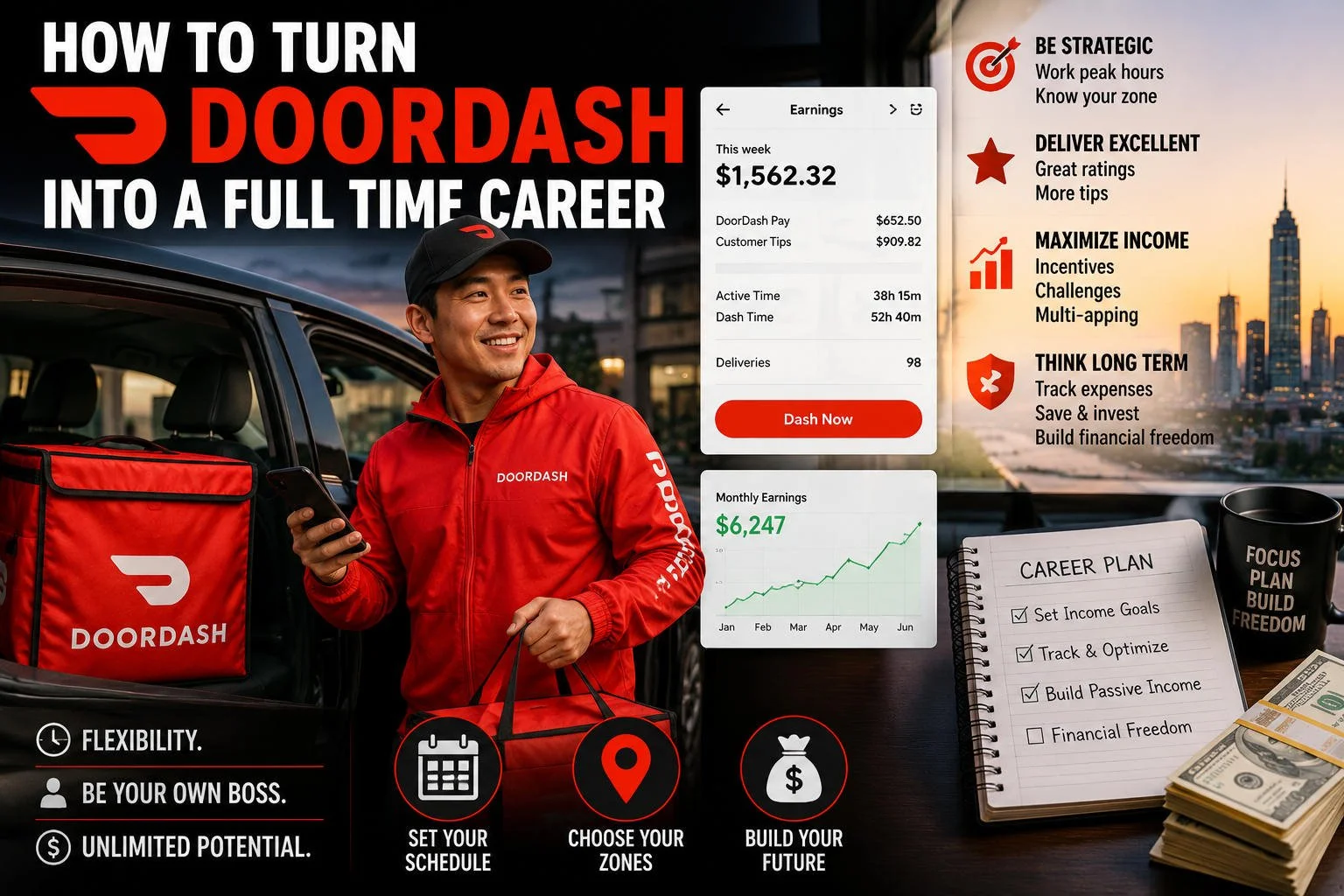
Turning DoorDash into a full-time career is possible in the same way living out of a van is possible: technically yes, but the difference between “freedom” and “what have I done” is planning, math, and whether your vehicle makes a new sound every Tuesday.
DoorDash is not a magic money button. It is not “be your own boss” in the inspirational Instagram sense, where the boss drinks iced coffee and stares at sunsets. It is “be your own boss” in the deeply annoying sense, where the boss is you, the employee is you, the accountant is you, the mechanic bill is yours, and the HR department is a granola bar in the glove box.
DoorDash can become full-time income, but only if you stop thinking like a casual driver and start thinking like a small delivery business with a phone mount.
First: DoorDash Full-Time Is Not the Normal Dasher Experience
Most Dashers are not out there grinding 45 hours a week like food-delivery monks. DoorDash’s 2025 U.S. impact report says more than 8 million people dashed in the U.S. in 2025, but in Q4 the average Dasher spent about 4 hours per week on delivery, and the typical Dasher was active for about 10 weeks during the year. In other words, the platform is mostly built around part-time flexibility, not everyone becoming a full-time burrito courier with lumbar problems.
So if you want to make DoorDash full-time, understand what you’re doing: you are not just “dashing more.” You are using a part-time-flexibility platform as your main income system. That means the casual-driver mindset has to die immediately, preferably in a parking lot behind a Chipotle.
The Basic Requirements Are Easy. The Business Is Not.
DoorDash says Dashers in the U.S. and Canada generally need to be at least 18, have an iPhone or Android smartphone, and complete the sign-up process; some states have higher age requirements, like California requiring new applicants to be 21. Depending on location, Dashers may use cars, motorcycles, scooters, bikes, or e-bikes.
That is the easy part. The hard part is everything after approval: choosing profitable orders, managing slow hours, tracking miles, avoiding bad zones, handling taxes, maintaining your car, protecting your ratings, and not developing a personal feud with every restaurant that says “five more minutes” while the food is clearly still being conceived.
The barrier to entry is low. The barrier to making it sustainable is math. Tragically, the math has no sympathy for your hustle playlist.
Gross Pay Is Not Your Pay. It Is a Lie Wearing Sneakers.
This is the most important rule: gross earnings are not income.
DoorDash might show you $180 for a day. Lovely. Inspirational. Screenshot-worthy if you enjoy misleading yourself. But that number comes before gas, maintenance, tires, brakes, oil, car depreciation, insurance, phone costs, taxes, dead miles, and the emotional cost of waiting 14 minutes for bubble tea while your acceptance screen mocks you.
Gridwise reported that in 2025, based on data from 115,771 DoorDash drivers, median gross pay was $11.63 per hour when including all earnings sources, before expenses. It also found top 10% gross pay at $16.33 per hour, again before expenses.
That does not mean your market cannot do better. Some drivers in strong markets, efficient vehicles, dense zones, and peak hours can beat those numbers. But it does mean anyone promising “easy $30 an hour full-time” should be handled like gas station sushi: with suspicion and distance.
Your Real Hourly Rate Is the Only Number That Matters
Use this formula:
Net hourly = gross earnings minus expenses, divided by total time worked.
Not just active time. Not just delivery time. Total time. The time you sat in a parking lot. The time you drove back from a dead zone. The time you waited at Buffalo Wild Wings while six staff members avoided eye contact like you were serving legal papers.
DoorDash’s Earn by Time mode pays based on active time, which begins when you accept an offer and ends when you drop it off or the order is canceled. DoorDash is very clear that active time is only part of dash time, and idle time is the time you spend waiting for an offer.
That distinction is everything. Your landlord does not accept “active time dollars.” Your car payment does not care that you were technically online. Track total hours like an adult, because your calendar is where reality keeps receipts.
Learn the Two Pay Modes Before They Learn You
DoorDash pay has three major components: base pay, customer tips, and promotions. DoorDash says base pay in Earn per Offer generally ranges from $2 to $10+ depending on estimated time, distance, and desirability, and that Dashers receive 100% of tips on top of base pay and promotions.
Earn per Offer is the classic mode: see the offer, judge the pay, distance, restaurant, destination, and likely time, then accept or decline.
Earn by Time pays a guaranteed active hourly rate from acceptance to drop-off, plus tips and applicable promos, but DoorDash says tips may be less frequent in that mode and that Dashers can decline or unassign only up to one offer per hour before the Earn by Time dash ends.
The full-time strategy is not “one mode is always best.” That is YouTube comment-section thinking, and it belongs in a drawer with broken chargers.
Earn per Offer can be better when you know your market and can identify profitable orders. Earn by Time can make sense when restaurants are slow, traffic is ugly, or your market has lots of long waits. Test both. Track both. Believe your spreadsheet, not the guy in the Dasher Facebook group who says he makes $400 a day but somehow never posts mileage.
Build Your Schedule Around Demand, Not Motivation
A full-time DoorDash career does not mean working whenever you “feel like it.” It means working when customers are ordering and tips are worth chasing.
DoorDash’s own scheduling guide says meal rushes are the obvious windows: lunch from 11 a.m. to 2 p.m. and dinner from 4:30 p.m. to 8 p.m. DoorDash’s 2025 Dash Report also says 5 p.m. to 9 p.m. was the busiest time of day for Dashers in 2024.
That means your full-time schedule probably looks ugly:
Lunch rush.
Break.
Dinner rush.
Maybe late-night on weekends.
Maybe breakfast in office-heavy zones.
Maybe Shop & Deliver during slower afternoons.
Not glamorous. Very effective. Full-time DoorDash is less “I work when I want” and more “I work when everyone else suddenly needs tacos.”
Schedule Your Dashes Like a Person Who Enjoys Paying Rent
Do not rely on Dash Now if your market is crowded. DoorDash says Dash Now availability depends on the number of Dashers currently in your area, and if scheduling times are unavailable, there are likely enough Dashers on the road for that area and time.
So schedule ahead.
Build a weekly calendar.
Protect peak hours.
Try multiple zones.
Track which zones perform best by hour.
Stop chasing red zones like a moth with a car loan.
A hot zone does not automatically mean profit. Sometimes it means six Dashers are already circling the same McDonald’s like vultures in Toyota Corollas.
Treat Your Car Like Your Coworker, Not Your Disposable Mule
If you use a car, your car is not transportation. It is your main business asset. If it dies, your career becomes “person standing near a dead Kia holding a thermal bag.”
DoorDash says Dashers must maintain their own primary auto insurance, and DoorDash’s coverage may not apply if you fail to maintain required insurance. DoorDash also says many personal policies may not cover vehicle damage during deliveries, and drivers should check with their insurer about delivery or business-use coverage.
DoorDash provides certain third-party liability coverage while in active delivery status, but it notes that damage to the Dasher’s own vehicle is the Dasher’s responsibility and should be handled by their own auto insurance carrier.
Translation: do not discover your insurance gap after someone redesigns your bumper at an intersection.
Get maintenance on schedule. Track oil changes, brakes, tires, battery, suspension, and mileage. If your vehicle gets 14 miles per gallon and makes a sound like a haunted washing machine, congratulations, your profit margin is already dead.
Track Mileage Like the IRS Is Hiding in the Back Seat
In 2026, the IRS standard mileage rate for business use is 72.5 cents per mile. That is a tax deduction rate, not a magical reimbursement from the sky, but it tells you something important: miles are expensive. Every “it’s only six miles” order is really a little vehicle-cost goblin chewing on your future.
Track miles from day one. Use an app, a notebook, or whatever system you will actually maintain. “I’ll remember later” is how tax season becomes a horror movie with receipts.
DoorDash says it sends mileage estimate emails by January 31 to U.S. and Canada Dashers who dashed by car and had on-delivery mileage, but do not make that your whole system. It is an estimate, not your personal accountant arriving on a white horse with brake-pad deductions.
Taxes Are Not Optional, Because Apparently Civilization Insists
Dashers are independent contractors. DoorDash says Dashers who earn $600 or more on the platform during the year receive a 1099-NEC. The IRS says gig economy income is taxable even if it is part-time, temporary, paid in cash, or not reported on a 1099.
The IRS also says self-employed individuals generally file an annual income tax return and pay estimated taxes quarterly. Self-employed people usually owe income tax plus self-employment tax, which covers Social Security and Medicare.
Set aside money for taxes every week. Not “later.” Not “after I buy tires.” Not “April Me will figure it out.” April You is an idiot who will be betrayed by January You.
A common practical move is setting aside 20% to 30% of net profit, depending on your state, income, deductions, and other earnings. A tax professional can help you get the number right. Yes, a tax professional costs money. So does being wrong with the IRS, and at least the accountant does not send letters with government fonts.
Stop Accepting Orders Like a Golden Retriever With a Phone
Full-time DoorDash requires order discipline.
Do not judge offers only by total pay. Judge:
Pay per mile.
Pay per estimated minute.
Restaurant reliability.
Pickup wait risk.
Drop-off location.
Parking.
Apartment complexity.
Whether the order drags you into a dead zone.
Whether it is stacked with garbage.
Whether the tip looks real or the offer is wearing clown shoes.
A $12 order can be terrible if it takes 50 minutes and dumps you 14 miles from civilization. A $7 order can be good if it takes 12 minutes and keeps you in the zone. This is not vibes. This is logistics with fries.
DoorDash Rewards can complicate this because Acceptance Rate, Completion Rate, Customer Rating, and delivery count can affect access to certain perks in some markets. DoorDash says requirements vary by area and may include rewards like priority access to high-paying orders, Dash Now access, advanced scheduling, VIP support, and large-order access.
So no, “decline everything” is not always smart. “Accept everything” is also not smart. The full-time driver’s job is to find the profitable middle without turning into a ratings hostage.
Use Promotions, But Do Not Worship Them
DoorDash promotions can include Peak Pay, Challenges, Delivery Streaks, Bonus Boost, Platinum Pay Promo, and Distance Pay. DoorDash says promotions vary by location, time of day, new-driver status, and other factors.
Promos are useful. They are not a retirement plan.
Peak Pay can help, but it also attracts drivers. A $3 Peak Pay zone with too many Dashers can become a parking-lot convention for people staring at silent phones. Challenges can be good, unless you accept terrible orders just to finish them and accidentally convert your car into a charity with cupholders.
Use promos as bonuses. Build your base strategy without them. If your business only works when DoorDash sprinkles promotional fairy dust over the map, your business does not work.
Learn Restaurants Like a Local Intelligence Agency
Full-time DoorDash drivers know restaurants the way fishermen know tides.
You need a restaurant blacklist, a restaurant gold list, and a “only during slow hours” list.
Good restaurants have:
Fast prep.
Clear pickup shelves.
Reliable packaging.
Easy parking.
Staff who do not treat Dashers like loose raccoons.
Bad restaurants have:
Mystery waits.
Bad parking.
Crowded lobbies.
Missing items.
Leaky drinks.
Staff who say “it’s coming out now” while the order has clearly not begun its journey through matter.
Track restaurant performance. If a restaurant burns you three times, stop pretending the fourth trip will be character development.
Master Apartments, Hotels, Hospitals, and Offices
A huge part of full-time delivery profit is not driving. It is not getting trapped in buildings designed by people who hate delivery workers.
Keep notes when allowed and appropriate:
Which apartments have gate codes.
Where visitor parking is.
Which hospitals require lobby drop-off.
Which hotels use valet.
Which office buildings have impossible elevators.
Which campuses are a walking tour disguised as delivery.
A five-minute delivery can become 18 minutes because the customer wrote “leave at door” and then failed to mention they live in Unit 4B behind three locked doors, a courtyard, and a small emotional maze.
Delivery skill is not just driving. It is navigation, communication, pattern recognition, and the ability to remain polite while someone texts “where are you?” from inside a building with no numbers.
Invest in Cheap Gear That Saves Time
You do not need to turn your car into a NASA delivery module. But a few items help:
Phone mount.
Car charger.
Insulated catering bag.
Pizza bag.
Drink carrier.
Flashlight.
Rain jacket.
Pen.
Wipes.
Hand sanitizer.
Small towel.
Portable battery.
Dash camera, if useful and legal in your area.
Comfortable shoes.
A full-time Dasher without a drink carrier is just volunteering for chaos. One spilled milkshake can turn a profitable hour into a sticky little Greek tragedy.
Build a Weekly Profit Dashboard
If you want this to be full-time, you need numbers.
Track weekly:
Gross earnings.
Total hours online.
Total active hours.
Total miles.
Fuel cost.
Maintenance reserve.
Insurance cost.
Parking/tolls.
Phone cost.
Tax reserve.
Net profit.
Net hourly.
Orders completed.
Average pay per order.
Average pay per mile.
Best zones.
Best hours.
Worst restaurants.
If this sounds boring, congratulations, you have discovered business. Every real career has paperwork. DoorDash just lets you do yours in a car that smells faintly of fries.
Full-Time Means Multi-Channel, Not DoorDash Worship
A full-time delivery career should not depend on one app behaving nicely forever. DoorDash can change pay, rewards, scheduling, zones, customer demand, and access rules. Your market can saturate. Restaurants can get slower. Gas can rise. Your car can implode in a way that sounds expensive.
Consider adding other income channels:
Uber Eats.
Grubhub.
Instacart.
Walmart Spark.
Amazon Flex.
Local courier work.
Catering delivery.
Medical courier work, if qualified.
Restaurant direct delivery.
Parcel delivery.
Your own local delivery relationships, if legally and operationally realistic.
Do not accept overlapping orders that make customers wait or violate platform rules. Multi-apping badly is how you get deactivated and become the tragic guy on Reddit typing “they got me for no reason” at 2:00 a.m.
Multi-apping correctly means using multiple platforms to reduce dead time, not creating a mobile hostage situation involving sushi, burritos, and a pharmacy order.
Protect Your Account Like It Is Your Paycheck, Because It Is
A full-time Dasher cannot treat ratings and contract violations casually.
DoorDash uses background checks before allowing new Dashers to access the platform and may rerun background checks under certain circumstances. DoorDash has also increased identity verification in recent years to address account sharing and safety concerns.
Keep your account clean.
Do not share it.
Do not use someone else’s.
Do not steal food.
Do not fake deliveries.
Do not be weird with customers.
Do not rage-text people because they live in a confusing apartment complex.
Do not drive like the order contains a donor heart unless it actually does, which it does not. It is pad thai.
Deactivation risk is business risk. Act accordingly.
Customer Service Matters More Than Your Ego
You do not need to be a butler. You do need to be professional.
Send short updates when useful:
“Waiting at restaurant; they said about 5 more minutes.”
“Traffic is heavy, but I’m on the way.”
“Dropped at front door. Have a good night.”
That is enough. Do not send a novel. Do not use 14 emojis. Do not flirt. Do not complain about the tip. Do not ask for a five-star rating like a desperate cruise director.
Good communication prevents bad ratings, reduces customer confusion, and makes you look like a person with a functioning frontal lobe. Rare. Valuable.
The Full-Time Weekly Schedule That Actually Makes Sense
A realistic full-time schedule might look like:
Monday: dinner only, because Monday lunch can be sad.
Tuesday: lunch and dinner.
Wednesday: lunch, dinner, maybe Shop & Deliver afternoon.
Thursday: lunch and dinner.
Friday: lunch, dinner, late-night.
Saturday: brunch/lunch, dinner, late-night.
Sunday: brunch, dinner.
That is not a prescription. It is a template. Your market decides.
Track every block for two weeks. If Tuesday lunch is garbage, stop working Tuesday lunch. If Sunday dinner prints money, be there. If late-night is all long drives, bad tips, and closed drive-thrus, leave it to people who enjoy suffering in LED headlights.
Make a Maintenance Reserve or Your Car Will Unionize
Every week, move money into a car fund.
Not optional.
Tires are coming.
Brakes are coming.
Oil changes are coming.
Suspension repairs are coming.
Battery replacement is coming.
Something weird involving a sensor you have never heard of is absolutely coming.
The IRS mileage rate exists partly because vehicles cost more than gas. Full-time delivery drivers who treat gas as their only expense are basically financial toddlers with hot bags.
Know When DoorDash Should Not Be Full-Time
DoorDash may not be a good full-time career if:
Your market is slow.
Your car is unreliable.
Your insurance won’t cover delivery use.
You cannot handle income swings.
You hate driving.
You hate waiting.
You cannot track expenses.
You need employer benefits.
You need predictable pay.
You are using a high-cost vehicle.
You are already underwater financially and cannot absorb repairs.
There is no shame in using DoorDash part-time. In fact, that is how most people use it. There is shame in pretending full-time delivery is freedom while your net pay quietly gets eaten by tires, taxes, and teriyaki wait times.
A 30-Day Plan to Test Full-Time DoorDash
Do not quit your job on day one unless your financial strategy is “panic, but mobile.”
For 30 days, test like this:
Work 15 to 25 hours per week around your existing schedule.
Track every mile and every hour.
Test at least three zones.
Test lunch, dinner, weekends, and late night.
Try Earn per Offer and Earn by Time.
Record net profit, not just gross.
Build your restaurant blacklist.
Calculate weekly taxes and vehicle reserve.
After 30 days, ask one question:
If I tripled this schedule, would the net profit support my life?
Not your fantasy life. Your actual life. Rent, food, insurance, taxes, repairs, debt, savings, and the occasional human pleasure not involving a drive-thru pickup shelf.
A 90-Day Plan to Go Serious
Days 1–30: test the market and build data.
Days 31–60: lock in your best schedule, add another app, improve gear, and start a separate tax/expense account.
Days 61–90: decide whether full-time is sustainable. Build an emergency fund. Get insurance sorted. Create a maintenance reserve. Refine your order filters. Explore catering, large orders, Shop & Deliver, and higher-value zones.
By day 90, DoorDash should look like a business with numbers, not a mood.
Final Verdict: DoorDash Can Be Full-Time, But Only If You Stop Romanticizing the Hustle
You can turn DoorDash into a full-time career, but not by driving randomly, accepting every order, ignoring taxes, and calling gross pay “income” like a financial raccoon.
To make it work, you need to operate like a small business:
Work peak demand.
Schedule ahead.
Track net profit.
Manage miles.
Protect your car.
Understand taxes.
Use promotions strategically.
Learn your restaurants.
Keep your ratings clean.
Avoid dead zones.
Build multiple income streams.
Save for repairs.
Know when the math says no.
DoorDash can be flexible. It can be useful. It can be a bridge, a side income, or, in the right market with the right discipline, a full-time grind.
But the app will not make you a career. You have to build the career around the app.
Otherwise, congratulations: you are not self-employed.
You are just depreciating your car for sandwiches.