What Bob’s Burgers Gets Right About Family Restaurants and Free Labor
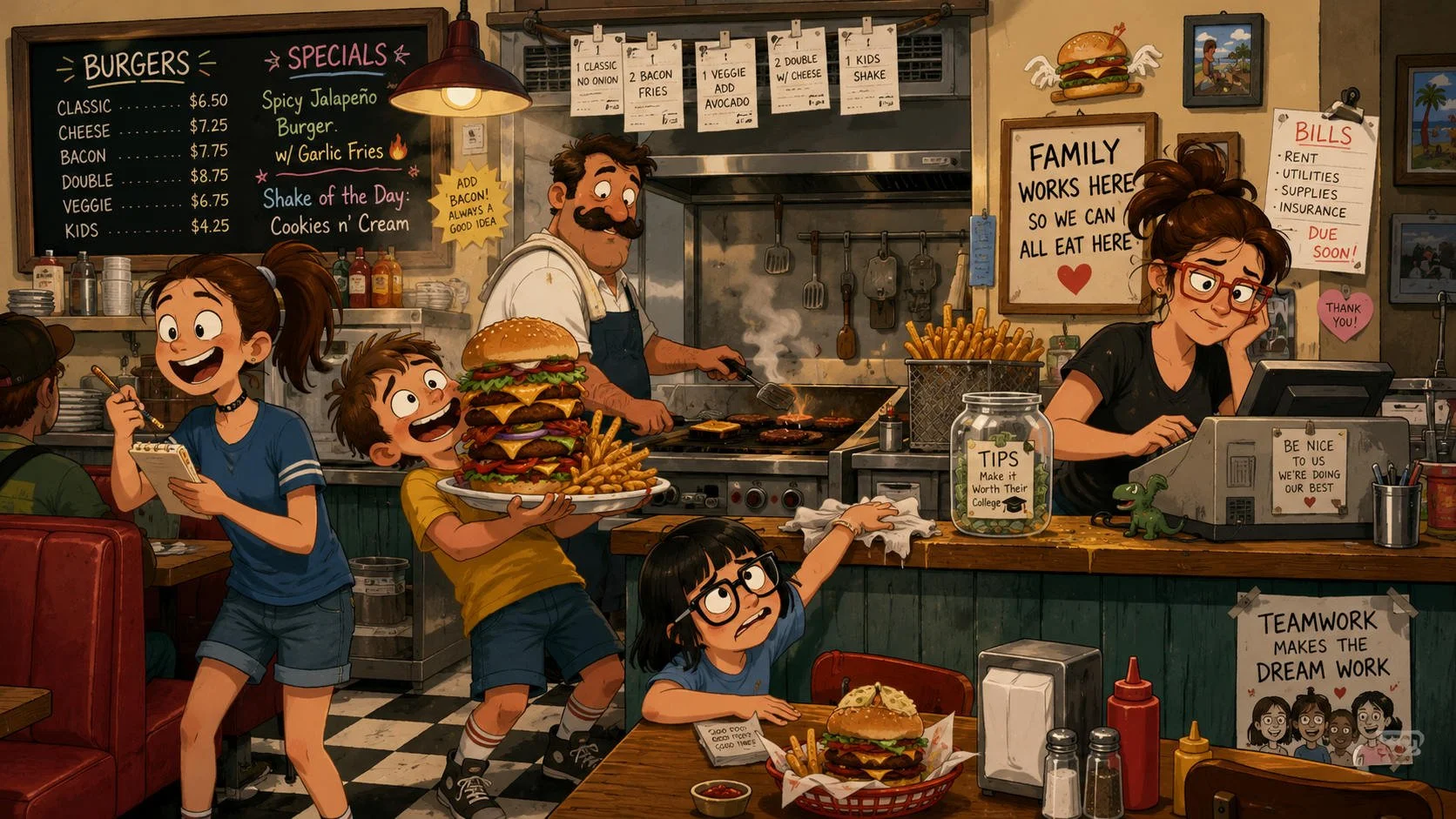
Bob’s Burgers is funny because the kids are weird. It is painfully accurate because the kids are working.
Tina, Gene, and Louise are not just comic relief with backpacks. They are also the restaurant’s emergency staffing plan, customer service department, cleaning crew, marketing liability, and occasional public-health threat in bunny ears. They are children, yes. They are also labor. Cheap labor. Incredibly questionable labor. Labor that can be paid in fries, parental guilt, and the promise that “we’re a family, so everyone helps.”
That is what Bob’s Burgers gets right about family restaurants: the line between “helping out” and “working a shift” is thinner than one of Bob’s profit margins.
Disney’s own description of the show says Bob runs the restaurant with Linda and their three kids, business is slow, Linda supports the dream but is tired of the slow times, and the restaurant is constantly in danger of going out of business. That is not just a sitcom premise. That is a small-business balance sheet wearing a mustache.
The Belcher Kids Are “Helping,” Which Is Family-Business Language for “Clock In, Tiny Person”
Family restaurants have a magical phrase: helping out.
It can mean wiping a table once. It can mean answering the phone. It can mean bussing dishes, working the register, restocking napkins, sweeping, seating customers, watching younger siblings, taking out trash, and standing in the restaurant so long that childhood becomes a booth near the soda machine.
In Bob’s Burgers, Tina, Gene, and Louise are constantly drifting between child and employee. One minute they are going to school. The next minute they are running food or harassing customers with the confidence of unpaid interns who cannot be fired because they live upstairs.
Salon’s restaurant-industry read of the show points directly at this: in “Bob Fires the Kids,” Bob lets Tina, Gene, and Louise go for the summer because they are “essentially unpaid employees,” then discovers he cannot afford replacement labor. Linda suggests an unpaid intern, because apparently the family restaurant labor model is one legal seminar away from becoming a haunted HR document.
Family Restaurants Run on Love, Guilt, and Labor Nobody Fully Counts
The show understands that family businesses do not run only on wages. They run on obligation. On “your father needs help.” On “just cover the lunch rush.” On “we all have to pitch in.” On “this is your future, maybe, unless you escape.”
That is why the Belcher kids feel real. They are not professional restaurant workers. They are children being absorbed into the family machine because the machine cannot afford adult employees and still pay rent. Tina works because she is old enough to be useful and anxious enough to comply. Gene works because he is physically present and occasionally holding a keyboard. Louise works because she understands power, loopholes, and extortion better than most consultants.
The joke is that they are terrible employees. The truth is that terrible family labor is still labor.
Bob Is Not Exploiting His Kids Like a Villain. That’s What Makes It Interesting.
The show is smart because Bob is not Mr. Burns with a spatula. He is not sitting in the basement cackling, “Yes, excellent, the children shall wipe menus for free.”
Bob loves his kids. He does not want them to have the same restaurant-childhood grind he had. “Bob Fires the Kids” works because Bob knows restaurant childhood can swallow a kid whole. He tries to give them a summer off, and the business immediately coughs up blood because it turns out three chaotic minors were part of the staffing model.
That is the ugly little family-business truth: exploitation does not always arrive wearing a cape and twirling a wage-theft mustache. Sometimes it arrives as love under pressure. Sometimes nobody is trying to be cruel. Sometimes the register is short, the lunch rush is coming, and your daughter already knows where the ketchup is.
The Restaurant Math Makes Free Labor Very Tempting
The Belchers’ dependence on family labor is not just a character joke. It is restaurant economics.
Before the pandemic, the National Restaurant Association said food and labor each took about 33 cents of every sales dollar for a typical independent restaurant, while utilities, occupancy, supplies, repairs, credit card fees, and other expenses took another 29 cents. That left roughly a 5% pre-tax profit margin. Five percent. That is not a cushion. That is a napkin under a collapsing table.
And the pressure has only gotten nastier. The Association’s 2026 report said 42% of restaurant operators reported their restaurants were not profitable in 2025, with rising costs and uneven traffic continuing to strain the business.
So when Bob cannot afford another employee, the show is not exaggerating for cartoon convenience. It is pointing at the horrifying math behind the counter: if paid labor eats a third of sales and your margins are already thinner than Jimmy Pesto’s self-awareness, unpaid family help starts looking less like a choice and more like survival cosplay.
“Unpaid Family Worker” Is a Real Category, Because Of Course It Is
The phrase sounds made up by a landlord, but it is real. The Bureau of Labor Statistics classifies people as employed in the Current Population Survey if they work without pay for at least 15 hours in a business or farm owned by a family member. BLS defines unpaid family workers as people who work without pay for a minimum of 15 hours during the survey week in a business or farm owned by a family member, while residing in the same household.
That is the statistical version. The family restaurant version is messier.
What if the kid works 10 hours? What if they only help after school? What if they wipe tables for years but nobody calls it work because “it’s family”? What if the labor is real but invisible because it is woven into dinner, homework, errands, and “just stand behind the counter for a second”?
Bob’s Burgers gets that invisible zone perfectly. The Belcher kids are not always “employees” in a formal sense. They are family. Which is exactly how the labor disappears.
The Law Is Weirdly Permissive When Parents Own the Business
Here comes the boring but important part, wearing sensible shoes and carrying a Department of Labor fact sheet.
Federal child labor rules generally allow youth of any age to work for businesses entirely owned by their parents, with major exceptions: children under 16 cannot work in mining or manufacturing, and no one under 18 can work in occupations declared hazardous. For restaurants generally, the Department of Labor says 14- and 15-year-olds can do certain jobs outside school hours, including cashiering, table service, bussing, cleanup, and limited kitchen work, but they face strict limits on hours and prohibited equipment.
So yes, the Belcher kids occupying the restaurant is not automatically some federal scandal, especially because Bob and Linda own the place. But “legal” and “healthy” are not twins. They are distant cousins who avoid each other at weddings.
A nine-year-old wiping tables because the family needs help is not the same as a teenager learning responsibility for a couple of hours. Context matters. Hours matter. Safety matters. School matters. Choice matters. Whether the child can say “no” without being treated like they personally foreclosed on the family dream matters.
Linda Is Also Free Labor, Just With Better Singing
The kids get the obvious laughs, but Linda is the more brutal example.
Linda is wife, mother, cashier, waitress, host, emotional support engine, morale department, chaos wrangler, occasional singer, and the person who makes the restaurant feel less like Bob’s sad beef cave. Her work is constant, and it is hard to separate what is “business labor” from what is “family labor,” because in the Belcher universe they are the same sticky countertop.
That is another thing the show nails. In family restaurants, the business does not end when the shift ends. There is no clean line between work and home when home is upstairs. Your marriage is in the restaurant. Your parenting is in the restaurant. Your dinner is in the restaurant. Your financial anxiety is on the grill, medium rare.
Linda is not just helping Bob chase his dream. She is subsidizing it with her time, personality, patience, and vocal cords.
The Upstairs Apartment Is the Whole Thesis
The Belchers living above the restaurant is not just convenient animation geography. It is the perfect symbol of family-business entrapment.
They do not go to work. They live on top of work. Work is downstairs, humming, waiting, needing something. That is why the children are always available. That is why Linda is always reachable. That is why Bob can never fully leave the restaurant mentally. The building itself is a labor trap with bedrooms.
Creator Loren Bouchard has talked about the Belchers’ little restaurant as a place that is “barely hanging on” but also strangely important to the town. That is exactly the emotional contradiction of small family restaurants: they can be fragile, broke, inefficient, beloved, and essential all at once.
Family Restaurants Also Become Childcare, Because America Is Very Normal
A family restaurant often becomes a childcare workaround with a fryer. The kids are there because where else are they supposed to be?
Restaurant work is notoriously hostile to normal childcare. Bon Appétit reported that restaurant shifts are long and variable, often running into prime evening hours, and noted that most day cares close around 5 p.m.; in one cited 2015 figure, only 8% of American childcare centers were open in the evening. The same article describes family restaurants sometimes functioning as a de facto childcare workaround.
Eater has reported similar problems, including restaurant shifts that can run late into the night and parents cobbling together care through family, neighbors, and informal arrangements.
So when Tina, Gene, and Louise are in the restaurant, it is not just because Bob and Linda need workers. It is also because the restaurant is where the family physically has to be. The kids are not visiting the workplace. The workplace is part of their childhood furniture.
The Show Gets the Ambivalence Right
The best part of Bob’s Burgers is that it does not treat the kids’ restaurant work as purely tragic or purely adorable. It is both.
The restaurant gives them responsibility. It gives them proximity to their parents. It gives them stories, weird skills, regular customers, and a sense that the family is a team. It also gives them obligations they did not choose, boredom, stress, and front-row seats to their parents’ financial panic.
That is the real family-restaurant bargain. Kids may learn work ethic, confidence, customer service, cooking, money, resilience, and how to read adults. They may also learn that love means being available for unpaid labor whenever the business needs saving.
Very wholesome. Very complicated. Very “please clean table four, your childhood can resume after lunch.”
Teddy Is a Customer, but the Kids Are Infrastructure
Teddy gets to be needy because he pays. The kids do not get that luxury.
A regular like Teddy is treated as part of the restaurant family, but he can leave. Tina, Gene, and Louise cannot. They live there. That difference is everything. Customers may feel like family. Actual family becomes staff.
That is why the show’s regulars are funny but the kids’ labor hits harder. Teddy hanging around is eccentric. Louise hanging around is staffing.
Bob’s Burgers Understands That “Family Business” Is Not Automatically Noble
People love romanticizing family restaurants. The little place. The family name. The old recipes. The kids growing up in the booths. The American dream with a grease trap.
And yes, sometimes it is beautiful. Family businesses can teach kids confidence, skill, pride, and belonging. Real families do this too: People reported in 2024 on a 10-year-old helping with her father’s Detroit family restaurant by shining silverware, weighing in on menu ideas, and helping when she did not have schoolwork. Her father framed it as work ethic and entrepreneurial learning.
That can be true. It can also be true that kids deserve boundaries, pay, safety, school, rest, and a childhood not entirely scheduled around whether the lunch rush needs bussing.
The fantasy says family labor is always love. The cynical take says it is always exploitation. Bob’s Burgers says, much more accurately: it is a sloppy burger-shaped pile of both.
What Real Family Restaurants Can Learn From the Belchers
The lesson is not “never let kids help.” That is silly. Kids can help. Kids can learn. Kids can feel proud of contributing.
The lesson is to stop pretending “family” magically makes labor disappear.
Set limits. Keep work age-appropriate. Keep kids away from dangerous equipment. Respect school, rest, and social time. Pay older kids when they are doing real shifts. Do not make the family business the child’s emotional debt. And do not call something a “lesson” when what you really mean is “we cannot afford payroll.”
The healthiest version of the family restaurant teaches kids how work works without making them responsible for whether the adults’ dream survives.
The Real Thing Bob’s Burgers Gets Right
Bob’s Burgers gets family restaurants right because it shows that small restaurants are not just businesses. They are ecosystems. Financial ecosystems. Emotional ecosystems. Childcare ecosystems. Labor ecosystems held together by ketchup bottles, unpaid hours, and somebody’s belief that the burger of the day might save everything.
The Belcher kids are funny because they are bad at work. They are poignant because they are working anyway.
Tina, Gene, and Louise are not just hanging around the restaurant because it makes good scenes. They are there because Bob and Linda need them, because childcare is hard, because staffing is expensive, because margins are brutal, because family businesses blur every boundary, and because in a struggling restaurant, everyone becomes part of the machine eventually.
That is the genius of the show. It makes you laugh at Louise avoiding work, Gene turning labor into a musical emergency, and Tina trying to provide customer service with the confidence of a haunted stapler.
Then it quietly reminds you that the only reason Bob’s Burgers stays open is because the whole family is working.
Not because the system is fair.
Because the rent is due.