
Third U.S. Carrier Group May Be Joining the Iran Fight as USS Gerald R. Ford Moves Closer
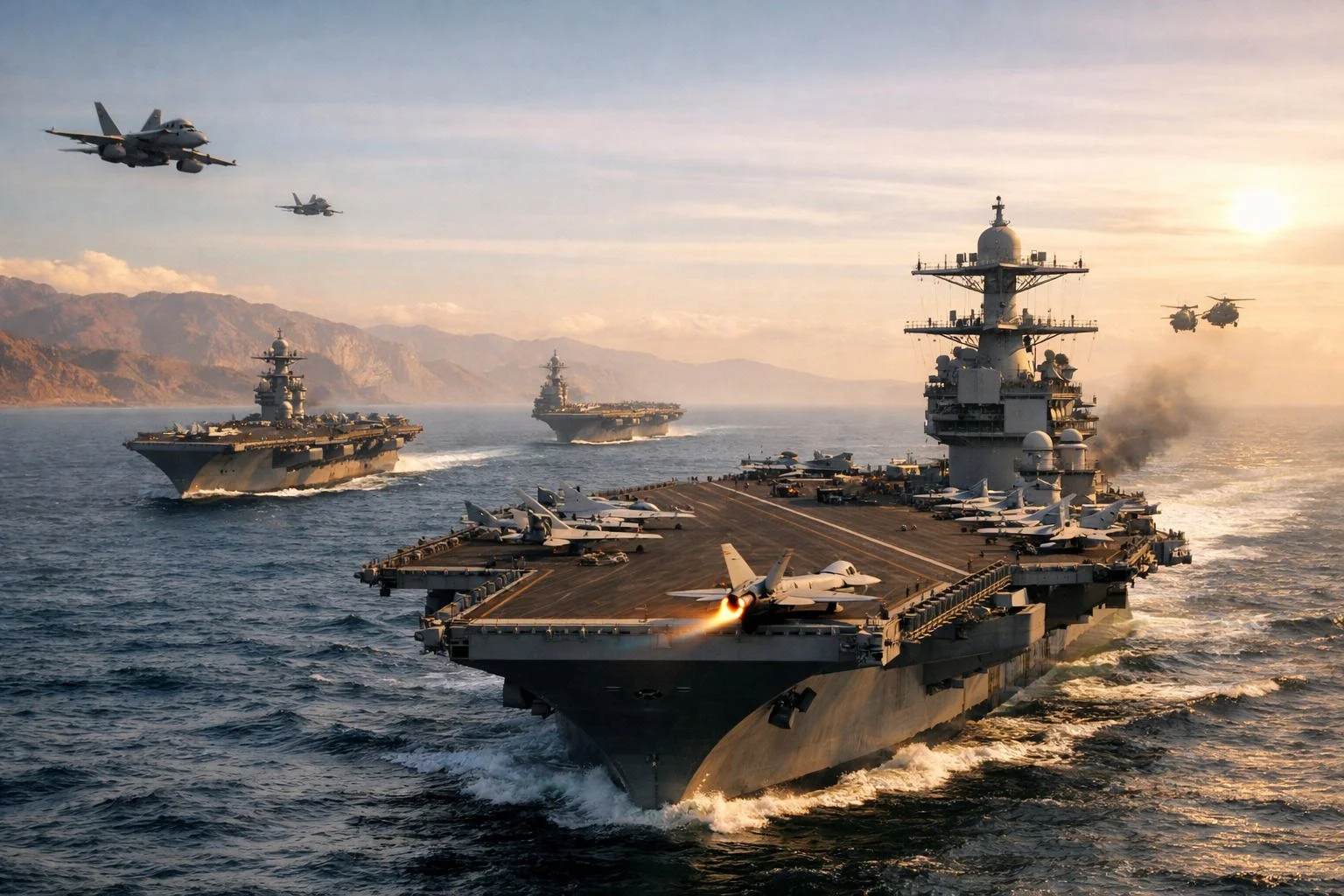
For anyone watching the map of the Middle East with a knot in their stomach, one fact now stands out more than any speech or headline: the sea around the war is getting crowded with carriers.
As of March 7, the USS Gerald R. Ford has moved from the eastern Mediterranean through the Suez Canal into the Red Sea, putting one of America’s largest and most capable warships closer to the core of the widening Iran conflict. At the same time, the USS Abraham Lincoln is already operating in the broader region, and public reporting suggests a third U.S. carrier strike group, likely led by the USS George H.W. Bush, may be preparing to deploy soon. The Ford’s move is confirmed by U.S. Navy imagery and reporting from USNI News; the third-carrier move, by contrast, appears to be reported but not yet formally announced by the Pentagon in a public statement.
That distinction matters. The Ford is not rumor. It is there. USNI reported that the carrier transited the Suez Canal on March 5 and is now operating in the Middle East, while Reuters-published Navy imagery showed the ship moving “en route to support” Operation Epic Fury. Public reporting also places the Lincoln in the Arabian Sea, meaning the United States already has two carrier strike groups positioned on either side of the Arabian Peninsula.
The possible third group is a different category of signal: not yet a fully public order, but a very loud hint that Washington may be preparing for a longer, larger, or more dangerous phase of this war. The USS George H.W. Bush Carrier Strike Group completed COMPTUEX, the final major integrated exercise that certifies a carrier group for deployment, on March 5. The U.S. Navy’s own release says the exercise is the certification event showing the strike group is ready for major combat operations around the world. USNI then reported that Bush is the “next aircraft carrier expected to deploy” from the United States. Separate media reports citing Fox News say the Bush could soon head across the Atlantic toward the theater.
In plain English, that means the Pentagon has one carrier inside the Red Sea, another already positioned in the region, and a third that now appears deployment-ready. That is not the posture of a crisis that decision-makers think is winding down. It is the posture of a military preparing for options: bigger strike packages, sustained air operations, deterrence against Iranian retaliation, coverage for multiple fronts, and insurance in case the war spreads further into Lebanon, the Gulf, the Red Sea, or beyond.
The timing is especially ominous because the naval buildup is happening while the political rhetoric is getting harsher, not softer. Reuters reported on March 7 that President Donald Trump said Iran would be “hit very hard” on Saturday and that he was considering widening the areas and groups of people being targeted. That kind of language, paired with additional carrier positioning, is exactly what markets, militaries, and regional governments read as a sign that the conflict may be entering a heavier operational phase rather than pausing for diplomacy.
The Ford’s move into the Red Sea matters for geography as much as firepower. The eastern Mediterranean gave Washington reach into the Levant and Iran’s western approaches. The Red Sea puts the carrier closer to the Bab el-Mandeb and the southern maritime approaches to the region, while also positioning it inside the wider battlespace where the Iran-aligned Houthis have attacked shipping and U.S. vessels in the past. USNI noted that Ford’s transit takes it into a part of CENTCOM’s theater where Houthi threats have remained a live concern for years.
That widens the significance of the move. This is not only about Iran in the narrow sense. It is about the entire connected war-zone architecture around Iran: the Gulf, the Red Sea, the Suez route, Israel, Lebanon, and the commercial shipping lanes that tie Europe to Asia. Reuters reported this week that the conflict has already disrupted maritime traffic, threatened the Suez and Red Sea corridors, and pushed governments like France to move additional naval power into the Mediterranean to protect economic interests and allied commitments.
France’s decision to redeploy the carrier Charles de Gaulle to the Mediterranean is another clue that this is no longer being treated as a contained bilateral clash. Reuters and the AP both reported that Paris is moving the ship to help secure maritime traffic and reinforce allied defenses as the conflict spreads across the region. When multiple major navies start repositioning capital ships at the same time, it suggests everyone is gaming out the same ugly possibility: that the next phase may be less about a burst of punishment and more about managing a sustained regional emergency.
There is also a more basic military reason to watch carriers. Carriers are not just floating symbols. They are mobile airfields, missile-defense nodes, command hubs, and political statements rolled into one. Reuters’ March 2 timeline of the opening U.S. operation said two carrier strike groups moved toward launching points before the first wave of strikes, which hit more than 1,000 targets in the first 24 hours and were followed by continued intercept operations against Iranian missiles and drones. That tells you the carriers are not being held back as abstract deterrents. They are woven directly into how this war is being fought.
That is why a third carrier report lands with such force. Even if the Bush is not yet under a publicly declared deployment order, its readiness changes the menu of choices available to Washington. It can relieve a stretched carrier. It can backfill another theater. It can deter opportunistic attacks by Iran-backed groups. It can let planners surge aircraft in a new wave while preserving defensive coverage elsewhere. Or it can simply exist as a threat hanging over Tehran and every militia commander trying to judge how far to push.
The context around Ford makes the picture even starker. According to USNI, the ship’s current extension is setting it up for an 11-month deployment, which Vice Chief of Naval Operations Adm. Jim Kilby told lawmakers would have downstream effects on maintenance and scheduling. In other words, the Navy is already bending its normal rhythm to keep this ship in the fight. Militaries do not casually do that unless leaders think the demand signal is serious.
And the war itself is already showing the signs of expansion that make carrier stacking look less like overkill and more like preparation. Reuters reported that Iran has apologized to Gulf states even as the war still spreads across the region, with cross-border attacks, civilian casualties, and infrastructure damage mounting. Another Reuters analysis warned that the dangers for the United States are multiplying as the conflict threatens to become more prolonged, more economically costly, and more unpredictable.
So what does this naval picture actually suggest?
First, it suggests Washington wants to retain escalation dominance at sea and in the air. Two carriers already provide formidable reach. A third would deepen redundancy and endurance.
Second, it suggests the White House and Pentagon are planning against the possibility that this war will not stay tidy. Iran still has missiles, drones, proxies, and geographic leverage. The Houthis can menace shipping. Hezbollah can heat up another front. Gulf infrastructure remains exposed. Carrier groups are one of the few tools that can move fast across all of those scenarios.
Third, it suggests allied governments are bracing for a conflict measured not just in airstrikes, but in weeks or months of regional instability. France does not move the Charles de Gaulle because everything looks under control. The United States does not keep Ford deployed deep into an already extended cruise because it expects an easy off-ramp.
That does not automatically mean a third U.S. carrier will definitely enter combat operations tomorrow. It does mean the board is being set for a much larger maritime war posture than many people expected just days ago. The confirmed facts are already alarming enough: Ford has moved into the Red Sea, Lincoln remains in the region, and Bush is now certified and publicly identified as the next likely deployer. The unconfirmed piece is only the final public order.
And that may be the most important takeaway. In fast-moving wars, the biggest shift often happens before the official sentence appears on a podium. It happens when ships start moving.