
What LeBron James Teaches Normal People About Protein
LeBron James is not a normal person. Let’s establish that before someone named Dylan from your gym starts eating six chicken breasts a day because he “studied LeBron.” LeBron is listed by the NBA at 6'9", 250 pounds, and 41 years old, while still putting up NBA production that would make most middle-aged men pull a hamstring reaching for the remote. He is not your coworker who bought creatine and now says “fuel” instead of “lunch.” He is a professional sports corporation with knees.
But that is exactly why he is useful. LeBron’s career is a giant neon sign that says: protein matters, but only as part of a bigger system. Not protein alone. Not protein powder as a religion. Not sad grilled chicken eaten over the sink while pretending joy is for weaker people. Protein works when it supports training, recovery, sleep, hydration, calories, carbohydrates, and consistency.
This is the normal-person lesson hiding inside the LeBron machine: you probably do need more intentional protein than you’re getting, especially if you train, want to maintain muscle, are aging, or keep calling a muffin “breakfast” like a legal defense. But you do not need to copy a 250-pound NBA legend’s intake like your Tuesday Pilates class is Game 7.
LeBron’s Real Protein Lesson: Recovery Is the Point
The best LeBron protein lesson is not “eat meat until your grocery bill starts crying.” It is that protein is part of recovery.
LeBron’s longtime trainer Mike Mancias told GQ that after hard practices or games, LeBron takes a protein recovery shake because his body is depleted and needs clean replacement calories, hydration, and recovery support. Mancias also described LeBron as eating about five times per day, with regular meals and snacks, including protein shakes around practice.
That is the key. Protein is not decoration. It is repair material.
When you train hard, lift weights, sprint, play basketball, run, cycle, or do anything more demanding than scrolling fitness TikTok while standing near dumbbells, your muscles need amino acids to repair and adapt. Protein does not magically build muscle while you sit perfectly still and argue with DoorDash. It supports the adaptation from training.
This is where normal people get stupid. They buy the shake, skip the workout, sleep five hours, eat like a gas station, then wonder where the gains are. Protein is not a magic wand. It is construction material. You still need to actually build the house.
He Also Teaches Us Not to Worship Diet Fads Like Tiny Food Cults
LeBron once did a famous low-carb stretch where he cut out sugar, dairy, and carbs for 67 days, eating foods like meat, fish, vegetables, and fruit. Men’s Health reported that phase as part of his weight-loss approach, but his trainer later described the Paleo-style experiment as a one-time trial, not his forever diet. Mancias specifically said he would not put LeBron on Paleo in-season because LeBron needs carbohydrates for all the minutes he plays.
That matters.
Normal people love turning athlete anecdotes into dumb permanent rules. LeBron cuts carbs once? Suddenly Todd from accounting thinks rice is poison because he played pickup basketball in 2018. Calm down, Todd. You are not defending Kevin Durant. You are defending your inbox from Outlook notifications.
The real lesson is that nutrition changes with the goal. LeBron adjusted when he wanted to lean out. He uses carbs when performance requires them. He uses protein for recovery. He does not seem to treat one diet as a sacred blood oath.
That is what normal people should copy: adapt the plan to the goal.
Trying to build muscle? Protein matters, calories matter, training matters.
Trying to lose fat? Protein helps preserve muscle and manage hunger, but calories still matter because biology remains irritatingly undefeated.
Training for endurance? Protein helps recovery, but carbs are still your friend, not a villain wearing bread shoes.
Aging and trying to keep muscle? Protein and resistance training become even more important, because your body eventually starts treating muscle like an optional subscription.
How Much Protein Do Normal People Actually Need?
Here is where we stop worshipping LeBron’s lunch and use math, that joyless little adult.
For sedentary adults, the basic Recommended Dietary Allowance is 0.8 grams of protein per kilogram of body weight per day. The American Heart Association gives the example that a 70 kg adult would need about 56 grams per day at that baseline.
That is not necessarily “optimal for getting jacked.” It is the basic amount to prevent deficiency in normal adults. In other words, it is the nutritional floor, not the VIP lounge.
Mayo Clinic Health System says people who regularly exercise often need about 1.1–1.5 g/kg, while people who lift weights or train for running or cycling events may need 1.2–1.7 g/kg. It also notes that once people reach their 40s and 50s, protein needs may increase to around 1.0–1.2 g/kg to help counter age-related muscle loss.
For serious athletes, the International Society of Sports Nutrition says 1.4–2.0 g/kg/day is a minimum recommended range for many training athletes, with higher amounts sometimes needed during calorie restriction to preserve lean mass.
So, for normal people, the useful range often looks like this:
A sedentary 165-pound person, about 75 kg, starts around 60g per day.
A regularly active 165-pound person may land around 83–113g per day.
A 165-pound person lifting hard or training seriously may land around 90–128g per day.
LeBron at 250 pounds, or about 113 kg, would be in a completely different universe. Using athlete ranges alone, he could plausibly need far more protein than the average person, and that is before considering NBA workload, total calories, recovery demands, and the fact that he is not living on a desk chair and three sad coffees. He is a professional athlete. You are a person trying not to become one with your office chair.
The Best LeBron-Inspired Rule: Eat Protein Throughout the Day
LeBron reportedly eats multiple times per day, with traditional meals and snacks, not one giant protein dump at night like a caveman with meal prep containers. Mancias said LeBron eats breakfast, lunch, dinner, and snacks between meals, including protein shakes around training.
This lines up with sports nutrition research. The International Society of Sports Nutrition suggests that 20–40g of high-quality protein per serving is a useful general target for stimulating muscle protein synthesis, with distribution across the day being helpful. It also notes that total protein and total calorie intake are the biggest factors, especially for non-athletes.
Normal translation: stop eating 8 grams at breakfast, 12 grams at lunch, and then trying to consume a steak the size of a car battery at dinner.
A better normal-person setup is:
Breakfast with 20–30g protein.
Lunch with 25–40g protein.
Dinner with 25–40g protein.
Optional snack with 10–25g protein, depending on your total target.
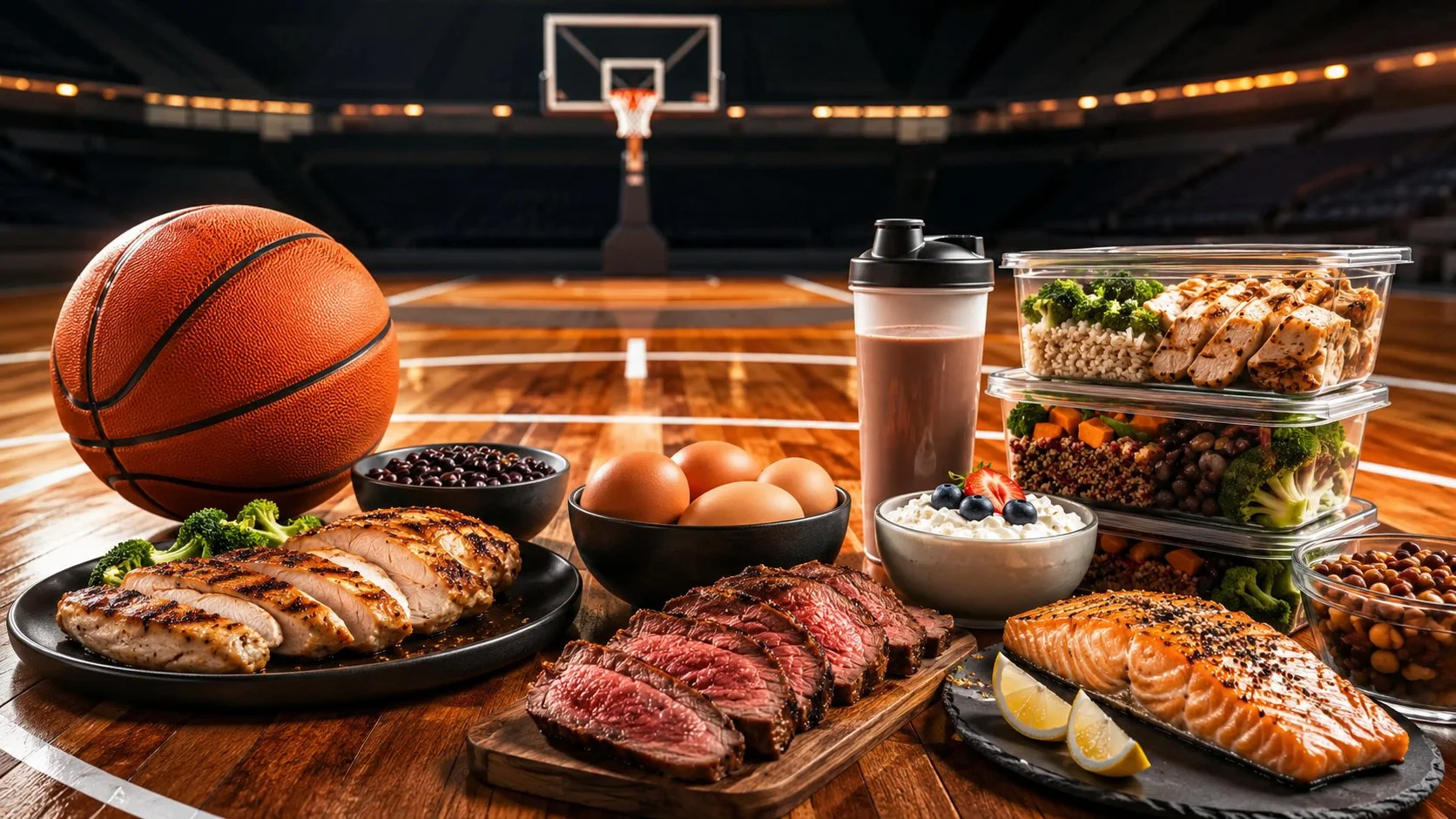
This does not require eating like a bodybuilder trapped in a chicken warehouse. It can be Greek yogurt and eggs. Tuna sandwich. Chicken bowl. Lentils and tofu. Cottage cheese. Turkey wrap. Salmon. Protein smoothie. Beans and rice with extra chicken. A high-protein fast-food order if life is currently attacking you with meetings.
The point is distribution. Protein works better as a daily rhythm than as one dramatic meat opera at 8:47 p.m.
Protein Shakes Are Tools, Not a Personality
LeBron uses recovery shakes. That does not mean every normal person needs to carry a shaker bottle like a tiny plastic trophy.
Protein shakes are useful when they solve a problem. If you train hard and cannot eat a full meal afterward, a shake helps. If you struggle to hit your protein target, a shake helps. If breakfast is usually “coffee and the emotional memory of a bagel,” a shake can help stop your morning from being a nutritional abandoned building.
But protein powder is not better than food by default. It is convenient. That is the whole trick. A protein shake is basically nutrition’s version of sending an email instead of writing a handwritten letter. Efficient, not magical.
Mayo Clinic notes that most people, including athletes, can meet protein needs with normal foods by including dairy, meat, beans, lentils, soy, or seafood, and that protein should be paired with fruits, vegetables, and whole grains rather than becoming the entire meal.
That is the normal-person upgrade: use shakes when helpful, but do not turn your kitchen into a supplement shrine. Protein powder on top of a bad diet is just expensive dust on a trash fire.
LeBron Also Teaches That Protein Needs Carbs Beside It
This is the part the low-carb zealots hate, so naturally it is important.
LeBron’s pre-game eating has included chicken breast, pasta, vegetables, fruit, and protein shakes. Men’s Health reported him saying that carbs help because he plays a lot of minutes.
For normal people, this is the anti-nonsense lesson: protein is not the only macro that matters.
If you lift weights, carbs help fuel training. If you run, carbs help. If you play sports, carbs help. If you are active and constantly under-eating carbs because a podcast goblin told you oatmeal is tyranny, your workouts may feel like dragging a refrigerator through mud.
Protein repairs. Carbs fuel. Fat supports hormones, satiety, and general “please don’t make every meal taste like cardboard” functioning. They all have jobs. This is not a reality show where one macro gets voted off the island.
The LeBron lesson is not “carbs bad.” It is “use nutrition for the task.” Low-carb may help some people reduce calories temporarily. It is not automatically the best choice for performance, and it is definitely not a sacred path to moral superiority. Rice did not personally betray you.
Aging Makes Protein More Important, Not Less
LeBron being productive at 41 is absurd. It is also a reminder that muscle preservation becomes more important as people age.
Mayo Clinic says muscle loss, or sarcopenia, begins to matter around ages 40–50, and that baseline protein needs may rise to about 1.0–1.2 g/kg to help maintain independence and quality of life.
This is where normal people should pay attention. You do not need LeBron’s life to need more intentional protein. You just need knees, bones, stairs, grocery bags, and the desire not to make a sound like a haunted door hinge every time you stand up.
Protein plus resistance training is one of the best normal-person investments. Not sexy. Not viral. Not sold in a neon tub by a man yelling “beast mode.” Just effective.
If you are in your 40s, 50s, 60s, or older, protein should not be an afterthought. It should show up at breakfast. It should show up at lunch. It should show up at dinner. Your muscles are not asking for a motivational quote. They are asking for amino acids and some resistance training that doesn’t look like carrying laundry once a week.
The LeBron Lesson Nobody Wants: Sleep Is Part of Protein
This sounds unrelated until you remember the body is not a collection of separate departments managed by tiny interns.
Fortune reported that LeBron emphasizes sleep as his most important recovery tool, with Mancias calling it the most important free recovery method. LeBron also uses a whole circus of recovery methods, but the point for normal people is painfully obvious: you cannot out-protein terrible sleep forever.
Protein supports recovery. Sleep is when a lot of recovery happens. If you are eating 140g protein but sleeping like a raccoon under a porch, your body is not exactly operating in championship mode.
This is where protein bros become exhausting. They will measure whey to the gram, then sleep five hours because they “grind.” Congratulations, your lifestyle is a poorly managed warehouse.
Normal people should take this LeBron lesson seriously: eat enough protein, train, hydrate, and sleep. Not because it sounds glamorous. Because it works, which is rude but convenient.
What Normal People Should Actually Copy From LeBron
Copy the consistency.
Not the exact calories.
Not the exact shakes.
Not the private chef.
Not the recovery chamber.
Not the NBA schedule.
Not whatever a billionaire athlete eats on game day.
Copy the boring structure.
LeBron’s trainer described him as regimented and consistent, with clean eating, planned meals, protein shakes around hard work, and occasional treats rather than constant food chaos.
That is the part normal people can use.
A normal LeBron-inspired protein day could look like this:
Breakfast: Greek yogurt, berries, and eggs.
Lunch: chicken, tofu, tuna, steak, shrimp, or beans in a bowl or wrap.
Snack: protein shake, cottage cheese, edamame, jerky, milk, or yogurt.
Dinner: lean protein plus carbs and vegetables.
That is not exciting. That is the point. Most useful nutrition is boring enough to survive Monday.
What Normal People Should Absolutely Not Copy
Do not copy LeBron’s intake gram-for-gram. He is 250 pounds and plays professional basketball. You answer emails and sometimes take the stairs when the elevator is “being weird.”
Do not copy temporary diet phases as if they are eternal commandments. His low-carb stretch was a tool for a specific goal, not a religion.
Do not assume protein shakes are mandatory. They are convenient, not holy.
Do not eat only protein. The American Heart Association warns that extra protein often comes from meats high in saturated fat and can displace foods many people already under-eat, like fruits and vegetables.
Do not use protein as permission to ignore calories. A 1,200-calorie “high-protein” fast-food meal is still 1,200 calories. Protein is useful. It is not a legal loophole.
Do not go extreme if you have kidney disease or a medical condition affecting protein needs. Talk to a clinician or dietitian, because your body is not a Reddit thread.
The Simple Protein Formula for Normal People
Here is the sane version.
Start with your body weight in kilograms. If you use pounds, divide by 2.2.
Use 0.8 g/kg if you are sedentary and just aiming for the basic minimum.
Use 1.1–1.5 g/kg if you exercise regularly.
Use 1.2–1.7 g/kg if you lift seriously or train for endurance.
Use 1.0–1.2 g/kg as a practical baseline if you are in midlife or older and trying to preserve muscle.
Then split that across meals instead of saving it all for one heroic dinner that looks like a medieval feast.
For example, a 180-pound person weighs about 82 kg.
Basic minimum: about 66g/day.
Regular exerciser range: about 90–123g/day.
Lifting or endurance range: about 98–139g/day.
That is much less ridiculous than “eat 250 grams because some shirtless man on the internet said so.” Your body needs protein. It does not need you to become a walking rotisserie.
The Best Protein Sources for People Who Don’t Have LeBron’s Chef
You do not need luxury foods. You need repeatable foods.
Good normal-person protein sources include eggs, Greek yogurt, cottage cheese, milk, chicken, turkey, lean beef, fish, shrimp, tofu, tempeh, edamame, lentils, beans, tuna, salmon, protein powder, and higher-protein breads or wraps if they fit your life.
The best protein source is the one you will actually eat consistently without turning into a miserable little meal-prep monk.
Chicken breast is useful.
Greek yogurt is useful.
Eggs are useful.
Lentils are useful.
Tuna is useful.
Protein shakes are useful.
A $9 “protein cookie” with 14 grams of protein and enough calories to power a leaf blower is less useful.
Not every food with protein branding is a good protein food. Peanut butter has protein, but it is mostly fat. Cheese has protein, but it often brings a lot of calories. Nuts have protein, but they are not lean protein. These foods are fine. They are just not protein cheat codes. They are calorie-dense little overachievers wearing health halos.
LeBron Teaches Protein Discipline, Not Protein Worship
LeBron James teaches normal people that protein matters because recovery matters. Muscle matters. Aging matters. Training matters. Consistency matters.
But he also teaches the opposite of what gym culture usually screams at you. Protein is not the entire system. It is one part of a system. LeBron’s long career is not built on one shake, one diet phase, one supplement, or one magical macro. It is built on training, recovery, sleep, hydration, smart fueling, body maintenance, and doing the boring stuff repeatedly while the rest of us are emotionally negotiating with a bagel.
For normal people, the lesson is simple: eat enough protein for your body and activity level, spread it across the day, pair it with real training, do not fear carbs when you need fuel, sleep like it matters, and stop treating protein powder like powdered immortality.
You do not need to eat like LeBron.
You need to steal the useful idea: protein supports the work.
Then actually do the work.
Annoying, yes. Effective, also yes.