The Korean Corn Dog Boom: The Viral Snack Lesson Most Food Businesses Are Missing
The Korean corn dog boom did not happen because someone put cheese on a stick and the internet lost its little collective mind.
Well, actually, yes. That did happen.
But that is not the full story.
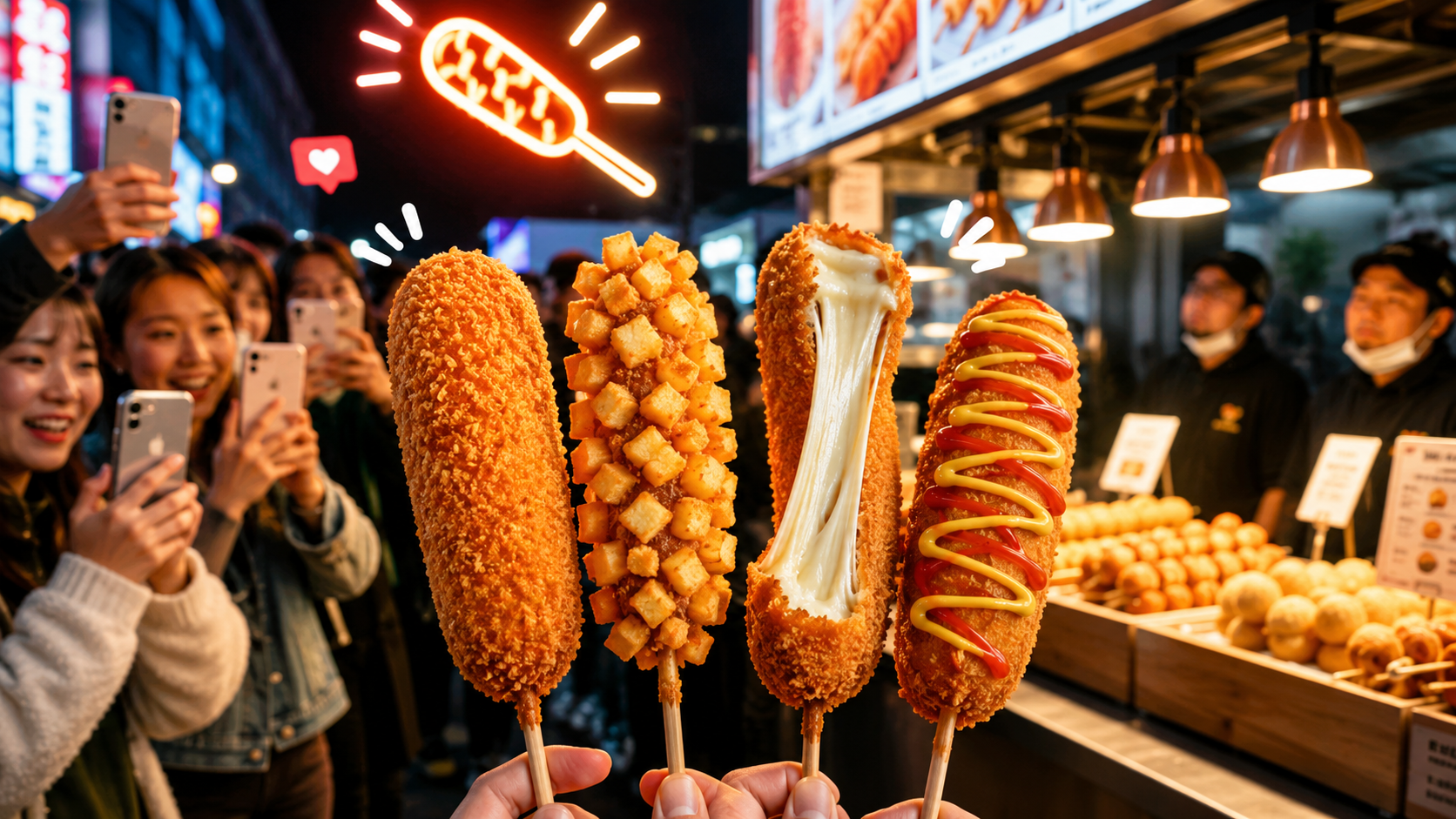
The mistake most food businesses make is looking at Korean corn dogs and seeing only the obvious stuff: the cheese pull, the Hot Cheetos dust, the potato cubes, the sugar sprinkle, the social media videos where mozzarella stretches across the screen like a dairy-based suspension bridge built by maniacs.
That is the flashy part. The circus tent. The part that makes TikTok users gasp like they have never seen melted cheese before, despite living in a civilization that has been emotionally dependent on pizza for decades.
But the real lesson is much more useful: Korean corn dogs became huge because they are easy to understand, fun to customize, visually dramatic, operationally focused, and low-risk for customers to try.
That is the part most restaurants miss while they’re busy adding one weird menu item and calling it “viral” like a dad who just discovered slang and now cannot be trusted near the specials board.
Korean Corn Dogs Were Built for the Internet Before the Internet Got to Them
A Korean corn dog is not just an American corn dog with a passport stamp. The classic Korean version uses a thick, chewy batter, usually with sausage inside, and is often finished with sugar plus sauces like ketchup and mustard. Korean versions also branch into potato coatings, mozzarella, cheddar, ramen crust, squid ink, rice cake, and other toppings that make the American county-fair corn dog look like it showed up to prom in khakis.
That variety matters. The Korean corn dog is not one item. It is a platform.
It has a base structure: stick, filling, batter, coating, fry, finish. Then it lets customers make small decisions that feel big. Sausage or mozzarella? Half cheese, half sausage? Potato crust? Crispy rice? Hot Cheetos? Sugar or no sugar? Sauce or no sauce?
This is menu design genius disguised as fried snack nonsense.
Customers love choice, but not too much choice. Give them 93 options and they freeze like a possum in headlights. Give them three or four simple decisions and they suddenly feel like the executive producer of lunch.
That is what Korean corn dog shops figured out. They made customization feel playful instead of exhausting.
The Boom Was Not Random. It Had a Machine Behind It.
The modern Korean corn dog wave is often credited to Myungrang Hot Dog, a chain that started near Busan in 2016 and grew to 650 stores in Korea within three years. Bon Appétit reported that Myungrang began expanding into the U.S. in 2018, and when it arrived in Los Angeles’s Koreatown the next year, the shop had to limit customers to five corn dogs each just to manage demand. Five. Imagine needing rationing rules for fried cheese sticks because the public has become ungovernable.
Then social media did what social media does: it found something stretchy, crunchy, colorful, and easy to film, and immediately began feeding it into the algorithm like coal into a Victorian nightmare engine.
But here is the business point: social media did not create the product’s appeal from nothing. It amplified a product that was already structured perfectly for sharing.
A Korean corn dog gives you the entire viral sequence in one item.
First, there is the visual choice at the counter.
Then the dramatic coating.
Then the fry.
Then the sugar.
Then the sauce drizzle.
Then the bite.
Then the cheese pull.
That is not food. That is a six-act play with mozzarella as the tragic hero.
The Real Product Was the Decision
Most restaurants think customers want the final item.
Wrong. Well, partly wrong. Congratulations, you are not completely useless.
Customers also want the decision. They want the little moment of choosing. They want to point at the menu and feel like they have discovered a personality. Korean corn dog shops turned ordering into a tiny game.
Two Hands Corn Dogs, for example, breaks the ordering experience into steps: choose a coating, choose a filling, choose a side, choose a drink. The chain lists options like classic, spicy, potato, injeolmi, crispy rice, half mozzarella and half sausage, full mozzarella, beef sausage, plant-based sausage, and more. That is not random menu sprawl. That is controlled customization.
This is the lesson a lot of food businesses somehow miss while standing directly in front of it with a clipboard.
The viral item is not just “Korean corn dog.”
The viral item is: I get to build a snack that looks different from my friend’s snack, but the restaurant can still execute it from the same basic prep system.
That is the golden zone.
Different enough for customers. Similar enough for operations. A miracle, basically, because restaurant operations usually treats creativity like a plumbing emergency.
The Best Viral Foods Are Familiar and Weird at the Same Time
A Korean corn dog works in the U.S. because people already understand the idea. It is fried food on a stick. Nobody needs a TED Talk. Nobody is standing there whispering, “But how do I interface with the stick?”
It is familiar.
But then comes the twist: chewy batter, mozzarella, potato cubes, ramen crust, sugar, spicy sauce, dramatic cheese pull.
That makes it weird enough to be exciting.
This is the balance every food business should be tattooing onto the inside of its eyelids: familiar format, novel execution.
Too familiar and nobody cares. That is just another chicken sandwich wearing a different hat.
Too weird and customers panic. That is when you get a menu item described as “fermented cloud foam with ancestral beet ash,” and everyone decides to order fries instead.
Korean corn dogs hit the sweet spot. They are recognizable enough to lower the risk and unusual enough to justify the visit.
The Menu Is Small, But It Feels Huge
A smart Korean corn dog menu does not need 47 items. It needs a few fillings, a few coatings, a few sauces, and some combo logic.
That is why the category scales so well. Circana reported in 2024 that Korean restaurant locations in the U.S. grew 10% in the prior year, and that five chains specializing in Korean corn dogs had reached 242 U.S. locations, up 52% from the previous year. The same report noted that these chains did not exist six years earlier. That is not a cute little niche. That is a snack format putting on steel-toed boots and marching across strip malls.
Two Hands says it has 68-plus locations and growing. Mochinut, another brand tied to the trend, presents Korean-style corndogs alongside mochi donuts and handcrafted drinks, basically creating a snack playground for people who want lunch, dessert, caffeine, and poor impulse control in one lease agreement.
That combination matters. Korean corn dogs often do not travel alone. They show up with boba, mochi donuts, slushes, fries, and other snackable menu items. This turns the shop into a “try a few things” destination instead of a single-product novelty trap.
And novelty traps are dangerous. Ask any restaurant that built its entire identity around one Instagram item and then watched the line disappear once everyone got their photo. A food business built only on “come see this weird thing once” is not a restaurant. It is a content booth with rent.
The Snack Is Portable, Shareable, and Not a Full Meal Commitment
Another underrated reason Korean corn dogs exploded: they are low commitment.
A customer does not have to sit down for a full Korean BBQ dinner. They do not need to understand banchan. They do not need to learn how to grill brisket without turning it into shoe leather. They can walk in, order a snack on a stick, take a photo, bite into it, and decide whether this is their new personality.
That matters for first-time diners.
A Korean corn dog is an entry point into Korean street food. It is approachable. It is fast. It is handheld. It is relatively affordable compared with a full restaurant meal. It is the culinary equivalent of saying, “Just try one episode,” and then suddenly someone has watched 19 hours of a K-drama and developed strong opinions about gochujang.
Food businesses should pay attention to that gateway effect.
Not every customer wants a full cultural deep dive on the first visit. Sometimes they want a crispy cheese stick with a potato jacket. Meet them there. Then give them a reason to come back.
The Cheese Pull Was Marketing, But Texture Was Retention
The cheese pull got people in the door.
Texture kept them interested.
That distinction matters. A lot of viral foods look great and eat terribly. They are architectural stunts. You take the photo, bite once, and realize you have purchased a prop with frosting.
Korean corn dogs avoid that when they are done well because the eating experience actually has contrast: crunchy crust, chewy batter, melty cheese, savory sausage, sugar, sauce, heat, salt, and sometimes crisp potato. Mochinut describes its Korean rice corn dogs as light, crispy, chewy, made-to-order, and customizable with fillings and toppings.
That is the important part: the item delivers after the camera leaves.
A food business cannot survive on spectacle alone. Spectacle brings the first visit. Texture, flavor, and consistency bring the second. If the product tastes like disappointment wrapped in confetti, congratulations, you have invented edible clickbait.
What Customers Should Order First
For a first Korean corn dog order, the smartest choice is usually half mozzarella and half sausage.
Full mozzarella gives the biggest cheese pull, yes, but it can also become a lot of melted dairy with no savory anchor. Full sausage is classic, but it misses the theatrical cheese moment that made everyone act like they personally discovered elasticity. Half and half is the best starter because it gives you both: the drama and the actual hot dog.
For coating, choose potato if you want the most satisfying crunch and the most “yes, I understand why this went viral” experience. Choose classic if you want to taste the batter and filling more clearly. Choose Hot Cheetos or spicy coatings if your favorite flavor profile is “snack aisle having a breakdown.”
Add sugar at least once. It sounds wrong until it works. Then you become one of those people saying, “No, trust me,” which is how all suspicious food habits begin.
Go easy on sauces the first time. Do not bury the thing. You are trying to taste the corn dog, not operate a condiment car wash.
What Food Businesses Should Actually Copy
Here is the lesson most food businesses are missing: do not copy the Korean corn dog. Copy the system.
Copy the way it balances familiar and new.
Copy the way the menu creates simple customer choices.
Copy the way one base product becomes many variations.
Copy the way the item creates a natural visual moment without requiring a marketing department to beg people to post it.
Copy the way it pairs with drinks and desserts.
Copy the way it functions as a snack, a side quest, and a group order.
Do not just slap mozzarella into something and assume the algorithm will come bless your fryer. The internet is dumb, yes, but not quite that dumb. Usually.
A viral food product needs three things: a clear decision, a satisfying reveal, and a reason to repeat.
Korean corn dogs have all three.
The Bigger Korean Food Wave Helped Too
The Korean corn dog boom did not happen in isolation. Korean food has been gaining serious momentum in the U.S., helped by Korean fried chicken, kimchi, Korean BBQ sauces, K-pop, K-dramas, and broader curiosity around Korean culture. Axios reported in 2025 that Korean food was surging in the U.S., citing Circana’s 10% growth number for Korean restaurants and pointing to corn dog cheese pulls as one of the viral street-food examples driving attention.
The National Restaurant Association’s 2025 trend coverage also pointed to customers wanting more adventurous flavor profiles, value, and wellness-minded choices, with kimchi and pickled vegetables among items expected to stay popular.
That bigger wave matters because a viral snack performs better when it is attached to a larger curiosity. Korean corn dogs were not just “random fried food.” They were part of a broader Korean food moment, which made them feel current, culturally connected, and easier for customers to justify.
People were not only buying a corn dog. They were buying access to a trend.
Yes, that sounds gross. Welcome to food marketing. Please take a number and enjoy your sauce drizzle.
The Korean Corn Dog Boom Was Not an Accident
The Korean corn dog boom is not just a story about cheese pulls. It is a lesson in menu design, snack psychology, cultural timing, and operational focus.
The product works because it is familiar but different. Cheap enough to try. Dramatic enough to film. Customizable enough to feel personal. Structured enough for restaurants to execute. Portable enough to eat anywhere. Flexible enough to pair with boba, mochi donuts, fries, and whatever other snack chaos the shop wants to sell.
Most food businesses look at the trend and think, “We need a viral item.”
No. You need a viral decision.
You need something customers can understand instantly, customize quickly, photograph naturally, enjoy sincerely, and reorder without feeling like they are repeating the exact same stunt.
That is the Korean corn dog lesson.
Not “put cheese in it.”
Not “make it spicy.”
Not “roll it in crushed chips and pray to TikTok.”
The lesson is to build a product that gives customers a tiny performance, a tiny choice, and a very obvious payoff.
The Korean corn dog did that with a stick, a fryer, a cheese pull, and enough toppings to make the American corn dog look like it retired in 1987 and now only talks about property taxes.
And that is why the boom worked.
Because the best viral food is not just food people want to watch.
It is food people want to order again after the video is over.