Luffy From One Piece Is the Ultimate Food Motivation Character
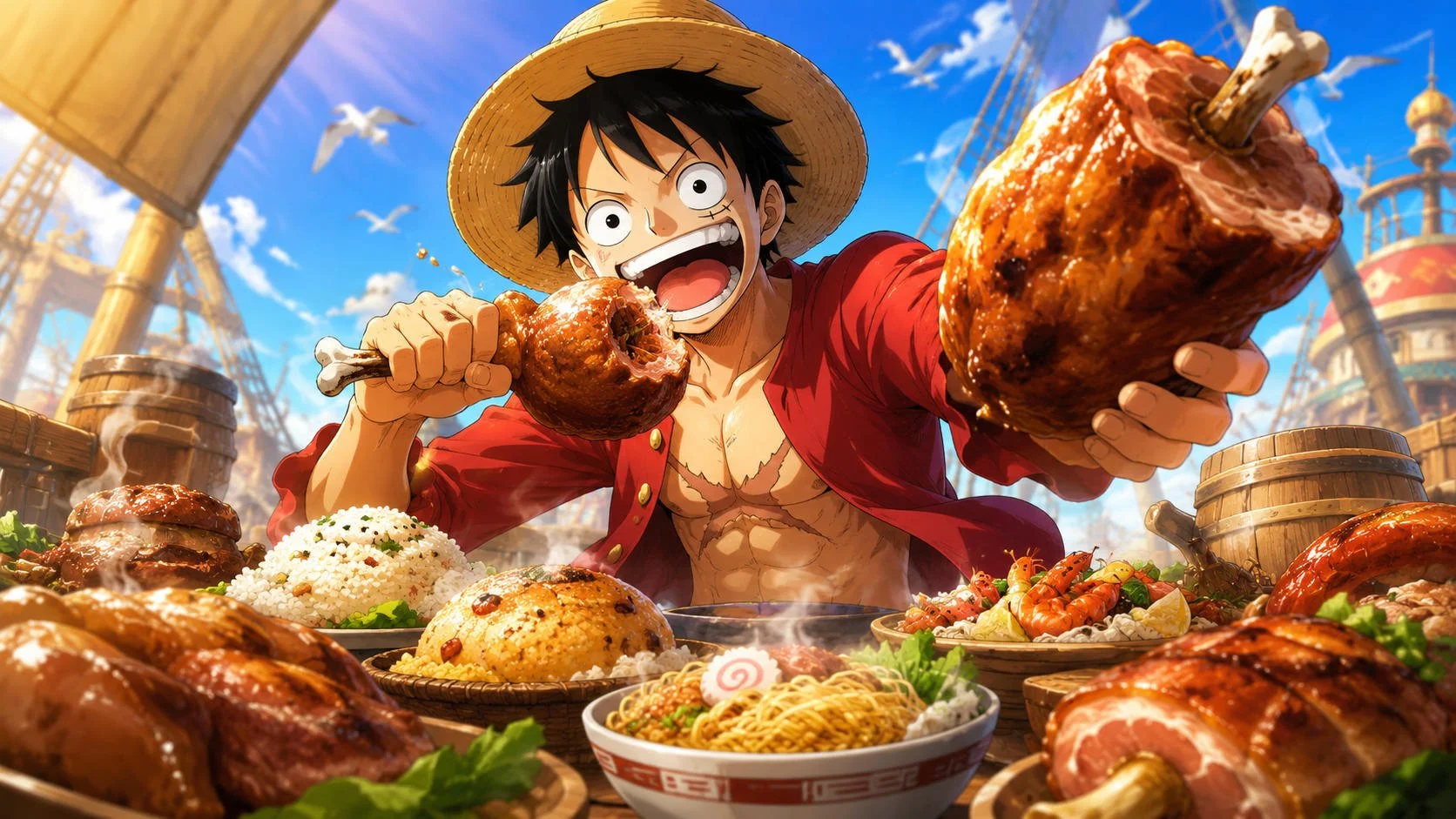
Some fictional characters inspire people to train harder, chase dreams, or become better versions of themselves. Monkey D. Luffy inspires all of that too, but he does it while chewing through a meat haunch the size of a toddler’s torso like nutrition labels were invented by cowards.
Luffy is not merely hungry. Hungry is what you are when lunch is late. Luffy is a walking appetite with a straw hat, rubber limbs, and the moral certainty of a raccoon breaking into a steakhouse. He does not “grab a bite.” He attacks food with the commitment of a man avenging a family tragedy against poultry. If most anime heroes eat after victory, Luffy eats before, during, after, and possibly inside the victory.
And somehow, this ridiculous meat-powered pirate is one of the best food motivation characters ever created.
Not because anyone should literally eat like him. Please do not model your meal plan after a rubber pirate whose metabolism seems to operate under Looney Tunes law. The point is not “consume three tables of meat and sprint into the ocean.” The point is that Luffy makes food feel like fuel for adventure, recovery after struggle, proof of friendship, and a reason to keep going when life has decided to become a cursed buffet of nonsense.
VIZ’s official One Piece page sums up the premise simply: Monkey D. Luffy and his crew are searching for the ultimate treasure, the One Piece, in Eiichiro Oda’s long-running pirate story. That sounds noble and mythic until you remember the captain’s other operating system is basically “dream big, punch tyrants, eat meat, repeat.”
Luffy’s Appetite Is Not a Joke. Fine, It Is a Joke, But It Works.
Luffy’s hunger is funny because it is absurd. The man eats like his stomach has shareholders demanding quarterly growth. He inhales food in piles. He treats meat on the bone like sacred scripture. He can go from near-death drama to “Where’s the food?” with the emotional range of a golden retriever who just heard a cheese wrapper.
But the joke works because it is tied to something deeper: Luffy wants to live. Loudly. Completely. With both hands full. He does not nibble at life like someone trying not to smudge lipstick at a networking brunch. He devours it.
That is what makes him motivational. Luffy’s appetite is a cartoon exaggeration of wanting things without apology. He wants freedom. He wants adventure. He wants to protect his crew. He wants to become King of the Pirates. He also wants food right now, and preferably enough of it to alarm livestock.
The official One Piece Film Red site describes Luffy as captain of the Straw Hat Pirates, a rubber-bodied fighter after eating the Gum-Gum Fruit, and someone whose dream is to become King of the Pirates. That dream is the serious part. The meat tornado is just the delivery system.
Food Is Luffy’s Fuel, Not His Personality Substitute
A lot of fictional food obsession is just a cheap gag. Character likes cake. Character screams about ramen. Character hoards snacks. Congratulations, give the writer a vending machine and a nap.
Luffy is different because food is connected to motion. He eats because he is about to do something ridiculous. He eats because he just did something ridiculous. He eats because the crew needs to recover from nearly being turned into decorative mulch by some villain with a cape, a trauma monologue, and too much confidence.
Food is not passive for Luffy. It is fuel.
This is where he becomes weirdly useful as motivation. A lot of people treat food like a courtroom drama. Every meal is evidence. Every craving is testimony. Every carb is cross-examined by some app with the emotional warmth of a tax audit. Luffy, meanwhile, treats food like energy for the next impossible thing.
That does not mean “eat recklessly.” It means food should help you do your life, not become a tiny moral prison with salad bars.
Luffy’s version of food motivation is simple: you need energy to chase big things. Not vibes. Not “hustle culture” quotes over a picture of a rented Lamborghini. Actual energy. Eat, move, fight, rest, laugh, keep going. It is basic. Naturally, modern adulthood has turned basic into a 12-week paid course with a downloadable PDF.
“You Can’t Become King of the Pirates on an Empty Stomach” Is Unreasonably Good Advice
The official VIZ shop page for One Piece: Pirate Recipes says the quiet part out loud: “You can’t become King of the Pirates on an empty stomach.” That book is a 96-page Sanji-themed cookbook, framed around hearty recipes that power the Straw Hat crew, which is honestly more useful than half the motivational books currently threatening airport bookstores.
That line is funny because it is true. Nobody does anything heroic while underfed, dehydrated, and pretending black coffee counts as breakfast. You are not “locked in.” You are one delayed email away from biting a coworker.
Luffy is the antidote to fake discipline culture. He does not starve himself into greatness. He eats, laughs, trains, gets stronger, gets knocked down, gets back up, and eats again. His ambition is not built on pretending the body is an inconvenient meat container attached to a dream board. He understands, in his feral little pirate bones, that bodies need fuel.
And yes, his version of fuel is frequently a cartoon roast the size of a fire hydrant. Again, do not be literal. Luffy lives in a world where people survive explosions, swim through plot logic, and name attacks like they are yelling sandwich orders into a hurricane.
The practical version is: eat enough to support what you are trying to do. Train? Eat. Work hard? Eat. Recover? Eat. Trying to function like a human instead of a haunted office chair? Eat.
Luffy Makes Eating Look Joyful Instead of Neurotic
One reason Luffy works as a food motivation character is that he has no food shame. None. Zero. The man has never stared at a plate and wondered whether it aligns with his “brand.” He has never described a meal as “naughty.” He has never said, “I’m being bad today,” because Luffy’s brain has not been poisoned by women’s magazine headlines from 2004.
He eats joyfully.
That joy matters because food culture is currently a deranged circus. One corner says eat nothing but meat. Another says meat is murder. Another says carbs are poison. Another says fruit is sugar. Another says seed oils are a global conspiracy. Another says the secret to health is a smoothie that tastes like lawn clippings and costs more than a phone bill. Humanity invented bread, then spent several thousand years building enough anxiety to fear it.
Luffy cuts through all of that with the subtlety of a cannonball. Food is good. Food is for living. Food is for celebrating. Food is for recovering. Food is for feeding friends. Food is for shouting over. Food is for making the next adventure possible.
It is not that he is “balanced” in the dietitian-approved sense. He is a fictional pirate, not a registered nutritionist with a sensible cardigan. But emotionally, he gets something right: eating should not feel like filing paperwork with your stomach.
Sanji Makes the Whole Thing Actually Work
Luffy may be the appetite, but Sanji is the infrastructure. Without Sanji, Luffy is just a rubber disaster wandering the sea looking for meat like a shipwrecked Labrador.
This is important because the Straw Hat dynamic turns food into care. Sanji cooks. The crew eats. The ship keeps moving. That is not just comic relief; it is community maintenance with knives and seasoning.
The VIZ description of One Piece: Pirate Recipes says Sanji supports Luffy with “flaming kicks and piping-hot meals,” and describes the recipes as hearty and filling enough to keep the crew well-fed. That is the food motivation sweet spot: food is not only personal fuel, it is how people take care of each other without making a big disgusting speech about “love languages.”
Sanji also gives Luffy’s hunger a moral frame. Luffy is not some isolated gym bro eating dry chicken out of a plastic box while mumbling about macros like a malfunctioning spreadsheet. He eats with his crew. He fights for people who are hungry. He understands, instinctively, that food belongs in the category of freedom, dignity, and survival.
In One Piece, feeding someone is rarely just feeding someone. It is rescue. It is loyalty. It is welcome. It is proof that people matter. Luffy’s appetite is funny, but the show’s larger food philosophy is surprisingly sincere: a person who is starving does not need a lecture. They need a meal.
Luffy Turns Recovery Into a Feast
A standard motivational hero recovers by staring at a sunset and whispering something about destiny. Luffy recovers by eating like the buffet personally insulted his mother.
Honestly? Better.
One of the most underrated parts of food motivation is recovery. People love the grind portion. They love the training montage. They love the sweaty, cinematic struggle. They are less interested in the part where you need to eat, sleep, and stop treating your body like a rental scooter.
Luffy makes recovery visible. After huge battles, food becomes part of getting back to life. Not a little protein bar consumed with the grim expression of someone paying a parking ticket. A feast. A ridiculous, loud, crew-filled, table-breaking feast.
That is psychologically useful. It reframes food as the reward for surviving hard things and the fuel for the next hard thing. You do not have to be a pirate to need that. You just have to be a person with a job, a body, a calendar, and a society that keeps inventing new ways to make lunch cost $18.
Luffy’s Motivation Is Simple Enough to Actually Use
Luffy is motivational because his desires are not buried under seventeen layers of fake sophistication. Netflix’s official Tudum character guide describes him as optimistic, driven by his dream, loyal to friends, and trusting his gut — which, in the same sentence, it notes is “constantly growling for a good meal.” That is probably the most Luffy sentence ever published by a major streaming platform.
He knows what he wants.
That is rare. A lot of characters spend entire seasons brooding over destiny like destiny is a complicated group project. Luffy points at the horizon, announces he will become King of the Pirates, and then asks what’s for dinner. His clarity is almost offensive. It makes every overthinking adult look like a broken printer trying to process a lunch order.
This is useful for food motivation because most people overcomplicate eating and goals at the same time. They want the perfect meal plan, perfect routine, perfect workout, perfect grocery list, perfect timing, perfect supplements, perfect app, perfect morning. Then they do nothing because perfection is a velvet couch for procrastination.
Luffy’s method is not perfect. It is direct.
Want the dream? Move. Need energy? Eat. Friends in trouble? Go. Hungry? Eat again. Get knocked down? Stand up. Still hungry? Obviously.
Do Not Eat Like Luffy Unless Your Digestive System Is Also Made of Rubber
Now for the boring adult portion, because someone has to say it before a man on Reddit tries “the Luffy diet” and wakes up inside a meat coma.
Do not eat literally like Luffy.
Luffy is a fictional rubber man from a manga universe where people can punch through buildings, survive absurd injuries, and emotionally process trauma by yelling attack names at authority figures. His appetite is symbolic, comedic, and narrative. Your appetite, tragically, exists in a world with cholesterol panels and pants.
The goal is not to eat mountains of meat. The goal is to steal the useful philosophy without committing digestive arson.
Eat with purpose. Eat enough. Enjoy food. Share meals. Stop treating every craving like a federal offense. Use food to support the life you claim you want. If you are training, fuel training. If you are exhausted, recover. If you are hosting friends, feed them. If you are on a long day, pack something better than a granola bar that tastes like compressed mulch.
That is the sane Luffy lesson. Big appetite for life. Reasonable relationship with actual portions. Your cardiologist does not need to become a Straw Hat.
Why Luffy Beats Other Food-Obsessed Anime Characters
Anime has plenty of hungry characters. Shonen heroes regularly eat like they are trying to win a forklift certification in chewing. But Luffy stands out because his hunger fits the entire story.
One Piece is about freedom, adventure, found family, injustice, loyalty, and chasing a dream so big it makes normal ambition look like a sad desk calendar. Luffy’s eating is not some random character quirk slapped on like a sticker that says “relatable.” It matches the scale of the world. Giant ocean, giant dream, giant enemies, giant appetite.
Guinness World Records notes that One Piece broke the record for the most copies published for the same comic book series by a single author, with the record confirmed again in 2022 after the series reached 500 million copies printed worldwide. A story does not become that massive because one guy likes meat, obviously. But Luffy’s appetite is part of why he feels so alive to readers and viewers: he wants everything at full volume.
That is the motivational difference. Other characters eat because it is funny. Luffy eats because he is built around appetite in every sense: appetite for food, freedom, friendship, danger, laughter, justice, and the next island. He is not a “foodie.” God, imagine Luffy saying “mouthfeel.” He is hunger as a heroic trait.
The Luffy Food Motivation Method
Here is the usable version, minus the ship, the bounty, and the possibility of being punched by a fish-man.
Eat before the adventure. That means stop starting hard days on fumes and vibes. Coffee is not breakfast; it is bean anxiety in a cup.
Eat after the fight. Recovery matters. A meal after effort is not weakness. It is maintenance, you dramatic little forklift.
Eat with your crew. Food is better when it connects people. Cook for friends. Share snacks. Accept that a good meal can fix group morale faster than any corporate team-building exercise, which is just adult detention with name tags.
Eat what makes you feel alive, not what makes you feel superior. Nobody likes the person who turns lunch into a TED Talk about discipline. That person should be marooned with unsalted crackers.
Keep the dream bigger than the meal. Luffy loves food, but food is not the whole mission. It powers the mission. That distinction matters, because otherwise “food motivation” becomes “I saw a sandwich and lost all ambition,” which is not exactly Pirate King behavior.
Luffy Makes Food Feel Like Freedom
The best thing about Luffy as a food motivation character is that he makes food feel connected to freedom. Not “freedom” as in eating whatever until your organs send a formal complaint. Freedom as in refusing to make food another tiny cage.
Food gives Luffy energy to chase the horizon. Food brings the crew together. Food marks safety after danger. Food is what you share when the fight is over and everyone is still alive, which is a pretty good reason to celebrate unless you are dead inside or work in wellness marketing.
He is not elegant. He is not mindful in the soft-spoken influencer sense. He is not weighing oats in a beige kitchen while telling you to “honor your hunger” in the voice of a sleep app. He is loud, messy, joyful, and absolutely committed to the next bite.
That is why it works.
Luffy’s food motivation is not about dieting. It is about appetite as proof of life. Want more. Move more. Laugh more. Feed your friends. Recover hard. Chase the impossible. Bring snacks.
Final Verdict: Luffy Is the Ultimate Food Motivation Character
Luffy from One Piece is the ultimate food motivation character because he understands, in the least subtle way imaginable, that big dreams need fuel. He makes eating look joyful instead of guilty, communal instead of lonely, and adventurous instead of neurotic. He turns meals into recovery, friendship, momentum, and celebration.
No, you should not eat like him literally. Unless your body is made of rubber and your doctor is a reindeer, please remain attached to reality.
But you can learn from him. Eat enough to support the life you want. Stop apologizing for having an appetite. Share food with people who matter. Treat meals as part of the journey, not an embarrassing interruption from it. And when life knocks you down, recover like someone who plans to get back up.
Preferably with something better than sad desk lettuce.
Luffy wants to become King of the Pirates. He also wants meat. Ridiculous? Yes. Effective? Unfortunately, also yes.
The man has cracked the motivational code: dream like a lunatic, fight like an idiot with conviction, and never try to conquer the Grand Line on an empty stomach.