How to Get Started as a Professional Eater, and Maybe Even Make a Living
Becoming a professional eater sounds like the easiest job on earth until you remember the “professional” part arrives right before the “eater” part, like a tiny legal disclaimer wearing mustard.
Everyone thinks they can eat. Congratulations. So can raccoons, toddlers, and Labrador retrievers with poor boundaries. Being a professional eater is different. It means turning eating into performance, competition, content, travel, branding, sponsorships, discipline, and stomach-based risk management. It is less “free lunch forever” and more “congratulations, your esophagus is now a business asset.”
And yes, people do make money doing it. But if your plan is “I will enter hot dog contests and become rich,” please also consider “I will find buried treasure under a Dave & Buster’s,” because the odds may be spiritually similar.
First, Pick Your Type of Professional Eater
“Professional eater” can mean a few different jobs, and confusing them is how people end up eating a 12-pound pancake for 800 views and a stomachache.
There are three main lanes.
The first is competitive eater: sanctioned contests, rankings, prize money, food records, travel, and events. Major League Eating ranks professional eaters and sanctions contests throughout the year, with Nathan’s Famous on July 4 functioning as the sport’s big glittering hot dog cathedral.
The second is food challenge creator: YouTube, TikTok, Instagram, restaurant challenges, giant meals, “can I finish this?” videos, food reviews, and content built around spectacle. This is where most people have a better shot at income, because the internet does not require you to beat Joey Chestnut. It only requires you to be watchable, consistent, and not make the audience feel like they are watching a medical incident with jump cuts.
The third is food personality: host, reviewer, livestreamer, event emcee, local food ambassador, brand partner, restaurant promoter, recipe chaos goblin, or “person who eats spicy noodles on camera and somehow has a mortgage.”
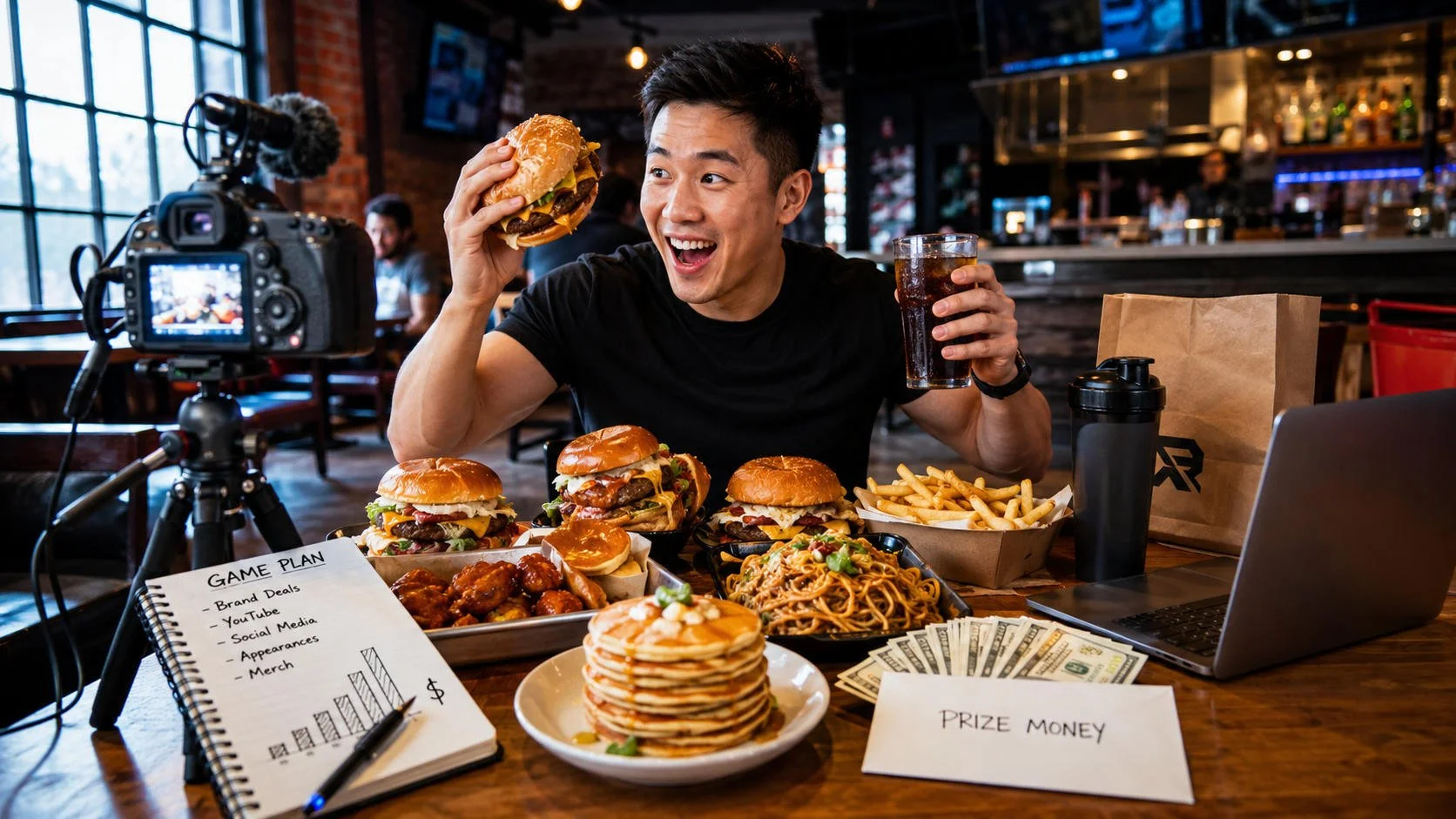
The smartest path is usually a hybrid: compete occasionally, create content constantly, build a brand, and monetize in multiple ways. Prize money alone is a wobbly little stool. Content, sponsorships, appearances, affiliate deals, merch, and local restaurant partnerships add the other legs.
Understand the Money Before You Turn Your Stomach Into a Startup
Competitive eating prize money exists, but it is not exactly NBA money unless the NBA has started paying players in gift cards and regional hot sauce exposure.
Contest purses vary. Some sanctioned competitions may offer a few thousand dollars in total prize money. Bigger events can offer more, but only the top finishers usually walk away with meaningful cash. Winning $2,500 for first place sounds great until you remember travel, hotels, missed work, taxes, and the cost of becoming a person known for eating bologna competitively all exist.
Nathan’s is bigger. In 2025, Joey Chestnut won his 17th Nathan’s title by eating 70.5 hot dogs and buns in 10 minutes, while Miki Sudo won her 11th women’s title with 33. Both winners earned $10,000.
That is real money. But if the biggest annual contest pays the winner $10,000, and you are not one of the greatest eaters alive, maybe do not tell your landlord you are transitioning into “mustard-based income.”
The Harsh Truth: Making a Living Usually Means Becoming a Media Business
Professional eaters who make real money are not just eating. They are selling attention.
Joey Chestnut is not merely a man who eats hot dogs. He is a brand, a media figure, an event draw, and a sponsorship platform. He has publicly discussed making significant income from competitive eating and related opportunities, but that level is rare. Very rare. Unicorn rare. “My stomach has an agent” rare.
That is the lesson. The money is not only in the eating. It is in the business around the eating.
A professional eater’s income can come from:
Contest winnings.
Appearance fees.
YouTube ads.
TikTok Creator Rewards.
Brand sponsorships.
Restaurant promotions.
Affiliate links.
Merch.
Livestream gifts.
Patreon or memberships.
Food festivals.
Local TV appearances.
Catering or event hosting.
Training commentary, not dangerous training instructions, because having a pulse is nice.
YouTube and TikTok both have monetization requirements, and those requirements can change. The broad point is simple: you need an audience before platforms pay you anything meaningful. You also need content that advertisers, restaurants, and brands do not look at and say, “Is this technically a cry for help?”
So yes, you can make money eating. But the job is also filming, editing, thumbnails, hooks, analytics, taxes, email, contracts, disclosures, posting, commenting, and pretending not to scream when a video flops after you spent $118 on tacos.
Start With Local Food Challenges, Not the Nathan’s Stage
Do not begin by declaring yourself the next hot dog king. That is adorable. Also, the sport already has apex predators, and they are not waiting politely for your digestive debut.
Start locally.
Find restaurants with food challenges: giant burgers, pizza walls of shame, ramen bowls, wing challenges, pancake stacks, taco records. Call ahead. Ask rules. Ask whether filming is allowed. Ask whether there is a waiver. Ask whether there is a prize, a free meal, a T-shirt, wall fame, or just the privilege of becoming a cautionary Yelp photo.
Then create content around it.
Your first goal is not to become world champion. Your first goal is to learn whether you can be entertaining while eating, whether you can handle pressure, whether you can finish safely, and whether strangers care.
Spoiler: eating a lot is not automatically entertaining. Watching someone silently shovel pasta into their face for 37 minutes has the cinematic appeal of a security camera in a cafeteria. You need personality, pacing, structure, commentary, editing, and stakes.
Join Real Contests Carefully
If you want the sanctioned competitive lane, apply to legitimate events. Major League Eating and similar organizers have rules, age requirements, selection processes, and liability language because competitive eating is not just “show up and inhale sausage in public.”
That means you cannot just appear at the table holding a fork and destiny. You apply. You get accepted or you do not. You qualify for certain events or you do not.
Nathan’s qualifiers are also controlled events. Registration does not always guarantee entry, and participants must usually be confirmed.
That is how to start properly: real events, real rules, real supervision. Not “my cousin timed me eating 44 nuggets in a basement and now I am basically an athlete.” Please no.
Safety Is Not Optional, Unless Your Career Goal Is “Emergency Room Cameo”
Competitive eating is dangerous. There. Annoying little sentence, but necessary.
Choking is one of the biggest risks, especially for ordinary people entering food contests without training, supervision, or any sense of self-preservation. Competitive speed eating can also carry risks involving vomiting, aspiration, gastrointestinal distress, reflux, dental issues, and possible long-term digestive complications.
Translation: this is not “free food with applause.” This is a risky performance activity involving your airway, stomach, and organs that did not consent to becoming props.
Before you seriously pursue this, talk to a doctor. If you have a history of eating disorders, gastrointestinal disease, heart problems, diabetes, swallowing problems, reflux, or any condition where “eat absurdly under pressure” sounds like a lawsuit against your organs, do not do this without medical guidance.
Also: do not practice dangerous methods at home. Do not water-load. Do not purge. Do not starve yourself before challenges. Do not eat non-food items. Do not do speed-eating stunts alone. Do not let TikTok design your medical future.
Build a Brand Before You Build a Stomach Legend
The world does not need another guy eating a giant burrito in silence under fluorescent lighting like a raccoon completing a prophecy.
You need a character.
Are you the funny local food challenger?
The small person with shocking capacity?
The polite destroyer?
The spicy food specialist?
The buffet strategist?
The athlete who treats it like sport?
The restaurant-review hybrid?
The budget challenge person?
The “I try food challenges so you don’t die in public” person?
A professional eater needs a hook. Joey Chestnut has dominance. Miki Sudo has championship history. Matt Stonie built massive YouTube appeal around fast, polished, high-energy food challenges. You need your own lane, not a cosplay version of someone else’s stomach résumé.
Your brand should answer one question: Why would someone watch you instead of the 9,000 other people eating burritos online?
If your answer is “because I eat a lot,” congratulations, you have described the table at Thanksgiving.
Film Everything Like It Is a Business
If you want to make a living, the camera matters as much as the plate.
Your content should show:
The restaurant.
The rules.
The food weight or item count.
The time limit.
The prize.
Your strategy.
The first bite.
The wall.
The finish or failure.
The aftermath, responsibly.
Your review of whether the challenge is worth trying.
That last part matters. The internet is full of spectacle. Useful spectacle wins longer.
Do not just eat the 5-pound burger. Explain the burger. Rate the burger. Talk to the owner. Show the kitchen if they allow it. Make the audience feel like they visited with you.
Also, thumbnails matter. Titles matter. Sound matters. Lighting matters. Captions matter. Editing matters. The algorithm does not reward your stomach because it is impressed by volume. The algorithm rewards retention, clicks, and consistency, because it is a tiny soulless casino in a server rack.
Make Content That Platforms Will Actually Monetize
Food challenge content can get risky if it looks dangerous, disgusting, self-harm-adjacent, or like it encourages harmful behavior.
Platforms often restrict or demonetize content that promotes self-harm, eating disorders, dangerous behavior, or shock content. That does not mean food challenges are banned. It means you should not build your brand around “watch me destroy my body until a sponsor gets nervous.”
Good format:
“I Tried a Famous 3-Pound Burrito Challenge at a Local Restaurant.”
Bad format:
“I Ate Until I Couldn’t Breathe, Gone Wrong, Ambulance?”
Congratulations, you discovered demonetization with sour cream.
Build your content around entertainment, food culture, restaurant stories, ratings, event coverage, and personality—not “watch me damage myself for clicks.”
The Sponsorship Game Is Where the Career Gets Real
The real money for professional eaters usually comes from brands, restaurants, and appearances.
Potential sponsors include:
Local restaurants.
Hot sauce companies.
Energy drinks, carefully, because caffeine plus eating contests is not a personality.
Food festivals.
Kitchen products.
Napkin or wipe brands, because of course.
Meal delivery brands.
Regional chains.
Sports bars.
County fairs.
Sauce companies.
Snack brands.
Tourism boards.
But you need credibility first. Sponsors want numbers, audience fit, reliability, and professionalism. They do not want a person who shows up late, eats like a crime scene, forgets to tag the brand, and then posts a blurry video with copyrighted music.
If you get free food, payment, affiliate commissions, or anything of value from a brand, disclose it. That is not optional. That is the part where the government politely reminds influencers that “I just love this sauce” hits differently when the sauce company paid you $750 and mailed you a hat.
Yes, disclosure is boring. So are taxes. Welcome to making money legally.
Build a Media Kit Before You Beg for Free Wings
A media kit is a one-page document that says, “I am a business, not just a guy with sauce on his shirt.”
Include:
Your name and handle.
Your niche.
Follower counts by platform.
Average views.
Audience demographics if available.
Best-performing videos.
Local market.
Past restaurant or brand partners.
Services offered.
Rates.
Contact email.
Clean photos.
Do not message a restaurant with “yo I eat a lot sponsor me.” That is not a pitch. That is a cry for free appetizers.
Better pitch:
“I create local food challenge videos averaging 25,000 views in the Midwest food scene. I’d like to feature your new wing challenge in a 60-second Reel and a longer YouTube video. I can include location tags, challenge details, and a call-to-action for viewers to try it. My rate is $X, or I can discuss a comped challenge plus a paid usage license if you want to repost the content.”
See? Adult. Horrifying, but effective.
Learn to Lose Without Becoming a Melted Nacho of Shame
You will fail challenges. Good.
Failure is content.
“Can I finish this impossible ramen bowl?” is interesting whether you win or lose. What matters is whether you make the attempt entertaining and honest.
Do not fake results. Do not hide food. Do not lie about times. Competitive eating already has enough controversy without you becoming the Barry Bonds of mozzarella sticks.
If you fail, review why. Too much bread? Bad pacing? Food temperature? Spice? Grease? Underestimated volume? Got cocky? Started strong, hit the wall, and became a man staring at coleslaw like it contained a war memory?
That is useful. Audiences like authenticity. Restaurants respect honest but fair coverage. Your stomach will respect not treating every failure like a referendum on your worth as a utensil holder.
Train the Skills Around Eating, Not Just Eating
The safest early “training” is not stomach expansion. It is everything else.
Train filming.
Train talking to camera.
Train editing.
Train pacing a video.
Train food photography.
Train restaurant communication.
Train travel planning.
Train budget tracking.
Train basic fitness and recovery.
Train reading contest rules.
Train business email.
Train not being a weird little goblin when someone gives you free food.
A professional eater who can produce clean content, show up on time, talk to media, respect staff, and deliver sponsors value is more employable than someone with giant capacity and the charisma of wet cardboard.
Keep Your Health Boringly Monitored
If this becomes serious, track your health like an adult.
Get regular checkups. Monitor blood pressure, lipids, glucose, weight trends, gastrointestinal symptoms, reflux, sleep, and mental health. Have a dentist who knows what you do. Have health insurance. Build recovery days. Stay physically active. Do not normalize pain, choking, vomiting, blood, fainting, chest symptoms, or severe abdominal distress.
I know. “Get labs and manage risk” is less exciting than “I conquered the burrito volcano.” But dead people have terrible sponsorship retention.
Create a Safer Content Mix
If every video is a maximum-capacity challenge, you will burn out, physically and creatively. Also, your channel will become one long negotiation with your colon.
Mix formats:
Restaurant challenges.
Food reviews.
Spicy tastings.
Behind-the-scenes prep.
“Best cheap eats in my city.”
Food festival visits.
Chef interviews.
Menu rankings.
Viewer-requested meals.
Cooking attempts.
Competitive eating explainers.
Contest recaps.
Training myths debunked.
Small challenges with humor.
This makes your brand bigger than “stomach capacity.” It also gives sponsors more ways to work with you and gives your body fewer reasons to file a union grievance.
Start With a 90-Day Plan
For the first 30 days, do research and build the channel. Pick your name, define your niche, create social handles, make a basic logo if needed, study local food challenges, and post short-form food content three to five times per week. No need to destroy yourself. Just learn the camera.
Days 31 to 60: do your first local challenge or two. Film them well. Ask restaurants for permission. Be polite. Edit fast. Post clips. Track what works. Build a small email list or link page. Start commenting on local food pages without being desperate, which is difficult but possible.
Days 61 to 90: pitch local restaurants. Offer a clear package. Enter a legitimate contest if one is nearby and you meet age and eligibility requirements. Build a media kit. Apply for platform monetization when eligible. Test one merch idea or affiliate link only if it actually fits.
By day 90, you should know whether this is fun, viable, or merely an expensive way to become tired near french fries.
What Not to Do
Do not quit your job because you won a taco challenge and got a T-shirt.
Do not copy dangerous eating methods from forums.
Do not purge. Ever.
Do not do extreme water intake. Ever.
Do not take stimulants to eat more.
Do not compete while drunk or high.
Do not make children imitate you.
Do not eat non-food items.
Do not hide health symptoms.
Do not lie to restaurants.
Do not take sponsorship money and forget disclosure.
Do not build your whole brand on “I damage myself for views.” That is not a career. That is a slow-motion liability waiver.
So, Can You Actually Make a Living?
Yes, but only if you stop thinking like an eater and start thinking like a creator-business.
The contest circuit can give you credibility, prize money, records, photos, and storylines. But full-time income usually comes from the media ecosystem around the eating: YouTube, TikTok, sponsorships, appearances, restaurant partnerships, affiliate deals, and maybe merch.
The cold truth is that very few people make a full-time living from competitive eating alone. Only the top names have a realistic shot at major income from contests and appearances. Everyone else needs content, partnerships, and a business model that does not depend on winning one mustard-soaked jackpot.
That is the business logic: if you are not at the top, you need content. If you are at the top, you still need content. The stomach opens the door. The brand pays the bills.
Professional Eating Is a Business, Not a Buffet
Getting started as a professional eater means picking your lane, learning local challenges, applying to real contests, building content, taking safety seriously, and turning your personality into something people want to watch while you eat an amount of food that would make a medieval village call a meeting.
Prize money is nice. It is not a plan.
A following is nice. It is not guaranteed income.
A big appetite is useful. It is not a brand.
The career version requires discipline: filming, editing, pitching, disclosing sponsorships, staying healthy, showing up, tracking numbers, respecting restaurants, and understanding that your digestive system is now part athlete, part prop, part coworker, and part lawsuit waiting to happen if you treat it like a garbage disposal with merch.
So start small. Stay safe. Build the channel. Enter real events. Learn the business. Make the eating entertaining, not just enormous.
And never forget: the difference between an amateur and a professional eater is not how much they can eat.
It is whether they can make money without turning lunch into a medical documentary.