Why Small Plates Make People Spend Big Money and Pretend It’s Sophisticated
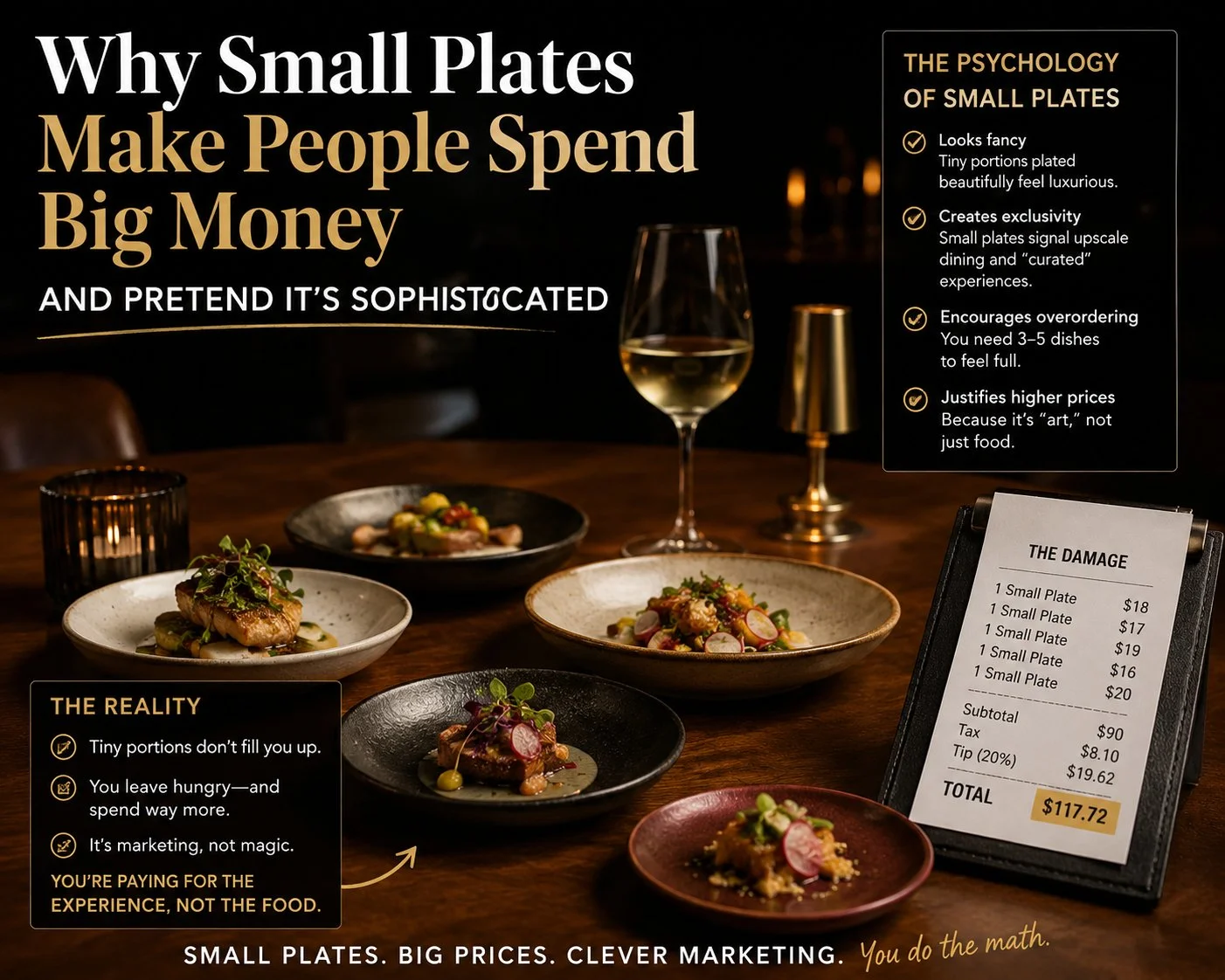
Small plates are the restaurant industry’s greatest magic trick: take a normal dinner, chop it into six confusing little fragments, serve each one on ceramic dishware shaped like a museum accident, and somehow everyone at the table feels enlightened while spending $94 to remain hungry.
It is brilliant. Evil, yes. But brilliant.
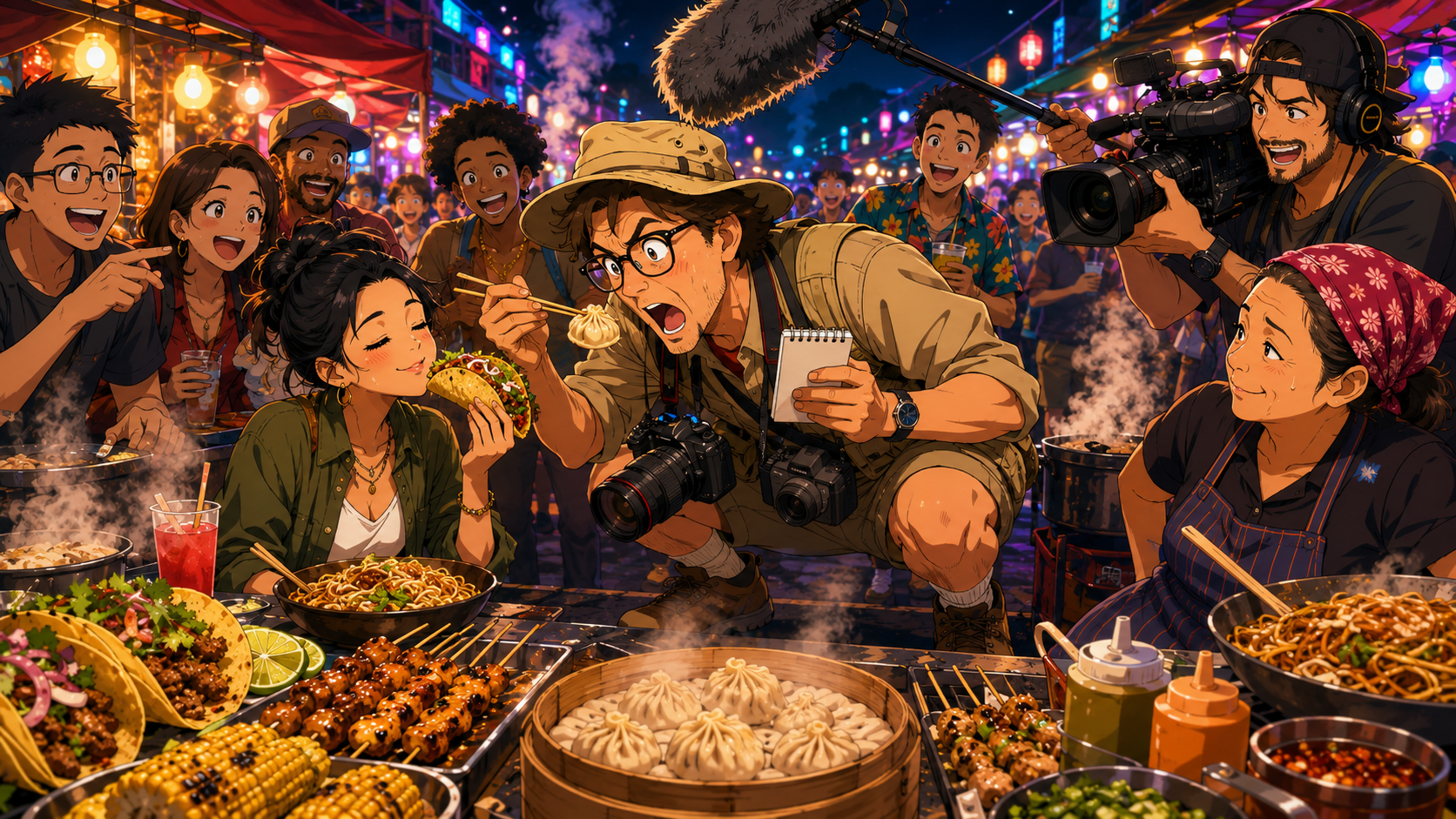
Small plates promise freedom. Variety. Sharing. Adventure. “A little bit of everything.” The kind of phrase that sounds charming until the bill arrives looking like it was printed by a ransom department. Somehow, four adults order twelve dishes, two “snacks,” three “for the table” items, one bread situation that costs actual legal tender, and a crudo so small it should be measured with jeweler’s tools. Then everyone nods solemnly and says, “That was such a great experience,” while privately wondering whether they should stop for fries on the way home.
And yet the trend keeps working because small plates hit several modern dining pressure points at once: people want variety, restaurants want higher margins, diners want food that feels social, and everyone wants to pretend they are not simply eating appetizers with better lighting.
Small portions are also having a broader moment. AP reported in March 2026 that restaurants from large chains to independent dining rooms are adding petite meals and smaller servings to appeal to customers watching budgets, appetites, health goals, and food waste. The same piece notes that small-plate tapas restaurants were already a major trend about 20 years ago, so congratulations, we have reinvented “less food” and given it a fresh invoice.
Small Plates Look Cheap Until They Form a Gang
The first reason small plates make people spend more is painfully simple: each individual item looks affordable.
A $14 mushroom toast feels harmless. A $16 plate of lamb meatballs feels fine. A $12 “crispy potato moment” sounds like a reasonable tribute to starch. A $9 bowl of olives seems tiny enough to avoid financial consequences. One by one, these prices slide into the order like little thieves wearing linen aprons.
But small plates are not ordered one by one. They are ordered in clusters. Nobody orders “one small plate” and then sits there like a monk. The whole format is built around accumulation. The server says, “We recommend two to three plates per person,” which is restaurant code for, “Please assemble your dinner from payable fragments.”
Suddenly the table has ordered ten things, and every item seemed cheap enough in isolation. This is how your brain gets mugged by tapas math. It does not register the total until the receipt arrives, at which point the receipt looks up at you with the cold dead eyes of a utility bill.
This is the genius. Small plates lower the psychological barrier to ordering. A $34 entrée makes you pause and think, “Do I really want this?” But a $13 bite-sized dish makes you think, “Sure, toss it in.” You have not ordered dinner. You have adopted a litter of appetizers.
Sharing Turns the Bill Into Emotional Fog
Sharing also makes people spend more because it destroys individual accountability. When everyone orders their own entrée, the math is brutally clear. You bought the chicken. You ate the chicken. You are responsible for the chicken. Society continues.
Small plates, however, create what I can only describe as communal invoice fog. Who ordered the anchovy toast? Who wanted the second round of dumplings? Who suggested the “one more vegetable dish” that somehow cost $18 and contained three carrots standing upright like they were giving a TED Talk?
Nobody knows. Everyone is guilty. Perfect system.
Shared-plate restaurants also rely heavily on servers guiding the order, especially for groups. Bon Appétit’s 2025 piece on shared plates explains that restaurants train servers to recommend when groups should add more items or double certain dishes so the number of pieces actually works for the table. One example: if six diners order a dish that comes in four pieces, the server may suggest adding more so no one has to conduct a miniature hunger tribunal.
That is reasonable from a hospitality standpoint. Nobody wants to watch six grown adults divide one arancini with the tension of a Cold War negotiation. But it also means the format naturally invites more ordering. A plate is not enough for the group? Add another. One scallop per person? Better add two more. Bread for the table? Of course. Sauce? Obviously. Suddenly the “light sharing dinner” has become a delicious little conference on financial erosion.
“We Recommend Ordering 9 to 14 Plates” Is Not Hospitality. It Is a Threat.
Small-plate menus love to include guidance like: “For a full meal, we recommend 3–4 plates per person.”
That sentence should be printed in red and accompanied by a tiny air horn.
Because when a restaurant tells four people to order 12 to 16 dishes, it has effectively replaced dinner with procurement. You are not eating anymore. You are managing inventory. The table becomes a loading dock. Plates arrive in waves. Someone loses track. Someone says, “Did we get the cauliflower?” Someone else says, “No, that was the other thing with tahini.” You are now in a hostage situation with garnish.
The genius is that the restaurant has moved the responsibility for fullness onto you. If you leave hungry, you under-ordered. If you spend too much, you over-ordered. Either way, the menu is innocent. It was just sitting there in lowercase font, offering “snacks” and “bites” like a charming little pickpocket.
The “Sophisticated” Part Is Mostly Scarcity in a Nice Bowl
Small plates feel sophisticated because scarcity looks fancy when plated correctly.
Three ravioli in a pool of foam? Elegant.
One scallop with a microgreen hat? Refined.
A beet cut into a shape no beet asked for? Seasonal.
A spoonful of smoked eggplant spread across a plate like a crime scene? Modern.
Put the same amount of food in a takeout container and people would call the police. Put it on matte ceramic with a tiny herb garnish and suddenly it is “thoughtful.” This is the entire scam. Not an illegal scam. A legal, tasty, well-lit scam.
Fine dining has trained us to associate smallness with precision. Tiny portions suggest craft. Restraint. Technique. A chef with tweezers and a complicated relationship with salt. The less food there is, the more important it must be. This is why one perfect bite can cost $18 and arrive with the confidence of a private school principal.
The portion is not small because you are being shortchanged. No, no. It is small because you are being invited to experience nuance. Congratulations, your hunger is now an aesthetic.
Small Plates Give Diners the Illusion of Control
Small plates work especially well right now because diners want control. They want flexibility. They want to snack, share, graze, customize, avoid waste, eat less, eat more, try new things, spend less, spend more, and somehow leave feeling virtuous while ordering fried cheese.
AP’s 2026 reporting connects smaller portions to changing attitudes about value, health, food waste, GLP-1 medications, and shifting eating habits. Restaurants are responding with scaled-down meals because customers want options beyond the old adult/kids-menu divide, which was always ridiculous anyway, as if only children and cartoon mice deserve smaller portions.
This gives small plates the perfect cultural disguise. You are not spending too much on snacks. You are making flexible, modern, portion-aware choices. Very responsible. Very adult. Very “we ordered seven dishes and still asked for more bread.”
The small plate says, “You’re in control.”
The final bill says, “Adorable theory.”
Menu Engineering Loves Small Plates Because Margins Love Confusion
Restaurants do not build menus by tossing dish names into a hat and praying to the aioli gods. Menu engineering is a real business practice: Baker Tilly defines it as analyzing menu items by popularity and profitability, then using that data to optimize pricing, layout, and promotion.
Small plates are a dream for this because they are flexible. Restaurants can use cheaper ingredients creatively. They can test new dishes without committing to a giant entrée. They can sell snackable items that pair beautifully with wine, cocktails, and “just one more thing.” They can make offcuts, vegetables, sauces, bread, pickles, spreads, and fried bits feel like composed dishes instead of kitchen leftovers with ambition.
The Guardian’s 2025 piece on snack menus and small plates makes this painfully clear: snacks can create upsell opportunities, many diners who order them still eat a full meal, and they can be high-margin because restaurants can use cheaper ingredients or offcuts.
That is not a criticism. It is smart cooking. Turning scraps and less expensive ingredients into delicious bites is good restaurant craft. But let’s not pretend the customer is always winning the transaction because the plate has a charming smear of cultured butter. Sometimes you are paying $11 for the privilege of eating the profitable edge of a pig.
“Just Snacks” Is How Restaurants Sell You Two Dinners in Disguise
Snacks are the pre-game of small plates, and restaurants know exactly what they are doing.
A snack menu feels casual. Low commitment. Fun. You are not ordering a course. You are just nibbling. You are grazing. You are being spontaneous, like a woodland animal with a reservation.
But snacks often arrive before the actual small plates. So now the meal structure is: snacks, small plates, maybe larger plates, sides, dessert. This is not dinner. This is a subscription service for plates.
The Guardian article notes that snacks have become a defining feature of modern informal dining, with restaurants using them as first impressions, social ice-breakers, and flexible options for guests who may want only a drink and a few bites. It also notes that at one restaurant, almost every table orders a snack.
Of course they do. A snack is nearly impossible to refuse. “Would you like the crispy cheese puff?” What are you supposed to say? “No, I reject joy and all its works”? You order the cheese puff. Everyone orders the cheese puff. The cheese puff has already won.
Variety Makes People Forget Fullness
The second or third small plate may satisfy you. The eighth is research.
That is another reason the format works: people love variety. We get bored. A big entrée gives you one main flavor experience. Small plates give you a carousel. Salty, crispy, sour, creamy, spicy, charred, raw, fried, pickled, smoky, weird little sauce, repeat.
This variety keeps appetite alive longer than a single large plate. You may be full of food, but you are not full of novelty. Your stomach says, “We are done.” Your brain says, “But we haven’t tried the lamb ribs with fermented plum lacquer.” Your wallet quietly walks into traffic.
The National Restaurant Association’s 2026 What’s Hot Culinary Forecast says diners are looking for comfort, adventure, value, and quality, with menus leaning into mood-lifting dishes and global flavors. Small plates fit that mood perfectly because they let people sample adventure in little increments instead of committing to one giant unfamiliar entrée.
In other words, small plates are culinary speed dating. You don’t marry the smoked trout dip. You just spend $17 getting to know it.
Tiny Plates Mess With Portion Perception
Humans are terrible at judging portion size. We are not measuring instruments. We are anxious mammals with debit cards.
A Cochrane review summarized by the University of Cambridge found that people consume more food and drink when offered larger portions, packages, or tableware, and the review analyzed 61 studies with 6,711 participants. The researchers emphasized that food environments, not just willpower, influence consumption.
Small plates exploit the same general truth from the opposite direction: the environment shapes how we interpret food. When the meal arrives as many little dishes, it becomes harder to judge how much you have eaten or how much you have spent. Your brain is good at recognizing “one large entrée.” It is worse at adding together seven ceramic saucers, two dips, one bread basket, and three bites stolen from your friend’s plate like a raccoon in a cardigan.
Small plates break the meal into fragments, and fragments feel less serious. This is also why people can eat 14 “little bites” at a party and insist they “barely ate.” Yes, Brenda. You barely ate an entire cheese board.
Price Presentation Helps the Scam Wear Better Shoes
Small-plate menus often look minimalist: dish name, sparse description, clean numbers. No dollar signs. No decimals. Just “charred cabbage 16,” sitting there like money is an abstract philosophical concept.
That matters. Cornell hospitality researchers studied menu price formats and found that guests given menus with numeral-only prices spent more than guests who saw prices with dollar signs or prices written out in words, though the authors cautioned that the findings may apply only to that restaurant lunch setting.
This is not saying every restaurant can remove dollar signs and instantly buy a yacht. Calm down, menu consultants. But it does suggest that price presentation can affect spending. And small plates already benefit from small-looking prices, so removing overt money cues is like putting a tiny invisibility cloak on the bill.
“Beef tartare 19” feels like a culinary idea.
“Beef tartare $19.00” feels like a transaction.
The first one whispers. The second one taps your bank account on the shoulder.
Small Plates Turn Dining Into Performance
Small plates also make people spend more because they turn dinner into a social performance.
You are not just eating. You are curating. You are collaborating. You are reacting. “Oh my God, try this.” “Wait, did you get the sauce?” “This one has preserved lemon.” “I actually love the bitterness.” “The texture is insane.” Everyone becomes a judge on a cooking show nobody auditioned for.
This is why small plates feel sophisticated. They generate conversation. They make diners feel involved. Each plate gets an entrance. Each dish gets discussed. A normal entrée just sits there doing its job like a union electrician. A small plate demands commentary.
The restaurant experience becomes less about fullness and more about participation. That is powerful. It is also how you end up paying for entertainment in the form of roasted cauliflower.
The Alcohol Pairing Is Not an Accident
Small plates also play beautifully with alcohol, which is where restaurants make much of their money and where diners make many of their worse decisions.
Salty snacks make people thirsty. Spicy plates ask for cocktails. Fatty little dishes beg for wine. A parade of varied flavors makes the “maybe we should get another bottle” conversation feel practically academic.
The Guardian’s piece quotes experimental psychologist Charles Spence suggesting that salty snacks can make people thirsty and that snacks are tied to sociability and sensory stimulation.
This is why wine bars and small plates are spiritually married. The food is not just food. It is beverage infrastructure. The anchovy toast is not there because the chef loves you. It is there because it makes orange wine seem like destiny.
Restaurants Can Test Weird Ideas Without Betting the Farm
Small plates are also useful because restaurants can experiment. A strange entrée is risky. A strange bite is charming. Nobody wants a full plate of fermented rutabaga dumplings unless they are trapped in a chef’s imagination, but a small plate? Sure. Let’s all try one and make the face.
Bar & Restaurant reported in 2026 that smaller menu items are easier for operators to adjust, swap, and test as specials, and that guests like trying smaller new items.
This is the practical side of small plates. They are menu laboratories. A restaurant can test flavor combinations, seasonal ingredients, and weird ideas without making a full entrée commitment. Diners get novelty. Chefs get creative space. The restaurant gets data. Everyone wins, except maybe the person who paid $15 for one experimental radish and a sauce that tasted like a campfire had anxiety.
Small Plates Are Great Until Sharing Becomes Competitive Math
The awkward part of small plates is that sharing is not always graceful. Some dishes divide cleanly. Others become culinary combat.
Four dumplings for five people.
Three prawns for six people.
One burrata for a table of seven, because apparently we are reenacting famine with basil oil.
Bon Appétit’s shared-plates article points out the practical absurdity of dividing tiny items among larger groups and notes that restaurants often need to engineer dishes and train servers around the logistics of sharing.
This is the dirty secret: small plates are social until the piece count goes wrong. Then everyone becomes a diplomat. “No, you take it.” “No, really, I had some.” “Let’s cut it.” Cut what? It is one shrimp, Angela. It has no future.
And because nobody wants the table to become weird, you order more. The format wins again.
How to Enjoy Small Plates Without Being Financially Pantsed
Small plates can be great. Truly. They can be fun, creative, social, and delicious. The goal is not to ban them from society and return to the tyranny of one chicken breast per person like some sad banquet hall monarchy.
The goal is to stop being tricked by tiny plates with big confidence.
Set a dish limit before ordering. Not after the server has described the special in a voice that makes carrots sound sensual. Decide: two or three plates per person, max, unless the portions are genuinely tiny.
Ask how many pieces come on the plate. This is not rude. This is survival. “Does that come with four pieces?” is the small-plates equivalent of checking the weather before leaving the house.
Order in waves. Start with fewer dishes, then add if needed. Restaurants love front-loading the table because hunger plus enthusiasm equals over-ordering. Resist the urge to summon the entire menu at once like a demon.
Watch the bread, snacks, and sides. These are the little bill inflators. Delicious, yes. Dangerous, also yes. Bread with cultured butter is wonderful, but it is still a cover charge with crust.
Be honest about hunger. A tiny crudo and a fried cheese puff do not equal dinner unless you are a haunted bird.
Small Plates Work Because We Want to Be Tricked Nicely
Small plates make people spend big money because they are perfectly engineered for modern dining psychology. They look affordable. They encourage variety. They blur individual spending. They create social energy. They make small portions feel refined. They help restaurants test dishes, use ingredients creatively, upsell snacks, and increase margins. They turn dinner into a charming little theatre production where the props are edible and the ending is a bill that makes everyone stare silently into the middle distance.
And we let it happen because small plates are fun.
That is the annoying part. They are not just a scam. They are a scam with good lighting and smoked butter. They make meals more interactive. They let you taste more things. They create conversation. They give chefs room to be creative. They make dinner feel less like fuel and more like an event.
But let’s stop pretending the whole thing is automatically sophisticated. Sometimes it is. Sometimes it is beautiful food served thoughtfully in a way that makes sharing feel generous and alive. Other times it is three bites of squash and a spoon drag of yogurt priced like it has a graduate degree.
Small plates are not evil. They are just very, very good at making us participate in our own upsell.
So enjoy them. Order the weird little anchovy thing. Share the dumplings. Get the crispy potatoes. Act impressed by the ceramic dish that looks like it was made during an earthquake.
Just remember: when the server says, “We recommend ordering several for the table,” what they mean is, “Welcome to dinner. The appetizers have formed a business model.”