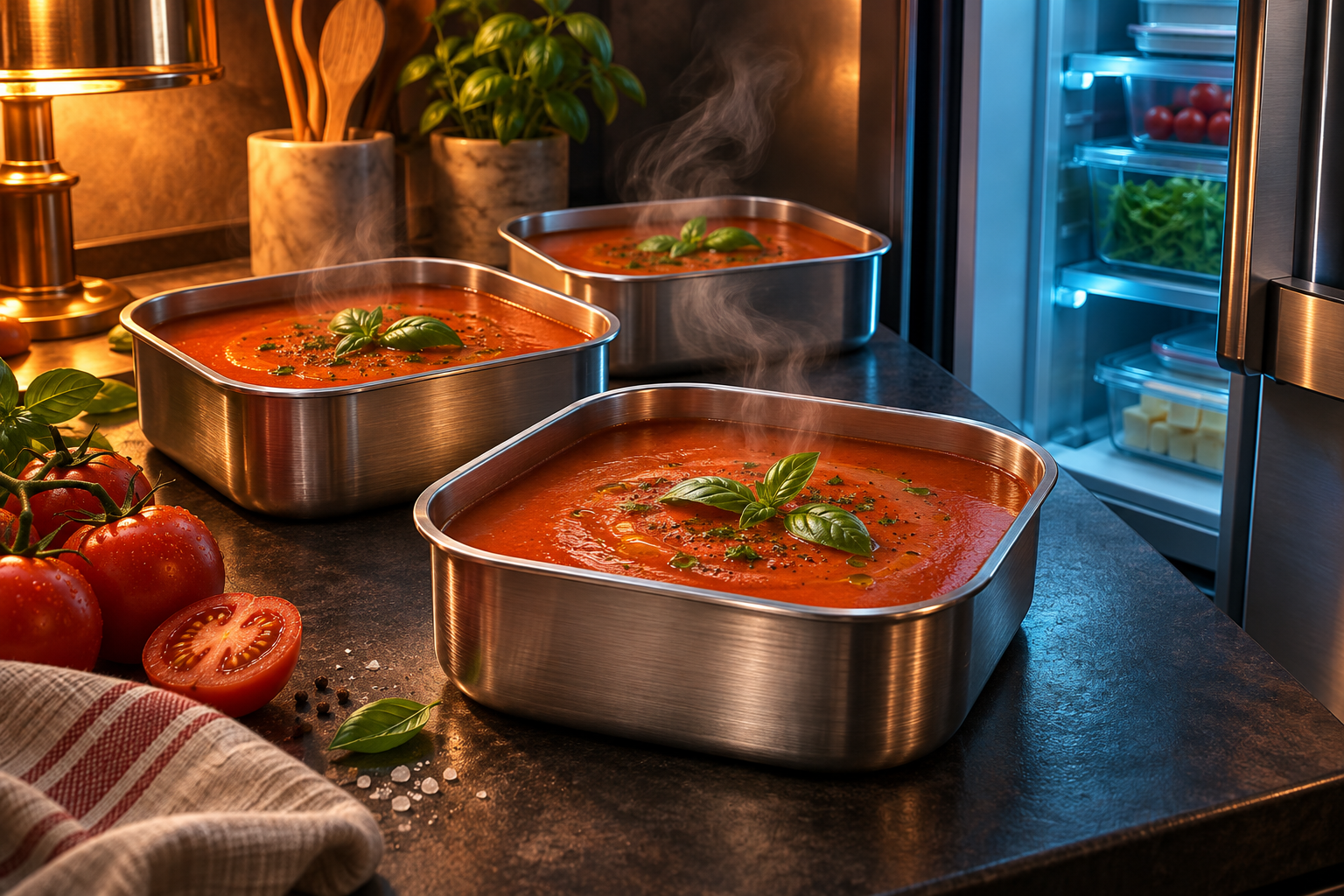
Small portions of hot leftovers can go straight into the refrigerator under U.S. federal consumer guidance. A large pot needs a different approach: divide it into shallow containers and cool it promptly. You do not have to give every serving an hour on the counter.
So why can another reputable guide tell you never to put hot food in the fridge?
Part of the confusion comes from compressing several questions into one: Will it harm the appliance? Will it warm the other food? Will the leftovers themselves cool quickly enough? Those are different concerns. But there is also a genuine disagreement in the published wording. It would be too tidy to claim that all the sources secretly say the same thing.
Three trustworthy sources, three different instructions
Here is what the pages actually say, rather than what a search snippet or family rule reduces them to:
The CDC permits small hot portions. Its food-poisoning prevention guidance, dated November 24, 2025, calls for warm or hot food to be divided among clean, shallow containers and refrigerated. It explicitly says small hot portions are okay.
University of Minnesota Extension calls for cooling first. Its heating and cooling guide, marked reviewed in 2025, says to reach about 70°F (21°C) before refrigerating and adds: “Never put hot food straight into the refrigerator or freezer.” It cites slow cooling and warming other food as concerns.
Health Canada distinguishes very hot food. Its leftovers guidance recommends prompt refrigeration in uncovered, shallow containers. Very hot items may cool first at room temperature; it says to refrigerate once steaming stops. That is not a direction to leave every meal out until it reaches room temperature.
The common ground is smaller portions and quick cooling. The remaining disagreement is real: Minnesota’s categorical sentence is broader than the CDC’s qualified permission. These pages do not establish why the authors chose different instructions. We cannot honestly attribute it to obsolete refrigerators, different research or a typo without further evidence.
The mistake is treating the fridge as an on/off safety switch
“It’s in the fridge” tells you where the food is. It does not tell you how quickly the middle of a deep container is cooling.
That is why the FDA’s refrigerator guidance pairs permission to refrigerate hot food with an instruction to use smaller containers. It also warns against crowding the refrigerator, because cold air must circulate. The agency says putting hot food inside does not harm the appliance; that statement is not a guarantee that any quantity, packed any way, will cool adequately.
The opposite shortcut fails too. “I let it cool” does not tell you how long it sat out or how warm it remained. Waiting is not automatically safer than refrigerating.
This is the useful distinction behind the argument: the goal is to remove heat promptly, not to win a debate about whether the food was technically hot when the door closed.
A practical plan for the leftovers you actually have
A small amount from dinner
For U.S. readers, the CDC’s answer is direct: use clean, shallow containers and refrigerate promptly, even while the food is hot. Its two-hour limit is a deadline, not a recommended waiting period. When food is exposed to temperatures above 90°F (32°C), the limit drops to one hour.
For Canadian readers, Health Canada’s guidance allows a preliminary cooling step for very hot items, then refrigeration when steaming stops. Keep that instruction alongside its two-hour room-temperature limit, not separate from it. Do not wait indefinitely for a large batch to stop steaming.
A large pot of soup, chili or stew
Change the cooling problem before putting it away. Divide the food into smaller, shallow containers rather than leaving the entire batch in its cooking pot. Minnesota Extension also describes stirring a container in an ice-water bath to remove heat actively. That is a cooling method, not simply leaving a pot on the stove and hoping.
Give the containers room in the refrigerator. Health Canada recommends leaving them uncovered or loosely wrapped during cooling; protect the food from contamination. Once chilled, use covered storage, as the FDA advises.
Food that has already sat out too long
Do not treat refrigeration as a rescue step. Health Canada advises discarding cooked food left at room temperature for more than two hours. It also warns that smell, appearance and taste cannot establish whether food is safe. “It still smells fine” does not supply the missing time-and-temperature history.
Why the restaurant’s six-hour rule is not your rule
Commercial cooling instructions sometimes enter the argument as if they contradict the household deadline.
For example, Washington’s food-service code includes an alternative cooling pathway from 135°F to 70°F within two hours, then to 41°F or below within six hours total. It also permits a specified shallow-layer method in refrigerated equipment. Its methods provision describes controlled approaches including shallow pans, smaller portions and ice-water baths.
That is not permission to leave dinner on the counter for six hours. It describes cooling performance under defined conditions, not an extension of a household room-temperature allowance. These are Washington food-service provisions, not a universal home-kitchen rule or a statement of Canadian law.
The least glamorous tool is the useful one
An appliance thermometer answers a question your hand cannot: is the refrigerator actually cold enough? The FDA recommends 40°F or below; Health Canada specifies 4°C or below. Keep airflow clear rather than treating every available inch as storage space.
The wording conflict remains, but dinner does not have to remain on the counter while you investigate it. Follow the relevant consumer guidance, divide large batches, and cool promptly. The important difference is not “hot versus cold.” It is a method that removes heat versus a ritual that merely passes time.