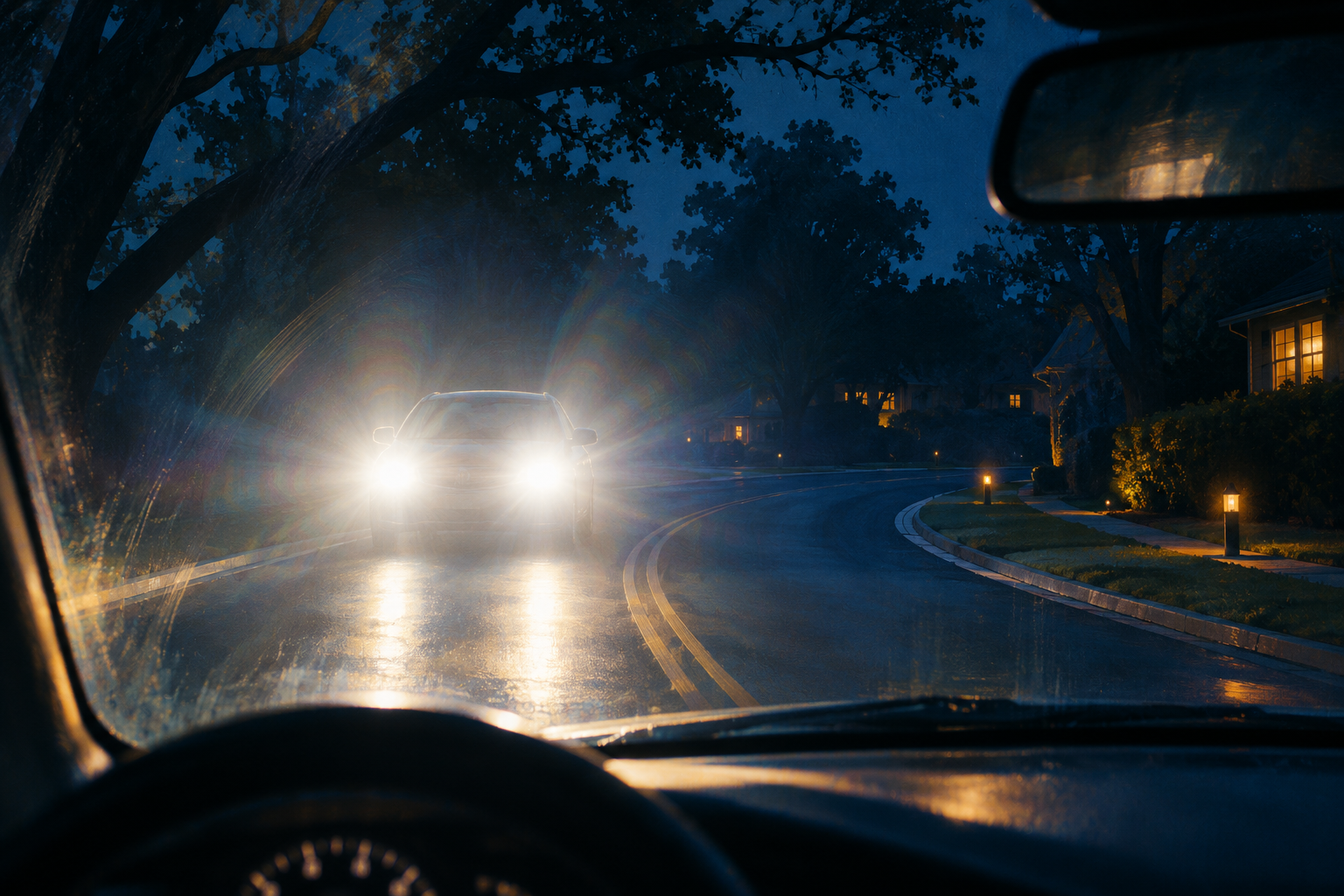
A car comes over a hill and its headlights seem to fill your windshield. You suspect high beams. The driver may insist they are using low beams. Both observations can be genuine.
A legal headlight is not a promise of a glare-free encounter. In the United States, the equipment must meet a defined performance standard. What reaches another driver’s eyes also depends on aim, mounting height and road geometry. And some glaring lights are incorrectly installed, improperly used or noncompliant in the first place.
That is the missing distinction: “Is this headlamp legal?” and “Is this light making it harder for me to see?” are different questions. This article explains the U.S. regulatory framework; it is not a determination of any particular vehicle’s legality, nor a statement of Canadian equipment law.
The rule controls a beam, not just a bulb
The main U.S. federal lighting rule is Federal Motor Vehicle Safety Standard No. 108. Its purpose includes illuminating the road and making vehicles visible to other road users. That requires a balance: too little useful light is a problem too.
A low beam is not simply a high beam turned down. It distributes different amounts of light in different directions. The standard defines a cutoff as the aiming cue separating brighter and darker areas. Compliance therefore cannot be reduced to a single advertisement saying “this bulb produces so many lumens.” The pattern matters, not just total output.
NHTSA’s explanation of LED headlamp requirements also clears up a common misconception: manufacturers self-certify compliance. The agency does not individually approve every headlamp before sale. It investigates safety defects and can address noncompliance.
A product being available to buy is not the same thing as the government having tested and approved your installation.
Why the same low beam can feel fine, then unbearable
Imagine the brighter part of a beam as a moving region in space. The road determines where that region goes relative to your eyes.
A crest or curve changes the angle between vehicles. Mounting height changes the starting point. Incorrect aim adds another problem. NHTSA’s report to Congress on nighttime glare described these mechanisms in 2007, long before today’s arguments about LED headlights: light useful for one driver’s view can overlap with another driver’s eye position.
That is a useful explanation for why glare can change abruptly as two vehicles approach. It is not a roadside diagnostic test. You cannot reliably identify the bulb, measure its compliance or decide whether its high beams are on from one uncomfortable encounter.
Nor does “blinding” always describe the same effect. Researchers distinguish discomfort glare, the unpleasant sensation, from disability glare, which reduces visibility as scattered light lowers contrast. A dirty or damaged windshield can worsen scatter. None of this makes the complaint imaginary; it explains why a convincing investigation needs more than the driver’s impression of brightness.
Legal equipment can still be the wrong installation
A complete headlamp engineered around LEDs is different from inserting an LED replacement into an optical system designed for another light source.
NHTSA’s February 2024 interpretation distinguished compliant integral LED headlamps from noncompliant LED replacement light sources then sold online. That is dated guidance, not a verdict on every replacement product available now. For a repair or conversion, the useful question is whether the actual replacement is compliant for the actual headlamp and vehicle, not whether it fits the socket.
The distinction applies to use as well. Federal equipment requirements do not replace state driving rules. California’s handbook, for example, tells drivers to dim high beams within 500 feet of oncoming traffic and within 300 feet when following another vehicle. Those are California instructions, not universal U.S. distances and not rules to export to Canada. Follow the rules where you drive.
Better light does not have to mean more glare
It is tempting to conclude that the solution is simply dimmer headlights. That misses the other half of the safety problem: seeing the road.
The Insurance Institute for Highway Safety evaluates illumination and glare together. Its tests use straight and curved approaches and evaluate headlights as received from the dealer, without first correcting their aim. Different headlight systems offered on the same vehicle can receive different ratings. A model name alone is not enough when comparing cars.
There is also counterevidence to the claim that every new generation gets worse. IIHS reports excessive glare in 5% of systems tested for the 2026 model year, versus 21% for 2017. This is a result for tested systems under its protocol, not the percentage of headlights bothering drivers tonight. It does not count every older vehicle, aftermarket installation or road encounter.
IIHS finds good and poor performance across lighting technologies. “LED” is neither a safety rating nor a verdict of guilt.
Automatic high beams are not the same as adaptive beams
This difference matters when reading a vehicle’s feature list. Automatic high beams switch between high and low. Adaptive driving beams selectively change parts of the projected beam around other traffic. Transport Canada explains the distinction and cautions that assistance does not replace driver attention.
The United States allowed adaptive driving beams in 2022. That does not mean every car has them, that every “automatic” lighting feature is equivalent, or that buying the technology guarantees every encounter will be comfortable.
Three questions worth asking before spending money
“Are my lights aimed correctly?” Ask a qualified repairer to check the system against the vehicle manufacturer’s procedure. Do not simply point them lower until nobody complains; useful illumination matters too.
“Is this replacement appropriate for my actual headlamp?” Ask about compliance and compatibility, not only wattage, color or advertised brightness. A socket match is not the whole answer.
“Which headlight system does this vehicle actually have?” If shopping, match the trim and equipment to the IIHS rating and read the manual’s description of its automatic functions. Keep your windshield clean, and follow local high-beam rules regardless of automation.
The regulatory debate is not closed. In October 2026, NHTSA announced a modernization effort addressing glare, aim and mounting height. That announcement began a process; it was not a finished new glare limit.
The goal should not be to win a contest between brighter headlights and angrier oncoming drivers. It is to put useful light where the driver needs it, and less where everyone else does not.