
Why Caribbean Curry Bowls Might Be the Best Comfort Food Trend Right Now
Caribbean curry bowls are having a moment, and honestly, thank God. Food trends have spent the last few years asking us to get excited about things like sad protein sludge, $19 lettuce architecture, and beige “wellness bowls” that taste like someone described lunch to a consultant over weak Wi-Fi. Finally, a trend shows up with actual flavor, actual history, actual comfort, and enough spice to wake up your soul instead of gently tapping it with a cucumber slice.
The National Restaurant Association named Caribbean curry bowls among the trending dishes in its 2026 What’s Hot Culinary Forecast, alongside globally influenced comfort foods and “flavor escapism.” Their forecast says diners are looking for comfort and nostalgia with a twist — food that can either take them back to a memory or transport them somewhere new. Caribbean curry bowls fit that brief so perfectly it is almost rude. They are warm, spicy, saucy, customizable, filling, and more interesting than another smash burger wearing pickles like it invented lunch.
Caribbean Curry Bowls Are Comfort Food With a Passport
Comfort food usually gets treated like it has to be heavy, beige, and emotionally dressed in sweatpants. Mac and cheese. Mashed potatoes. Chicken pot pie. Casseroles with the structural integrity of wet drywall. Lovely foods, all of them. But after a while, “comfort” starts to feel like a culinary witness protection program for butter.
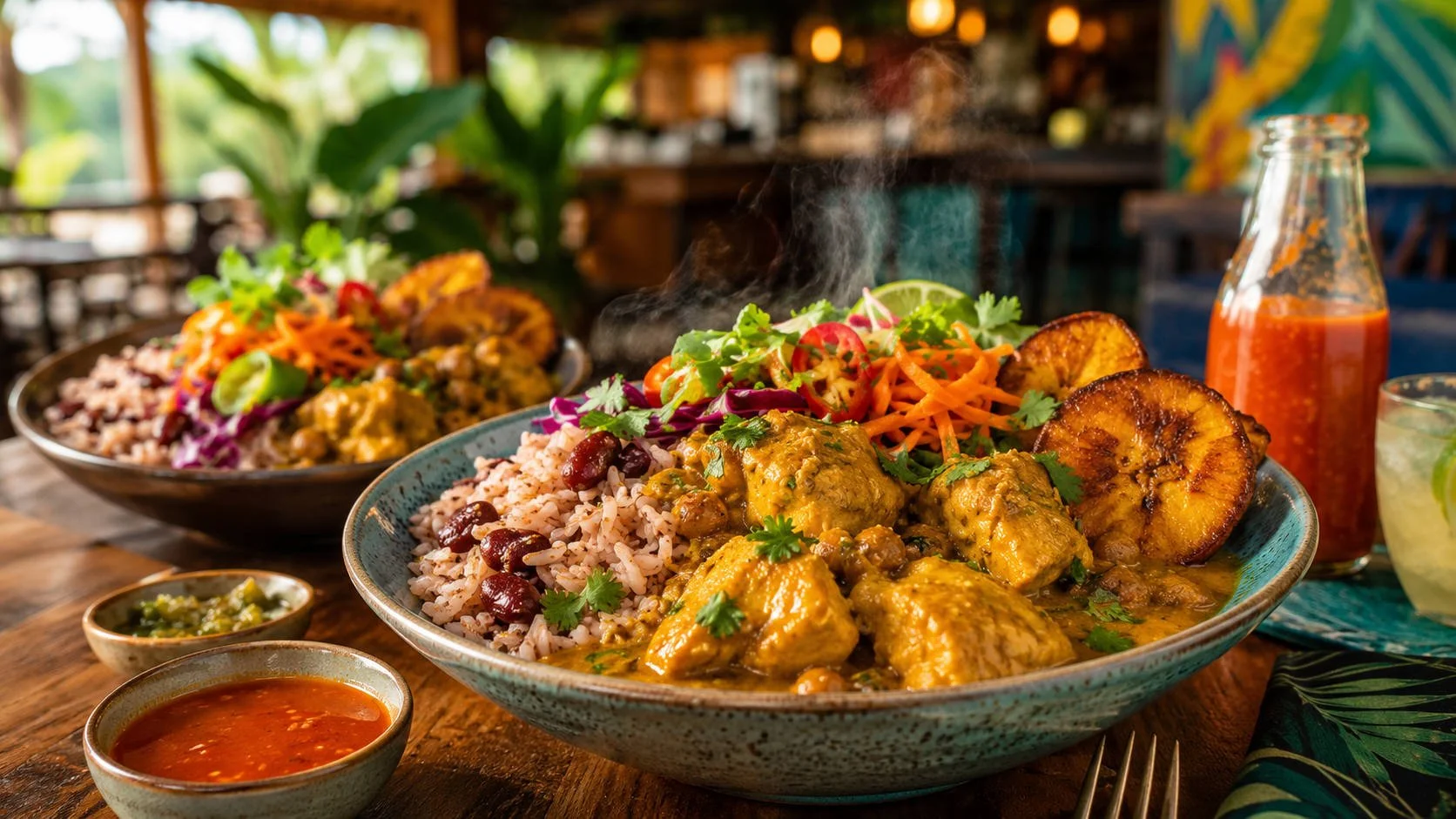
Caribbean curry bowls offer something better: comfort food with movement. A bowl can start with rice, peas, chickpeas, plantains, cabbage, greens, or roasted vegetables, then add curry chicken, curry goat, shrimp, fish, tofu, or coconut curry vegetables. Then comes the good stuff: curry gravy, Scotch bonnet heat, thyme, garlic, ginger, allspice, coconut milk, scallions, lime, pickled onions, and maybe a little mango or pineapple if the bowl wants to flirt with chaos.
That is comfort food that does not just sit there like a weighted blanket filled with cheese. It has brightness. It has depth. It has spice. It has history. It has the decency to be interesting.
The National Restaurant Association’s 2026 trend coverage specifically connects comfort food with global flavors, saying restaurant menus are leaning into dishes that provide emotional satisfaction while bringing in cultural influences. That is basically the job description for a Caribbean curry bowl, minus the part where it also makes your office lunch look like it gave up in 2018.
The Bowl Format Was Already Taking Over Lunch, Because Apparently Plates Were Too Emotionally Complicated
Bowls are everywhere now. Grain bowls, protein bowls, salad bowls, poke bowls, burrito bowls, smoothie bowls, Buddha bowls, and the tragic desk-lunch species known as “whatever survived in the fridge and is now touching quinoa.” The format works because it is easy to customize, easy to package, easy to eat, and easy to pretend you are making mature choices while aggressively adding sauce.
Foodservice coverage has noted that bowls have grown substantially on menus, with one industry summary reporting bowls on more than 40% of operator menus and identifying curry bowls among the top bowl types in the U.S. The Guardian also recently described the rise of customizable takeaway bowls as a defining modern lunch format — grains, protein, vegetables, toppings, dressing, and then off to a desk, because capitalism apparently looked at lunch and said, “Make it stackable.”
This is exactly why Caribbean curry bowls make sense right now. The bowl format is already mainstream. People understand it. They know how to order it. They know how to customize it. The difference is that Caribbean curry bowls are not another pile of spinach, grilled chicken, and moral superiority. They bring actual culinary swagger to a format that has too often been bullied into blandness by wellness marketing.
A Caribbean curry bowl says: yes, you may have vegetables. But they will not taste like punishment. Revolutionary stuff.
Global Flavors Are Not a Side Quest Anymore
The rise of Caribbean curry bowls also fits the bigger shift toward global flavors in everyday dining. Datassential reported in 2025 that nearly half of U.S. consumers had eaten a globally influenced dish in the previous week, and that 70% of operators reported increasing customer demand for global flavors. Translation: people are bored with the same three menu items wearing different sauces and pretending it is innovation.
This matters because Caribbean food has long deserved more mainstream attention than it gets. Too often, “Caribbean” gets flattened into jerk chicken and tropical drinks, as if an entire region’s cuisine can be reduced to spice rub and umbrella garnish. Caribbean curry bowls push past that lazy postcard nonsense. They make room for Indo-Caribbean curries, Jamaican curry chicken and goat, Trinidadian curry, Guyanese-style flavors, coconut-based stews, legumes, rice and peas, callaloo, cabbage, plantains, and all the island-by-island variation that makes the category so much more interesting than “spicy chicken, but vacation.”
Caribbean curry is not some random sauce trend invented in a conference room by people wearing fleece vests. Curry has deep roots in the Caribbean, shaped in part by Indian indentured workers who arrived in the region in the 19th century. Britannica notes that curry became integral to Caribbean cuisines including Jamaica, Trinidad, and Martinique through that history of migration. Food & Wine similarly traces curry’s spread through indentured labor after slavery was abolished in British colonies, including to Trinidad, Guyana, Jamaica, and other regions.
So no, Caribbean curry bowls are not “fusion” in the shallow, menu-gimmick sense where someone puts kimchi on fries and expects applause. They are a modern format carrying older foodways. The bowl is the new package. The flavor has been doing its job for generations.
Curry Is Built for Comfort Because Sauce Is Civilization
The reason curry works so well as comfort food is embarrassingly simple: sauce. Humans love sauce. We built entire cuisines around it because dry food is a social failure. A good curry is warming, aromatic, layered, and forgiving. It clings to rice. It hugs chicken. It makes chickpeas useful. It turns vegetables from “obligation confetti” into something people voluntarily eat.
Caribbean curry has a particular advantage because it is rarely one-note. Depending on the island and cook, you can get turmeric earthiness, cumin warmth, coriander, garlic, ginger, thyme, scallion, Scotch bonnet heat, coconut richness, allspice depth, and lime brightness. That combination gives you richness without necessarily turning the bowl into a cream-and-cheese funeral procession.
This is why Caribbean curry bowls feel more exciting than many other comfort food trends. They are cozy without being sleepy. They are hearty without being a brick. They are spicy without needing to perform macho nonsense like, “Can you handle the heat?” Nobody needs lunch to become a fraternity initiation with peppers.
The best Caribbean curry bowls hit that rare sweet spot: warm, filling, aromatic, bright, spicy, and customizable. That is not a trend. That is a full personality.
They Fit the Modern “Healthy-ish” Mood Without Becoming Sad
One reason this trend has legs is that Caribbean curry bowls can be built as indulgent, balanced, plant-forward, high-protein, gluten-free, dairy-free, or vegetarian without losing their soul. That is not easy. Many “healthy” restaurant items lose their soul immediately, usually around the time someone replaces sauce with “light vinaigrette” and starts talking about ancient grains like they discovered agriculture.
The National Restaurant Association’s 2026 trend coverage says health, wellness, and value are also driving menus, including smoothie bowls, protein add-ons, and affordability. Mintel’s 2026 food and drink predictions also point toward more diverse diets, sensory experiences, and modernized traditional food, which is basically a giant blinking arrow over a curry bowl with coconut, Scotch bonnet, rice, and vegetables.
Caribbean curry bowls work because they do not require choosing between “comforting” and “not a total nutritional incident.” A bowl with curry chicken, rice and peas, cabbage, and greens can feel deeply satisfying. A curry chickpea bowl with roasted vegetables and coconut sauce can be plant-forward without tasting like someone printed the word “wellness” on cardboard. A shrimp curry bowl can be lighter but still bold. A curry goat bowl can be rich and celebratory, the kind of meal that tells your sad desk salad to pack its things and leave.
The format lets people adjust the bowl to their appetite and goals. More protein? Add chicken, shrimp, fish, tofu, or beans. More vegetables? Add cabbage, callaloo, peppers, onions, carrots, greens, or slaw. Want richness? Add coconut curry sauce or avocado. Want comfort-food glory? Add plantains. Want to keep it lighter? Go easy on rice and fried toppings. Incredible. A trend that allows both pleasure and restraint, like a grown-up.
The Best Caribbean Curry Bowl Builds
A classic curry chicken bowl is probably the easiest entry point. Start with rice and peas or plain rice, add curry chicken, cabbage or greens, pico-style tomato, pickled onions, and hot sauce. It is familiar enough for the cautious crowd and flavorful enough for people who believe lunch should have a pulse.
A curry goat bowl is the richer, deeper, more “I deserve this because life has been acting weird” option. Goat curry is iconic in parts of the Caribbean, especially Jamaica and Trinidad, and it brings slow-cooked comfort in a way grilled chicken can only dream about while wearing its little fitness tracker. This one is usually heavier, so it works best with lighter sides like cabbage, greens, cucumber, or slaw instead of adding six starches and pretending gravity will not notice.
A coconut curry shrimp bowl is ideal for people who want bold flavor without the full “I need a couch and silence” aftermath. Coconut milk, curry spice, shrimp, lime, herbs, rice, and vegetables make a bowl that feels tropical without becoming a resort buffet crime scene.
A chickpea and vegetable curry bowl may be the most underrated version. Chickpeas, potatoes, pumpkin, carrots, cabbage, callaloo, spinach, or peppers can carry curry beautifully. Done right, it is hearty, affordable, plant-forward, and satisfying. Done badly, it is just chickpeas sitting in yellow sadness, so please season the thing like you have met food before.
An Ital-inspired curry bowl can lean vegan or plant-based with coconut curry, beans, vegetables, rice, plantains, and fresh herbs. This is where the bowl format really shines because it can be nourishing and deeply flavorful without requiring meat to barge into the room like a protein landlord.
How to Not Ruin a Caribbean Curry Bowl Like a Rookie
The easiest way to ruin a Caribbean curry bowl is to treat it like a buffet dare. Rice, rice and peas, potatoes, plantains, roti, mac pie, and fried dumplings are all great. They do not all need to be in the same bowl unless your goal is to build a starch museum.
Pick one main base. Rice and peas? Great. Coconut rice? Fine. Greens and rice? Lovely. But if the bowl starts looking like every carbohydrate in the kitchen formed a coalition government, maybe intervene.
Do not be cheap with the curry sauce, but do not drown the bowl either. Curry should coat the food, not turn the bowl into a spice swamp with chicken debris floating in it like a weather emergency.
Add acid. This is the secret that separates a great curry bowl from a heavy one. Lime, pickled onions, vinegar slaw, mango chow, cucumber, tomato, or pineapple salsa can brighten the whole thing. Without acid, rich curry can get sleepy. With acid, it wakes up and starts paying rent.
Add crunch. Cabbage, cucumber, roasted chickpeas, toasted coconut, scallions, or crisp vegetables give contrast. Nobody wants a bowl where every bite has the same texture as a hotel pillow.
Respect the heat. Scotch bonnet is beautiful, fruity, and powerful. It is not just spicy. It has flavor. But it also does not need to be dumped on everything by some man named Kyle who thinks pain equals personality.
Why Restaurants Should Care
For restaurants, Caribbean curry bowls are a gift. They are operationally flexible, scalable, visually appealing, and easy to customize. A curry base can work with chicken, goat, shrimp, tofu, chickpeas, vegetables, or fish. Rice and vegetable sides are familiar. Toppings can be prepped ahead. The bowl format works for dine-in, takeout, delivery, catering, and sad office lunches eaten while pretending to read an email.
They also offer value. In a time when food prices still matter to diners and operators, curry bowls can make affordable ingredients feel abundant and exciting instead of cheap and desperate. The Institute of Food Technologists noted in 2026 that food-price concern remains high among consumers, with FMI data showing nearly two-thirds of consumers were still extremely or very concerned about grocery prices. A well-built curry bowl can deliver comfort, flavor, and perceived abundance without requiring a steak the size of a roofing tile.
The key is not to make a bland “Caribbean-inspired” bowl that tastes like curry powder whispered near rice. Restaurants need to actually build flavor: toasted spices, aromatics, proper seasoning, texture, acid, heat, and culturally literate toppings. Put another way: do not treat Caribbean curry like yellow gravy with a tourism brochure.
Why This Trend Feels Better Than the Usual Food-Trend Nonsense
A lot of food trends are just regular foods wearing a tiny hat. “Loaded toast.” “Elevated cereal.” “Girl dinner.” “Functional soda.” Thank you, internet, for inventing dinner and bubbles.
Caribbean curry bowls feel different because they solve several real cravings at once. People want comfort, but not boredom. They want global flavors, but not gimmicks. They want customization, but not a 17-step ordering process that makes lunch feel like filing taxes. They want food that feels generous, but not necessarily like a fried cheese accident. Caribbean curry bowls can do all of that.
They are also visually strong, which matters because everyone now eats with their phone first like a little glass goblin. Golden curry, green herbs, purple pickled onions, orange plantains, red pepper sauce, bright slaw, white rice, black beans, and grilled protein all look good in a bowl. Finally, a food trend that photographs well and still tastes like something after the camera leaves.
The Cultural Respect Part, Because Yes, It Matters
Caribbean curry bowls should not become another case of mainstream food culture discovering something that already existed and acting like it was invented yesterday by a fast-casual brand with minimalist branding and stools that hate the human spine.
Caribbean curry has history. Indo-Caribbean foodways were shaped by migration, indenture, adaptation, poverty, resilience, skill, agriculture, and home cooking. UCL’s discussion of Indo-Caribbean food describes how Indian food traditions in the Caribbean developed through adaptation to unfamiliar ingredients and harsh conditions, turning available foods into something meaningful and familiar.
So yes, restaurants can modernize. Yes, bowls are a smart format. Yes, menus can evolve. But credit the roots. Use real ingredients. Learn the difference between Jamaican, Trinidadian, Guyanese, Bajan, Haitian, and other Caribbean food traditions instead of smashing them all into one “island curry” bucket like a lazy cruise buffet with SEO goals.
The trend is exciting precisely because it has depth. Remove the depth, and it becomes just another bowl of marketing paste.
Caribbean Curry Bowls Actually Deserve the Hype
Caribbean curry bowls might be the best comfort food trend right now because they are not trying to choose between cozy, bold, fresh, filling, affordable, customizable, and culturally interesting. They just show up and do all of it, which is rude but appreciated.
They fit the modern bowl obsession without becoming another sad pile of greens and corporate vinaigrette. They satisfy the demand for global flavors without feeling like fusion nonsense assembled by a branding committee. They are comfort food without being bland. They are wellness-adjacent without being joyless. They can be meaty, vegan, spicy, mild, rich, light, cheap, premium, simple, or elaborate.
Most importantly, they taste like somebody cared.
And in the current food-trend swamp, where every week some new item gets called “elevated” because a chef put chili crisp on it and charged $22, that is no small thing. A Caribbean curry bowl is warm, saucy, spicy, filling, flexible, and genuinely exciting. It is comfort food with a backbone. It is a bowl that does not need to apologize for having flavor.
So yes, Caribbean curry bowls might be the best comfort food trend right now. Not because they are new. Because the rest of the food world finally caught up, wearing expensive sneakers and acting surprised.