Start with the airfare charge on your card statement, not the logo on your booking confirmation. For a qualifying cancellation on a flight to, from, or within the United States, the airline or travel agency shown as the merchant of record is responsible for issuing the ticket refund. Booking through Expedia does not, by itself, tell you who collected the money.
There is an important exception: refunds for separately purchased airline services, such as an unused paid seat or baggage service, are the airline’s responsibility even when an agency collected those fees. DOT explains both responsibilities here.
That means one canceled trip can require two refund conversations. The useful question is not simply “Expedia or the airline?” It is “Which charge am I trying to recover?”
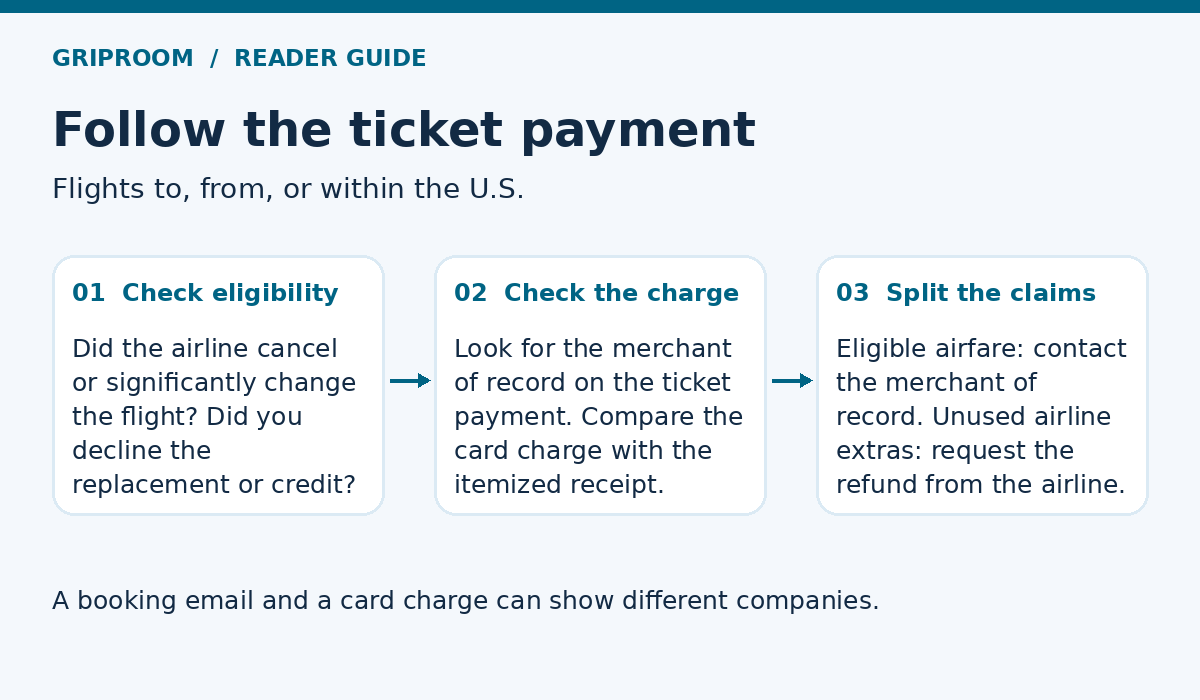
Find the merchant of record for the ticket before chasing an airfare refund. Airline extras follow a separate path.
First, distinguish an airline cancellation from your own cancellation
If the airline cancels and you decline replacement transportation and compensation such as a voucher, you are entitled to a ticket refund, including on a nonrefundable fare. The reason for the cancellation does not change that basic entitlement. But taking the replacement flight generally means you cannot also claim the canceled itinerary’s full airfare back. DOT’s passenger explanation describes the refund conditions.
A different situation is deciding not to travel while your flight still operates normally. Then your fare’s cancellation conditions matter. Do not click a voluntary-cancellation or credit option simply because you expect the airline to cancel later.
The distinction belongs in your first message to support: “The airline canceled my flight” describes a different problem from “I want to cancel my booking.” Save the airline’s cancellation notice so the record does not depend on how an agent summarizes the conversation.
What if the flight changed instead of being canceled?
For covered U.S. itineraries, a significant timing change means departure at least three hours earlier, or arrival at least three hours later, than originally scheduled. The threshold is six hours for international itineraries. These are itinerary comparisons, not a rule that every three-hour departure delay automatically qualifies.
Other qualifying changes include a different origin or destination airport, more connections, or a cabin downgrade. Additional protections cover disability-related changes, including a different connecting airport or replacement aircraft missing needed accessibility features. You still must decline the affected travel and refund alternatives to claim the corresponding ticket refund. These definitions appear in 14 CFR 260.2.
For example, a domestic itinerary originally arriving at 6 p.m. and changed to arrive at 9 p.m. reaches the timing threshold. A change to 8:30 p.m. does not meet that threshold alone, although another qualifying change could still apply.
Follow this receipt-to-refund decision tree
1. Did the airline cancel the flight?
Yes: Decide whether you still want replacement travel. If you want a refund instead, clearly decline the alternatives offered.
No: Check whether the change qualifies under DOT’s significant-change rules, or whether your ticket’s own refund conditions apply. A minor inconvenience is not automatically a cash-refund entitlement.
2. What does the airfare transaction show?
Expedia or its payment entity: Ask Expedia to identify the merchant of record and process the eligible airfare refund.
The airline: The airline is responsible for that ticket refund. Expedia may still help manage the booking or communicate the request.
An unclear descriptor or several charges: Match amounts to the itemized receipt before choosing a route. Ask support which transaction covers the ticket itself.
3. Are there separate bag, seat, or other airline-service fees?
Track separately purchased airline services with the airline. Do not assume a ticket refund settles a separate bag or seat charge. But do not strip taxes or ticket-included charges out of the airfare request just because the receipt itemizes them. Ask for a breakdown of what the ticket refund covers.
4. Is the disputed amount actually a hotel, insurance premium, or agency service fee?
Do not apply the airfare answer to it automatically. Identify the product and its terms first.
Expedia’s terms of service say refunds are returned by the party that took the original payment, using the original payment method. They also distinguish Expedia’s own fees from travel-provider charges. The practical lesson is to separate the invoice before arguing about the total.
How long should an Expedia refund take?
The crucial detail is when the applicable clock starts, not just the number of days.
DOT’s compliance guide distinguishes automatic airline ticket refunds from agency refunds made upon request. When the ticket agent is responsible, the guide specifies seven business days for credit-card payments or 20 calendar days for other payment methods after the agent receives airline confirmation that a refund is due. The agent must meet that deadline even if the airline has not yet returned the funds to it.
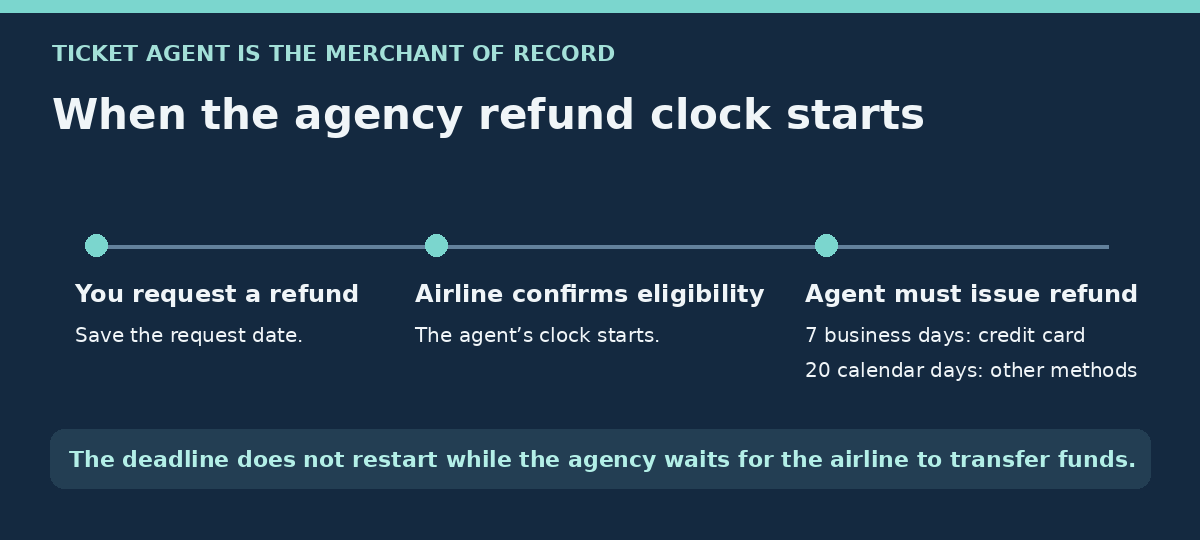
This timeline applies when the ticket agent is the merchant of record. An airline-issued refund follows its own triggers.
So “We are waiting for the airline” needs a follow-up: waiting for eligibility confirmation, or waiting for the money? Those are not the same milestone.
For airline-issued refunds, the regulation identifies separate triggers: a cancellation with no alternative offered, your rejection of the offered alternatives, or specified deadlines passing without a response or travel. Simply seeing an automatic rebooking in the app is not the same as choosing to accept it. If you want your money back, communicate that choice clearly rather than leaving the record ambiguous.
Ask for the request date, confirmation date, amount, and refund reference. A message saying a refund was approved is useful evidence, but it is not the same as a credit appearing in your account.
A useful follow-up when both companies point elsewhere
Suppose Expedia confirms it was the ticket merchant, while the airline says “we authorized your refund.” Ask the airline for the date it sent eligibility confirmation to Expedia, then ask Expedia whether it received that confirmation. If Expedia says it has approval but is waiting for funds, refer to the DOT deadline and request the issue date and transaction reference.
This is a fictional support scenario, not proof of wrongdoing. “Authorized,” “sent to the agency,” and “credited to your card” describe different events. A useful escalation identifies which event has actually happened and which remains missing.
Send a request that is easy to resolve
Here is a starting point to adapt only where accurate:
The airline canceled flight [number] on [date], booked under Expedia itinerary [number]. I am requesting a refund to my original payment method, not a travel credit. I have not accepted replacement travel or other compensation. My statement shows [merchant] charged [amount] for the ticket. Please confirm the responsible refund merchant, whether the airline has confirmed eligibility, the refundable amount, and the processing date or reference.
Attach the cancellation notice, itemized receipt, and relevant transaction details through the provider’s official support channel. Redact unrelated purchases and avoid sending a full card number. Keep the written responses together.
If support sends you back and forth, ask each side to identify the specific missing action rather than opening another vague “Where is my refund?” conversation.
If the refund still stalls
Escalate with your chronology and documents. DOT accepts air-travel consumer complaints; its guidance recommends first giving the airline an opportunity to resolve the issue. A complaint is an escalation route, not a promise of immediate payment.
You can also ask your card issuer about dispute options and deadlines while continuing to track the refund. Explain any pending or received credit accurately so you do not seek duplicate recovery.
The first useful action takes two minutes: open the payment statement and label each charge “ticket,” “airline extra,” or “other.” That turns one confusing canceled trip into a short list of identifiable amounts, responsible parties, and missing steps.