What Soccer Players Eat Before a Game: Match-Day Fueling Guide

Soccer players do not eat before a game the same way someone eats before a normal gym workout.
A soccer match is long, fast, and unpredictable. Players may jog, sprint, cut, jump, tackle, accelerate, decelerate, press, recover, and do it again for 90 minutes. Elite players can cover roughly 10–13 km in a match, with repeated high-intensity efforts layered on top of that distance. Soccer is also a glycogen-demanding sport, meaning stored carbohydrate in the muscles is a major fuel source, especially late in the game when fatigue starts to show.
That is why the best pre-game meal for soccer is not just “high protein.”
It is usually:
High carbohydrate.
Moderate protein.
Low to moderate fat.
Lower fiber than a normal healthy meal.
Familiar.
Easy to digest.
The goal is simple:
Start the game fueled, hydrated, comfortable, and not thinking about your stomach.
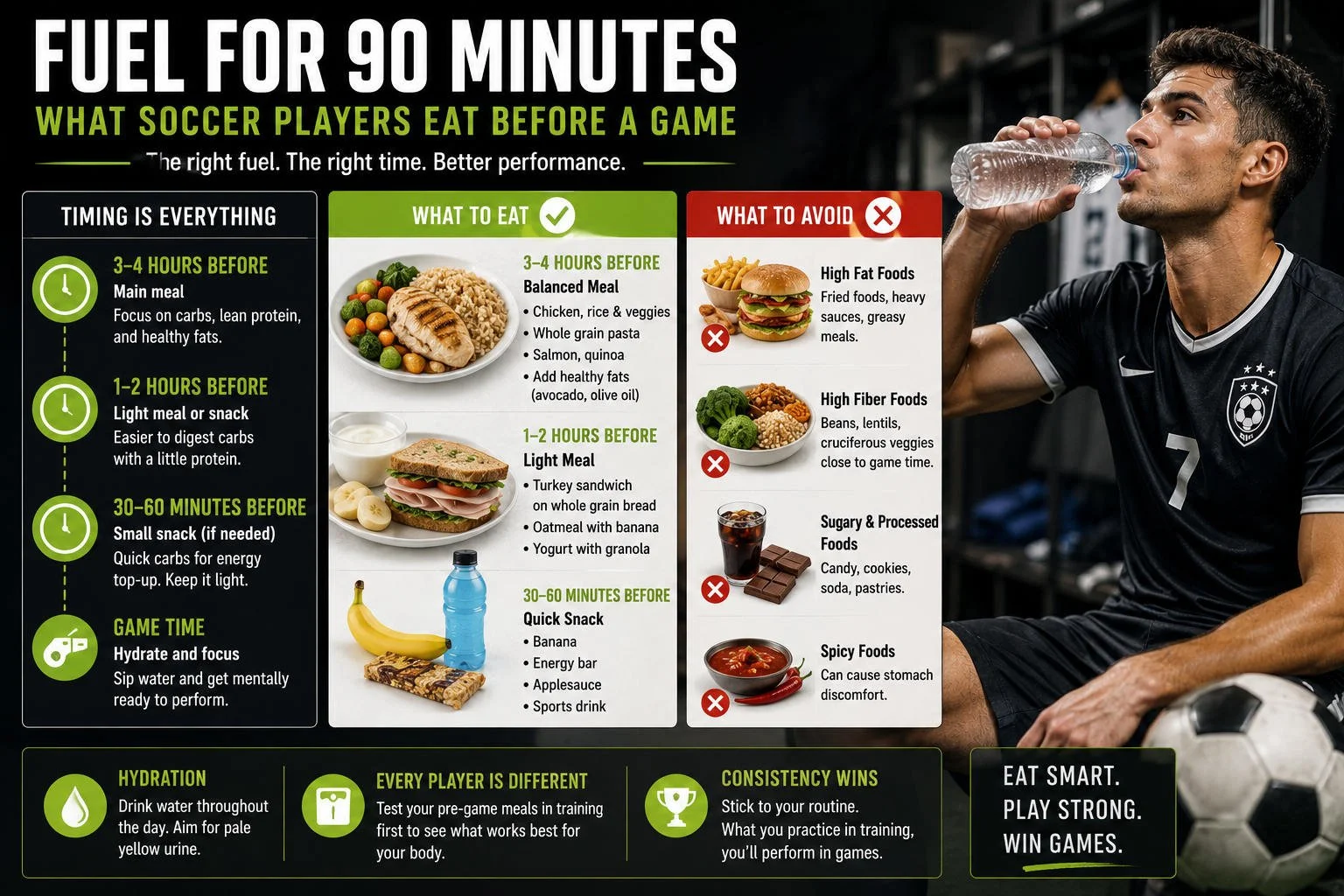
For most players, the best pre-game meal is eaten 3 to 4 hours before kickoff and is built around rice, pasta, potatoes, oats, bread, fruit, or another easy carbohydrate source, plus a lean protein like chicken, turkey, eggs, fish, tofu, or Greek yogurt. UEFA’s expert group statement on elite football recommends a carbohydrate-rich meal of about 1–3g carbohydrate per kilogram of body mass 3–4 hours before a match, within an overall match-day carbohydrate target of about 6–8g/kg.
This is not medical advice or a personalized nutrition plan. Players with diabetes, food allergies, eating disorders, GI conditions, RED-S risk, pregnancy, kidney disease, or other health concerns should work with a registered dietitian, sports dietitian, physician, or qualified clinician.
Quick answer: what should soccer players eat before a game?
The best soccer pre-game meal is:
A carb-heavy meal 3 to 4 hours before kickoff, with moderate lean protein and low fat.
Good examples:
Chicken and rice with a small amount of vegetables
Pasta with tomato sauce and grilled chicken
Turkey sandwich on bread with fruit
Oatmeal with banana and Greek yogurt
Eggs or egg whites with toast and fruit
Rice bowl with tofu, chicken, or fish
Potatoes with lean protein
Bagel with banana and a small amount of peanut butter
Smoothie with banana, oats, yogurt, and milk if solid food is hard
Then, closer to the game, add a small carb snack if needed:
Banana
Applesauce pouch
Pretzels
Crackers
Granola bar
Sports drink
Energy chews
Dried fruit
Rice cakes
Dry cereal
Johns Hopkins recommends a pre-competition meal 3–4 hours before competition, made mostly of carbohydrates with moderate lean protein; it also suggests a mostly simple-carbohydrate snack about 30 minutes before competition if needed.
The soccer match-day food timeline
The day before the game
The day before a soccer game is when players start topping up fuel stores.
This does not mean eating junk all day.
It means eating enough carbohydrate with normal protein, fluids, and familiar foods.
Good day-before foods:
Pasta
Rice
Potatoes
Bread
Oats
Fruit
Low-fat yogurt
Lean meat
Fish
Eggs
Tofu
Beans, if tolerated
Soup
Sports drink if needed for hydration
Water throughout the day
A good dinner the night before could be:
Pasta with marinara and chicken.
Rice bowl with salmon and vegetables.
Turkey sandwich with fruit.
Chicken, potatoes, and cooked vegetables.
Tofu stir-fry with rice.
Johns Hopkins notes that most athletes should have a balanced meal the night before competition, and that soccer players in long games may benefit from higher-carbohydrate meals 24–48 hours before competition.
Best rule:
Do not experiment the night before a game.
The night before is not the time for a new spicy restaurant, a huge greasy meal, or a food you are not sure your stomach likes.
3 to 4 hours before kickoff
This is the main pre-game meal.
The goal is to give the body enough time to digest while still filling muscle and liver fuel stores.
Sports nutrition guidelines commonly recommend 1–4g carbohydrate per kilogram of body weight in the 1–4 hours before exercise, with the amount depending on sport, duration, timing, and the athlete’s tolerance. The Gatorade Sports Science Institute summarizes this range and also notes that high fat, protein, and fiber close to exercise can slow digestion and potentially increase GI distress.
For a soccer player, the main meal should usually be:
Mostly carbs
Moderate lean protein
Low to moderate fat
Lower fiber than usual
Not too spicy
Familiar
Good 3–4 hour pre-game meals:
Chicken and rice
Simple, reliable, easy to digest.
Pasta with tomato sauce and grilled chicken
Classic for a reason. Avoid heavy cream sauce.
Turkey sandwich with fruit
Good for travel games.
Oatmeal with banana and Greek yogurt
Good for morning games.
Eggs, toast, and fruit
Good if you tolerate eggs well.
Rice bowl with tofu or fish
Good for players who do not want meat.
Potatoes with chicken or eggs
Good for players who prefer potatoes over pasta or rice.
Smoothie plus toast
Good for nervous players who struggle to eat.
Better Health Channel says a high-carbohydrate meal 3–4 hours before exercise can benefit performance, and that a high-fat, high-protein, or high-fiber meal close to exercise is more likely to cause digestive discomfort.
1 to 2 hours before kickoff
This is snack time, not a second meal.
The goal is to top off energy without creating stomach heaviness.
Good 1–2 hour pre-game snacks:
Banana
Applesauce pouch
Toast with jam
Bagel
Pretzels
Crackers
Low-fat granola bar
Cereal
Rice cakes
Sports drink
Fruit smoothie
Dried fruit
Small bowl of oatmeal
Avoid making this snack high-fat or huge. A peanut butter-heavy sandwich, fried food, pizza, cheeseburger, or big bowl of chili is much more likely to sit in the stomach.
Best rule:
The closer you are to kickoff, the simpler the food should be.
30 to 60 minutes before kickoff
This is for quick energy.
Not every player needs this, but many players like a small carbohydrate top-up before warm-up or right before kickoff.
Good choices:
Half banana
Applesauce pouch
Sports drink
Energy chews
Gel
Pretzels
Graham crackers
Fruit gummies
Dry cereal
Small piece of toast
Rice cake
Johns Hopkins lists simple-carbohydrate snack examples such as applesauce, pretzels, banana, fruit gummies, graham crackers, dried fruit, and dry cereal in the 30-minute pre-competition window.
Best rule:
Small, simple, mostly carbs.
Not:
Protein shake plus peanut butter plus a giant bar plus coffee.
That might be fine at breakfast, but too much right before a game.
During the game and halftime
This article is mainly about before the game, but halftime matters.
A soccer game is long enough that carbohydrate during the match can help, especially for older youth, competitive adult players, elite players, hot conditions, and tournaments.
Gatorade’s carbohydrate guidance recommends 30–60g carbohydrate per hour for team and power sport athletes exercising for an hour or longer, and Better Health Channel gives the same 30–60g per hour range for exercise lasting more than 60 minutes.
Good halftime options:
Sports drink
Gel
Chews
Half banana
Applesauce pouch
Pretzels
Dried fruit
Small energy bar
Water plus electrolyte drink if hot
Gatorade Sports Science Institute notes that increasing muscle and liver glycogen before competition and ingesting carbohydrate during competition can delay fatigue and help maintain soccer-specific skill execution.
Best halftime rule:
Use carbs you have already practiced with.
Do not try a new gel for the first time in a final.
What soccer players should eat before a game by kickoff time
Morning game
Morning games are tricky because there may not be enough time for a full meal 3–4 hours before kickoff.
Best plan:
The night before: eat a good carbohydrate-rich dinner.
Morning of: eat a smaller, easy breakfast.
Good morning-game breakfasts:
Oatmeal with banana
Bagel with jam
Toast with eggs
Greek yogurt with banana and cereal
Smoothie with banana, oats, and yogurt
Cereal with low-fat milk
Rice cakes and fruit
Applesauce and a sports drink if appetite is low
If kickoff is very early:
Eat a bigger carb-rich dinner the night before, then a small breakfast and a pre-game snack.
Johns Hopkins gives the same idea: for early-morning competition, focus on a carbohydrate-rich meal the night before and add a pre-competition snack.
Noon game
A noon game usually means breakfast is the main pre-game meal.
Good options:
Oatmeal, banana, Greek yogurt
Eggs, toast, fruit
Bagel, turkey, fruit
Rice bowl with eggs
Smoothie plus toast
Cereal, milk, banana
Then add a small snack 30–60 minutes before if needed:
Sports drink
Banana
Pretzels
Applesauce
Best rule:
Eat breakfast early enough that you are not still digesting during warm-up.
Afternoon game
An afternoon game is usually easiest.
Eat breakfast normally, then a main pre-game lunch 3–4 hours before kickoff.
Good pre-game lunches:
Chicken and rice
Turkey sandwich and fruit
Pasta with tomato sauce and chicken
Rice bowl with tofu
Potatoes with lean meat
Wrap with turkey and low-fat fillings
Then use a small carb snack closer to kickoff if needed.
Evening game
Evening games require more planning because players may accidentally under-eat or over-eat during the day.
Best plan:
Breakfast: normal balanced meal.
Lunch: carbohydrate-rich but not greasy.
Pre-game meal: 3–4 hours before kickoff.
Snack: 30–60 minutes before if needed.
Good evening-game pre-match meals:
Pasta with tomato sauce and chicken
Rice with fish or chicken
Turkey sandwich and fruit
Potatoes with eggs or chicken
Oats, banana, and yogurt if you prefer breakfast food
Smoothie plus bagel if solid food is hard
Best rule:
Do not save all your food for the last meal before kickoff.

Best pre-game meals for soccer players
1. Chicken and rice
This is the classic.
Why it works:
High carbohydrate from rice
Lean protein from chicken
Easy to digest
Easy to portion
Easy to meal prep
Works for travel games
Best version:
White rice or jasmine rice + grilled chicken + small amount of cooked vegetables + a little salt.
Avoid:
Heavy cream sauce
Too much oil
Huge raw salad
Very spicy sauce
2. Pasta with tomato sauce and chicken
This is another classic pre-game meal.
Why it works:
Pasta provides carbohydrates
Tomato sauce is usually lighter than cream sauce
Chicken adds moderate protein
Easy to eat 3–4 hours before kickoff
Best version:
Pasta + marinara + grilled chicken + small amount of parmesan if tolerated.
Avoid:
Alfredo
Heavy cheese
Sausage-heavy sauce
Too much oil
Giant portions right before warm-up
3. Turkey sandwich with fruit
This is one of the best travel-game meals.
Why it works:
Easy to pack
Carbs from bread
Protein from turkey
Fruit adds extra carbs and fluid
Lower fat than many fast-food options
Best version:
Turkey sandwich on bread + banana or apple + water.
Avoid:
Lots of mayo
Too much cheese
Greasy deli meats
Huge high-fiber bread if it upsets your stomach
4. Oatmeal with banana and Greek yogurt
This is excellent for morning games.
Why it works:
Oats provide carbohydrates
Banana adds easy carbs
Greek yogurt adds protein
Warm and easy to digest for many players
Best version:
Oats + banana + honey or maple syrup + Greek yogurt on the side.
Avoid:
Too many chia seeds or flax seeds before a game
Huge amounts of nut butter
Very high-fiber toppings if they cause GI issues
5. Eggs, toast, and fruit
This works well if you tolerate eggs.
Why it works:
Toast gives carbs
Eggs give protein
Fruit gives quick energy
Simple and familiar
Best version:
Eggs or egg whites + toast + banana or berries.
Avoid:
Bacon-heavy breakfast
Sausage-heavy breakfast
Fried potatoes in a lot of oil
Very large portions
6. Smoothie plus toast or bagel
This is good for nervous players who struggle to eat before games.
Why it works:
Easier to consume than a full solid meal
Can include carbs and protein
Can be adjusted for appetite
Best version:
Banana + oats + Greek yogurt + milk + honey.
Pair with:
Toast, bagel, or cereal if you need more carbs.
Johns Hopkins notes that a smoothie can be an easier-to-digest balanced meal for athletes who do not tolerate a full meal before competition.
7. Rice bowl with tofu, fish, or chicken
This is a good flexible meal.
Best builds:
Rice + tofu + soy sauce + cooked carrots
Rice + salmon + cucumber
Rice + chicken + small amount of teriyaki
Rice + eggs + fruit on the side
Avoid:
Too much avocado
Heavy mayo sauces
Large amounts of raw cruciferous vegetables
Spicy sauces if they cause reflux
8. Potatoes with lean protein
Potatoes are underrated pre-game fuel.
Good options:
Baked potato with chicken
Mashed potatoes with lean protein
Boiled potatoes with fish
Sweet potatoes with eggs
Avoid:
Loaded potato with bacon, sour cream, cheese, and butter
Fries
Heavy gravy
What soccer players should avoid before a game
High-fat meals
Examples:
Burgers and fries
Pizza
Fried chicken
Bacon-heavy breakfast
Sausage
Creamy pasta
Alfredo
Heavy cheese
Chips
Donuts
Fat takes longer to digest and can make players feel sluggish or uncomfortable before exercise. Johns Hopkins specifically lists high-fat foods like fried foods, whole-milk dairy, red meats, cheeseburgers, fries, and chips as foods to avoid before competition because they digest slowly and can interfere with carbohydrate intake.
Very high-fiber meals close to kickoff
Normally, fiber is healthy.
Right before soccer, too much can be a problem.
Examples:
Huge raw salad
Beans if not tolerated
Large bran cereal
Lots of broccoli or cauliflower
High-fiber protein bars
Heavy whole-grain meals if they upset your stomach
Johns Hopkins notes that high-fiber foods can increase gas, bloating, cramping, or diarrhea before competition.
Better:
Save the big salad and bean-heavy meal for after the game or a non-game day.
Too much protein right before kickoff
Protein is important for recovery and daily muscle maintenance.
But right before a game, too much protein can slow digestion and displace carbohydrates.
Bad timing examples:
Steak right before kickoff
Giant protein shake 20 minutes before warm-up
Chicken-heavy meal with no carbs
Protein bar with lots of fat and fiber
Better:
Moderate protein in the main meal. Mostly carbs closer to kickoff.
Better Health Channel notes that meals high in protein close to exercise can increase digestive discomfort, while pre-exercise meals should emphasize carbohydrates.
New foods
The golden rule of match-day nutrition:
Do not try something new before a game.
Avoid experimenting with:
New gels
New energy drinks
New pre-workout
New protein powder
New spicy food
New restaurant
New supplement
New high-fiber bar
The best pre-game meal is boring if boring works.
Too much caffeine or energy drinks
Some players use caffeine well.
Others get jitters, stomach upset, anxiety, or urgent bathroom trips.
If you use caffeine, test it in training first.
Do not try a huge energy drink for the first time before a match.
Hydration before a soccer game
Food is only half the pre-game plan.
Players also need to start hydrated.
A simple general strategy is to drink fluid in the hours before the game, not chug a huge amount right before kickoff.
Better Health Channel suggests about 500 mL of fluid in the 2–4 hours before an event as a general hydration strategy.
The National Athletic Trainers’ Association recommends roughly 500–600 mL of water or sports drink 2–3 hours before exercise, plus 200–300 mL 10–20 minutes before exercise.
A practical soccer version:
3–4 hours before: drink with your meal.
1–2 hours before: sip water.
10–20 minutes before: small top-up if needed.
During warm-ups and halftime: sip based on thirst, sweat, heat, and coaching rules.
Hot weather, turf, high sweat rates, tournaments, and long games may require electrolytes or sports drinks.
Best hydration rule:
Start hydrated. Do not try to fix dehydration during warm-up.
Should soccer players drink sports drinks before a game?
Sometimes.
A sports drink can help when:
The game is long
The weather is hot
The player sweats a lot
The player struggles to eat enough
There are multiple games in one day
The player needs carbs close to kickoff
Halftime fueling is possible
Sports drinks provide fluid, carbohydrate, and electrolytes. Gatorade’s carbohydrate guidance notes that team sport athletes competing for an hour or longer may benefit from 30–60g carbohydrate per hour during exercise, and that athletes should practice a plan combining carbohydrate and hydration.
Sports drinks are less necessary when:
The game is short
The player already ate enough
The weather is cool
The player is not sweating much
The player is very young and playing a shorter match
Best rule:
Use sports drinks as fuel, not as a default soda replacement.
What soccer players eat by position
Wingers and fullbacks
These players may do repeated high-speed running and recovery runs.
They usually need strong carbohydrate prep.
Good pre-game focus:
Rice
Pasta
Potatoes
Fruit
Sports drink if needed
Moderate lean protein
Central midfielders
Midfielders often cover lots of ground and need sustained energy.
Good pre-game focus:
High-carb meal
Familiar snack
Hydration
Halftime carb top-up if the game is intense
Strikers
Strikers need sprints, pressing, finishing, and repeated acceleration.
Good pre-game focus:
Carbs for repeated high-intensity efforts
Light protein
Avoid heavy fat that slows them down
Center backs
Center backs still need carbs, but may have fewer repeated long sprints than wingers depending on style of play.
Good pre-game focus:
Balanced carb-rich meal
Avoid overeating
Hydration
Goalkeepers
Goalkeepers may not cover the same distance as outfield players, but they still need focus, reaction speed, explosive movement, and hydration.
Good pre-game focus:
Moderate carb meal
Lean protein
Avoid heavy greasy food
Hydration
Smaller snack if appetite is lower
The big picture:
Every position needs carbs. Outfield players with heavier running loads may simply need more.
What youth soccer players should eat before a game
Youth players need the same basic structure, but with age-appropriate portions.
Good youth pre-game meals:
Oatmeal with banana
Turkey sandwich and fruit
Pasta with tomato sauce
Chicken and rice
Eggs and toast
Yogurt, cereal, and fruit
Smoothie and toast
Rice bowl with chicken or tofu
Good youth pre-game snacks:
Banana
Applesauce pouch
Pretzels
Crackers
Granola bar
Cereal
Toast with jam
Sports drink if needed for long/hot games
Alberta Health Services’ youth sports nutrition guide says the best foods before activity are high in carbohydrates, moderate in protein, and low in fat and fiber to fuel muscles and reduce the chance of stomach upset; it also recommends 400–600 mL of fluid 2–3 hours before activity.
Youth players should not be pushed into extreme dieting, low-carb diets, dehydration strategies, or supplement-heavy routines unless medically supervised.
Best parent rule:
Pack familiar carbs, water, and a small snack. Do not rely on concession food.
Best pre-game snacks for tournaments
Tournaments are different because players may have multiple games in one day.
The goal is:
Eat enough to recover, but not so much that you feel heavy before the next game.
Good between-game foods:
Banana
Applesauce pouch
Pretzels
Crackers
Bagel
Turkey sandwich
Sports drink
Chocolate milk after a game if tolerated
Rice cakes
Granola bar
Smoothie
Cereal
Low-fat yogurt
Fruit
Pasta or rice if there is enough time
If there are only 30–60 minutes between games:
Use simple carbs and fluids.
If there are 2–3 hours between games:
Use a small meal with carbs and lean protein.
If there are 4+ hours between games:
Use a normal pre-game meal again.
Gatorade’s carbohydrate guide recommends 1–1.2g carbohydrate per kilogram per hour for the first four hours after exercise when recovery time is under eight hours, then returning to normal daily fueling.
Best pre-game meals by stomach type
If you have a nervous stomach
Choose:
Smoothie
Banana
Applesauce
Toast
Rice
Plain pasta
Sports drink
Oatmeal
Crackers
Low-fat yogurt if tolerated
Avoid:
High fat
High fiber
Large meals
Spicy food
Too much coffee
Best nervous-stomach meal:
Smoothie with banana, oats, yogurt, and milk, plus toast if needed.
If you get hungry during games
You may need more carbs earlier.
Try:
Bigger carb meal 3–4 hours before
Sports drink during warm-up
Banana or applesauce before kickoff
Halftime carb snack
Best meal:
Chicken and rice + banana + sports drink at halftime.
If you feel heavy before games
You may be eating too close to kickoff or too much fat/fiber.
Try:
Eat the main meal earlier
Reduce fat
Reduce raw vegetables
Use smaller snacks closer to game
Switch from heavy foods to rice, toast, pasta, banana, or applesauce
Best meal:
Pasta with tomato sauce and chicken 4 hours before kickoff.
If you cannot eat early in the morning
Prepare the night before.
Try:
Bigger carb dinner
Small breakfast
Liquid meal
Banana or applesauce before game
Best plan:
Carb-rich dinner the night before, smoothie in the morning, banana before kickoff.
What this does not mean
This article does not mean:
Every soccer player needs the exact same meal.
Every player needs pasta.
Protein is bad before a game.
Fat and fiber are bad in general.
Sports drinks are always necessary.
Players should eat sugar all day.
Youth players should use adult supplement strategies.
Goalkeepers can ignore fueling.
Pre-game food fixes poor sleep or poor training.
New foods should be tested on game day.
This replaces advice from a sports dietitian or clinician.
It means this:
Soccer players should start games fueled, hydrated, and comfortable. That usually means a carb-rich meal 3–4 hours before kickoff, moderate lean protein, low fat and lower fiber close to game time, and a simple carb snack or sports drink closer to kickoff if needed.
Common mistakes soccer players make before games
Mistake 1: Eating too little
Some players get nervous and skip food.
Then they fade in the second half.
Better:
Use a smoothie, banana, applesauce, or sports drink if solid food is hard.
Mistake 2: Eating too much fat
Pizza, burgers, fries, fried chicken, and creamy pasta can sit heavily.
Better:
Rice, pasta with tomato sauce, potatoes, toast, fruit, and lean protein.
Mistake 3: Eating too much fiber right before kickoff
A giant salad or bean-heavy meal may be healthy on a normal day, but not ideal right before intense exercise.
Better:
Lower-fiber carbs closer to kickoff.
Mistake 4: Waiting too long to hydrate
Chugging water right before kickoff can cause sloshing and bathroom urgency.
Better:
Hydrate steadily in the hours before the game.
Mistake 5: Trying new supplements
Pre-workout, caffeine, gels, or energy drinks can backfire if untested.
Better:
Practice game-day nutrition during training.
Mistake 6: Thinking protein is the main pre-game fuel
Protein matters, but soccer runs mostly on carbohydrate availability during high-intensity match play.
Better:
Carbs first before the game. Protein with the meal, not instead of carbs.
Best soccer pre-game meal formulas
Formula 1: Classic pre-game meal
Rice + chicken + cooked vegetables + water
Best for:
Afternoon games
Players who like simple meals
Easy digestion
Formula 2: Pasta pre-game meal
Pasta + tomato sauce + grilled chicken + water
Best for:
Evening games
Carb loading
Players who tolerate pasta well
Formula 3: Morning-game meal
Oatmeal + banana + Greek yogurt + water
Best for:
Morning kickoff
Players who need a lighter breakfast
Players who do not want meat before a game
Formula 4: Travel-game meal
Turkey sandwich + fruit + water
Best for:
Away games
Bus rides
Tournaments
Formula 5: Nervous-stomach meal
Smoothie + toast
Smoothie:
Banana
Oats
Greek yogurt
Milk or water
Honey if needed
Best for:
Players who cannot handle a full meal
Early games
Anxiety before matches
Formula 6: Last-minute snack
Banana + sports drink
Best for:
30–60 minutes before kickoff
Players who need a quick carb top-up
Players who ate their main meal earlier
Sample match-day meal plans
Morning kickoff
Night before
Pasta with chicken and tomato sauce
Water
Morning
Oatmeal with banana
Water
30 minutes before
Applesauce pouch or sports drink
Halftime
Water or sports drink
Pretzels or chews if needed
Afternoon kickoff
Breakfast
Eggs, toast, fruit
Water
3–4 hours before game
Chicken and rice
Small amount of cooked vegetables
Water
1 hour before game
Banana or granola bar
Halftime
Sports drink or water
Quick carb if needed
Evening kickoff
Breakfast
Oats, yogurt, fruit
Lunch
Turkey sandwich, fruit, water
3–4 hours before game
Pasta with tomato sauce and chicken
30–60 minutes before game
Sports drink or pretzels
Tournament day
Breakfast
Oatmeal, banana, yogurt
Before game 1
Water
Small carb snack
Between games
Sports drink
Turkey sandwich or bagel
Fruit
Pretzels
After final game
Protein plus carbs
Fluids
FAQ
What do soccer players eat before a game?
Most soccer players should eat a carbohydrate-rich meal 3–4 hours before kickoff, with moderate lean protein and low fat. Good options include chicken and rice, pasta with tomato sauce and chicken, turkey sandwiches, oatmeal with banana, eggs and toast, rice bowls, potatoes with lean protein, or a smoothie plus toast.
What is the best meal before a soccer game?
The best meal is one you tolerate well and have practiced before. A safe general option is chicken and rice with water or pasta with tomato sauce and grilled chicken about 3–4 hours before kickoff.
How many carbs should a soccer player eat before a game?
UEFA’s expert group statement recommends about 1–3g carbohydrate per kilogram of body mass in the pre-match meal 3–4 hours before kickoff. General sports nutrition guidance often gives a broader 1–4g/kg range in the 1–4 hours before exercise.
Should soccer players eat protein before a game?
Yes, but not too much close to kickoff. Protein should be moderate in the main pre-game meal. Carbohydrates are the main pre-game fuel, while protein supports recovery and helps the meal feel complete.
Is pasta good before soccer?
Yes. Pasta with a lighter tomato-based sauce and lean protein can be a good pre-game meal, especially 3–4 hours before kickoff. Avoid heavy cream sauces, too much cheese, and greasy meat toppings.
Is rice good before soccer?
Yes. Rice is one of the easiest pre-game carb sources to digest for many players. Chicken and rice is a classic pre-game meal because it gives carbohydrates, lean protein, and simple portion control.
What should soccer players eat 1 hour before a game?
One hour before a game, choose a small, easy carbohydrate snack such as a banana, applesauce pouch, pretzels, crackers, granola bar, sports drink, rice cakes, dried fruit, or cereal.
What should soccer players avoid before a game?
Avoid greasy foods, fried foods, very high-fiber meals, huge raw salads, very spicy food, too much protein right before kickoff, and new supplements or foods you have not tested before.
What should a soccer player eat for a morning game?
For a morning game, eat a carb-rich dinner the night before. In the morning, choose oatmeal with banana, toast with eggs, cereal with milk, a smoothie, a bagel with jam, or Greek yogurt with fruit. If the game is very early, keep breakfast small and use a simple carb snack before kickoff.
Should soccer players drink sports drinks?
Sports drinks can help when the match is long, the weather is hot, the player sweats heavily, or the player needs carbohydrate close to kickoff or at halftime. For shorter, cooler, lower-intensity games, water may be enough.
What should soccer players eat at halftime?
Good halftime choices include sports drink, banana, applesauce, gel, chews, pretzels, dried fruit, or water with a quick carb source. The goal is quick energy without stomach heaviness.
Should soccer players carb-load?
Competitive soccer players may benefit from higher carbohydrate intake before matches, especially for long games, tournaments, intense competition, or repeated games. For most players, this means eating enough carbs the day before and a carb-rich meal before the match, not overeating junk food.
Let’s play!
Soccer players eat before a game to fuel running, sprinting, decision-making, and late-game performance.
The best pre-game plan is:
Day before: eat enough carbs, fluids, and normal protein.
3–4 hours before kickoff: eat a carb-rich meal with moderate lean protein.
1–2 hours before kickoff: use a small carb snack if needed.
30–60 minutes before kickoff: keep it simple: banana, applesauce, sports drink, pretzels, or chews.
During/halftime: use water, sports drink, or quick carbs depending on match intensity, heat, and player needs.
Avoid: greasy food, high-fat meals, too much fiber, spicy food, huge portions, and anything new.
The simplest pre-game meal:
Chicken and rice.
The simplest morning-game meal:
Oatmeal, banana, and Greek yogurt.
The simplest last-minute snack:
Banana or sports drink.
The best rule:
Eat carbs early, protein moderately, fat lightly, and nothing new on game day.
That is how soccer players fuel for a full match without feeling heavy, cramping, or fading late in the game.