What McDonald’s Happy Meals Teach About Kids, Food, and Bribery
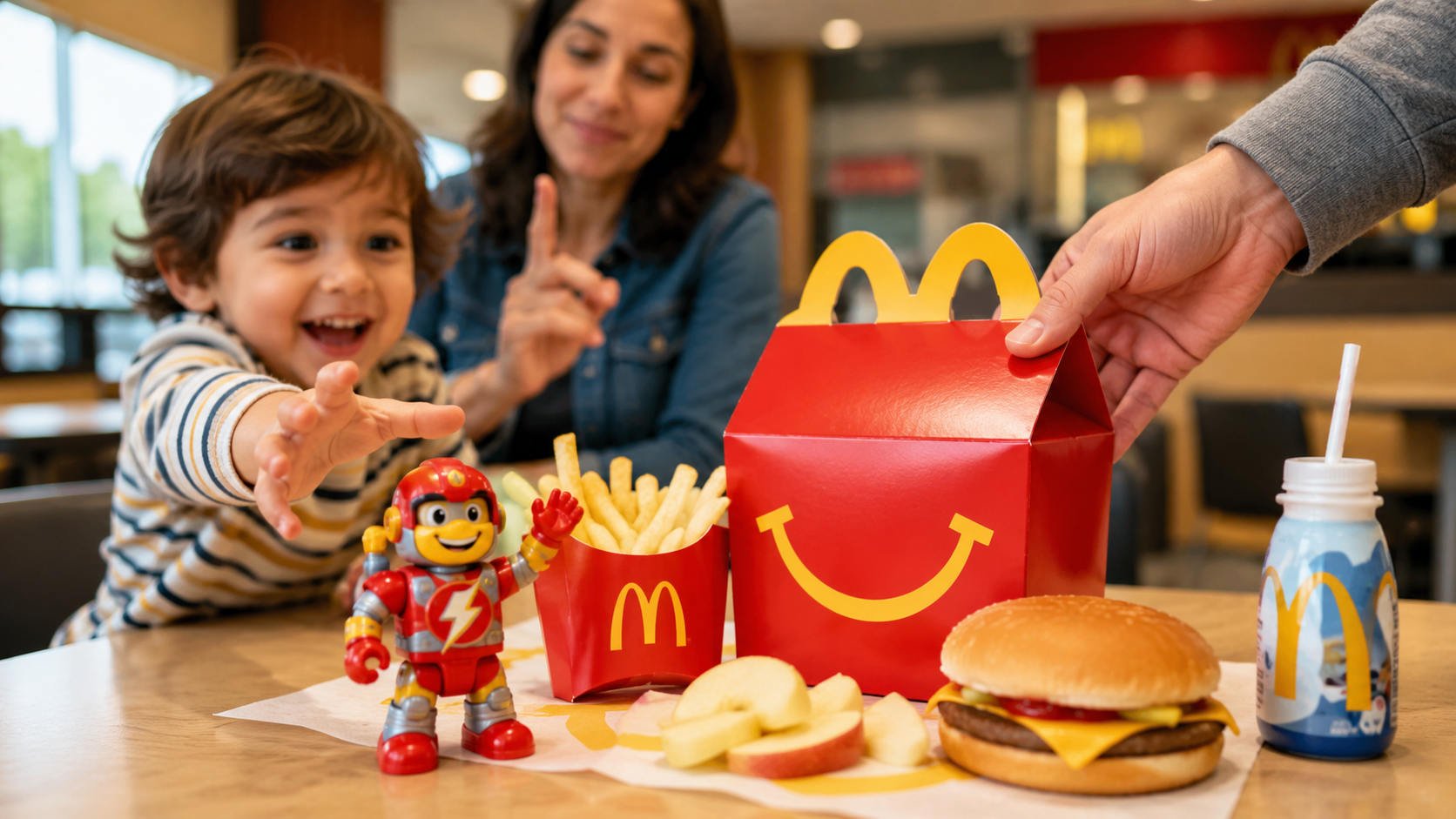
The McDonald’s Happy Meal is not a meal. Please. A meal is something you eat because you are hungry. A Happy Meal is a tiny red hostage negotiation box with fries, branding, a toy, and just enough apple slices to make everyone involved feel like the republic still has standards.
It is one of the most brilliant food inventions of modern parenting because it understands children better than most adults do: kids do not want lunch. Kids want an event. They want a box. They want a toy. They want control. They want to be handed a little plastic or paper object with the solemn gravity of a medieval prince receiving land. The hamburger is just the edible paperwork.
McDonald’s current U.S. Happy Meal menu includes hamburger or Chicken McNuggets options with kids fries, apple slices, a beverage choice, and a Happy Meal toy; the listed Hamburger Happy Meal with kids fries, apple slices, and 1% low-fat milk comes in at 475 calories.
The Happy Meal Is Bribery With Better Packaging
Parents have been bribing children with food since the first cave parent said, “Eat the mammoth paste and you can play with the sharp rock.” The Happy Meal simply professionalized the transaction. It took the awkward parental bribe — “If you behave, maybe we’ll get nuggets” — and folded it into a cheerful box with handles, so nobody has to say the ugly part out loud.
The genius is that the toy does not feel like a bribe. It feels like magic. The kid thinks, “I got a toy.” The parent thinks, “I bought 11 minutes of peace.” McDonald’s thinks, “Excellent, the small consumer has formed an emotional bond with the brand before learning multiplication.”
This is not accidental. The Happy Meal has been around for decades; McDonald’s celebrated the Happy Meal’s 40th anniversary in 2019 by bringing back 15 classic toys, and its own nostalgia tour included McNugget Buddies, Changeables, Hot Wheels, Teenie Beanie Babies, Tamagotchi, Furby, and other tiny pieces of branded childhood debris.
The Toy Is the Main Course, Obviously
Adults pretend the Happy Meal is about food because adults enjoy lying in drive-thru lanes. Children know the truth: the toy is the reason this whole cardboard circus exists.
A kid does not stare longingly at a four-piece nugget meal and whisper, “Ah yes, protein and portion control.” A kid wants the Pokémon card, the mini fries toy, the tiny register, the movie character, the weird collectible thing that will be beloved for nine minutes and then live under a car seat until college.
McDonald’s keeps proving that the toy is the point. In 2025, the company launched Lil McDonald’s Happy Meals with 21 miniature toys inspired by McDonald’s restaurant objects — tiny fries, a register, a Boo Bucket, and other pint-sized brand relics — and called the Happy Meal “more than just a meal.” That is corporate-speak for “yes, the toy is doing emotional labor.”
Kids Don’t Just Eat Food. They Eat Stories.
A Happy Meal is powerful because it turns food into a story. The box has a face. The toy has a theme. The meal has a ritual. The kid gets to open, discover, collect, compare, and demand the next one like a tiny museum curator with ketchup on their sleeve.
That is why character tie-ins work so well. McDonald’s 2025 Pokémon Happy Meal included trading card booster packs, a poster, stickers, themed boxes, and even in-app digital rewards for Pokémon TCG Pocket. The food was still there, of course, quietly doing burger work in the background while the collectibles ran the meeting.
This is the central lesson: children do not experience food as nutrition first. They experience it as play, identity, routine, attention, and reward. The Happy Meal did not invent that. It just put handles on it.
Food Marketing to Kids Is Not Subtle, Because Subtlety Does Not Sell Nugget Boxes
Public health researchers have been yelling about toys in kids’ meals for years, because attaching a toy to food is not exactly a neutral act of benevolent fry distribution. Healthy Eating Research reported that, in 2009, top fast-food chains spent $341 million on toys for children’s meals and sold slightly more than 1 billion meals with toys to children ages 12 and under.
The World Health Organization says food marketing affects children’s food choices, dietary intake, purchase requests to adults, and norms about food consumption. Translation: when kids are blasted with branded food fun, they do not calmly say, “Mother, I have considered the sodium.” They ask for the thing. Repeatedly. In public. Near your weakening spirit.
Pester Power: The Real Happy Meal Sauce
The Happy Meal is also a masterclass in “pester power,” which is the polite academic phrase for “your child has asked 47 times and you are now spiritually underwater.”
A Dartmouth-linked study found that the more children watched channels airing child-directed fast-food ads, the more often their families visited those restaurants. In the same study, 54% of children requested visits to at least one of the advertised restaurants; among the 29% who collected toys, almost 83% requested visits to one or both restaurants.
That is not lunch. That is a marketing funnel wearing light-up shoes.
The kid sees the ad. The kid wants the toy. The kid asks the parent. The parent says no. The kid asks again. The parent says no with less conviction. The kid asks in the car while the parent is trying to merge. The parent hears themselves say, “Fine.” And somewhere, a shareholder smiles into a spreadsheet.
The Happy Meal Solves a Real Parent Problem, Annoyingly
Here is the inconvenient truth: the Happy Meal works because it actually helps parents in the moment.
It is predictable. It is portioned. It is portable. It is easy to order. It gives the kid a choice without giving them full menu democracy, which is important because children with too many choices become tiny constitutional crises. Hamburger or nuggets. Milk, water, juice, or chocolate milk. Toy. Done. Drive away before anyone develops a new opinion.
That is the part critics sometimes miss. Parents are not always seeking ideal nutrition in the drive-thru. Sometimes they are seeking silence, calories, and a rear-seat ceasefire before soccer practice. The Happy Meal is not pretending to be lentil soup from a Waldorf school. It is a practical tool for exhausted adults managing small humans who believe hunger is a personal betrayal.
McDonald’s Knows the Criticism, So Now the Bribe Comes With Apple Slices
The Happy Meal has changed because the criticism worked, at least somewhat. The modern version is not the old-school “fries, soda, toy, good luck raising a pancreas” arrangement. McDonald’s now lists apple slices as part of U.S. Happy Meals and offers drink choices including milk, reduced-sugar chocolate milk, water, and juice.
McDonald’s also created global Happy Meal nutrition goals. Its 2022 final report said an average of 56% of Happy Meal bundle offerings across 20 major markets met its nutrition criteria, exceeding its 50% goal; the same report said 100% of Happy Meal bundles shown in children’s ads across those markets met the nutrition criteria in 2022.
The criteria in that report included limits of 600 calories, 650 mg sodium, 10% of calories from saturated fat, and 10% of calories from added sugar for advertised Happy Meal bundles. So yes, the Happy Meal got a nutrition rubric, because apparently even childhood bribery now has compliance metrics.
Healthier Defaults Matter More Than Lecturing a Six-Year-Old
One useful lesson from Happy Meals is that defaults work. Not speeches. Not “let’s make good choices, Brayden.” Defaults.
A CDC-published study on San Francisco’s toy ordinance found that, after changes in children’s side dishes and beverages at one chain, children’s-meal orders saw decreases in calories, sodium, and fat; the authors concluded that healthier default menu options may be a powerful way to improve dietary intake.
This is why apple slices matter even when a child treats them like edible packing material. The point is not that every kid lovingly eats the apples while contemplating fiber. The point is that putting fruit in the box normalizes fruit being part of the meal. Very sneaky. Almost adult.
Food as Reward Is Still a Slippery Little Grease Slide
The problem is not one Happy Meal. The problem is the pattern where food becomes the emotional currency of childhood: fries for behaving, candy for cleaning, dessert for eating vegetables, nuggets for shutting up in Target. A little of this is normal because parents are humans, not Montessori vending machines. But when food becomes the primary reward system, things get messy.
University of Rochester Medical Center warns that using food as a reward or punishment can undermine healthy eating habits, interfere with children’s ability to regulate eating, and encourage eating when they are not hungry as a form of self-reward.
So the Happy Meal teaches a brutal parenting truth: bribery works immediately and gets weird later. Very on-brand for modern life.
The Box Makes the Parent Feel Like the Good Guy
The Happy Meal is also emotionally convenient for the adult. That matters.
A parent does not have to say, “I am buying your temporary obedience with salted potatoes and a branded toy.” They get to say, “Let’s get a Happy Meal.” See? Softer. Cheerful. Sanitized. The box smiles. The child smiles. Everyone smiles except the apple slices, which know exactly how this ends.
This is the genius of packaging: it launders the transaction. The parent gets to feel generous, the kid gets a toy, the brand gets loyalty, and the food gets to ride along pretending it was invited to its own party.
The Happy Meal Teaches Kids How Consumer Rituals Work
A Happy Meal is a child’s first lesson in bundled value. You do not just buy food. You buy food plus toy plus identity plus habit plus anticipation. It is basically a tiny MBA program in cardboard.
The child learns that meals can come with prizes. That brands can be friendly. That characters can tell you what food to want. That a collectible can turn lunch into a mission. That “limited time” means urgency, even before they can spell urgency.
McDonald’s shift toward more sustainable Happy Meal toys by the end of 2025 shows the company understands the toy is not optional decoration; it is central enough to require a global materials strategy. The company said it aimed for every Happy Meal toy to use more renewable, recycled, or certified materials, reducing virgin fossil-fuel-based plastic in Happy Meal toys by about 90% from a 2018 baseline.
That is a lot of corporate effort for something that supposedly is just a fun little extra. Sure. And the fries are just potato bookmarks.
What Parents Can Actually Do With This Information
The answer is not “ban Happy Meals forever” unless your parenting style is “joyless courtroom.” The answer is to stop pretending the Happy Meal is neutral.
Set expectations before the drive-thru. Say whether this is a meal, a treat, a travel convenience, or a birthday-adjacent little fry festival. Do not make the Happy Meal the automatic reward for every act of basic civilization, like not licking a shopping cart.
Choose the better defaults when possible: milk or water, apple slices, smaller portions, and no extra sugary drink just because the toy has already hypnotized everyone. The current menu makes some of those choices available; the adult still has to act like the adult, which is annoying but legally part of the position.
Treat the toy as a bonus, not the reason for eating. A child can enjoy the thing without the whole meal becoming a tiny altar to consumer dopamine. Yes, they may still ask for the next toy. That is because children are adorable and also basically unpaid lobbyists.
The Real Lesson of the Happy Meal
What McDonald’s Happy Meals teach about kids, food, and bribery is simple: children are not rational nutrition calculators. They are story-driven, reward-seeking, toy-detecting chaos muffins who experience food through emotion, play, repetition, and parental limits.
The Happy Meal works because it understands all of that. It makes food predictable. It makes the meal fun. It makes the toy the headline. It makes the parent’s life easier. It turns lunch into a collectible event and calls the whole thing “happy,” because “Compliance Meal With Fries” tested poorly with focus groups.
Is it manipulative? Yes. Is it useful? Also yes. That is the annoying part.
A Happy Meal is not evil. It is not health food. It is not parenting failure in a red box. It is a perfectly engineered little machine that turns hunger, play, marketing, and parental exhaustion into a single transaction.
The kid gets nuggets.
The parent gets quiet.
McDonald’s gets the next generation.
And the apple slices sit there, heroic and ignored, like tiny pale witnesses to capitalism.