“Pre-emptive” is doing a great deal of work in the argument over presidential pardons. It can sound like permission to commit the next offense. The legally important meaning is usually permission to avoid prosecution for conduct that has already happened.
A president can pardon a completed federal offense before charges are filed. That is different from pardoning an offense before it is committed. It is also different from reaching into state criminal law or erasing every record of the underlying events.
Those boundaries matter as Donald Trump discusses protecting staff and allies. The publication record for his November 2 Pod Force One episode describes a discussion of pardons if Democrats take Congress. An accessible syndicated report of the exchange attributes conditional pardon remarks to him.
The remarks are politically consequential. An issued pardon would be a different document, with a different legal effect. The first task is to keep the promise, the covered conduct and the actual grant from blending into one story.
The offense can come before the prosecution
A criminal investigation has several dates. The alleged conduct occurs. Investigators may learn about it later. Charges can follow later still. A pardon granted between those stages is not necessarily a pardon for future wrongdoing.
The Supreme Court’s opinion in Ex parte Garland described the pardon power as exercisable after an offense’s commission, including before legal proceedings begin. The Congressional Research Service’s overview likewise distinguishes that broad timing power from a pardon issued to cover a crime before its commission.
This is why a pardon recipient need not first be charged or convicted. An absence of charges does not, by itself, make a pardon legally meaningless. It also does not prove that the recipient committed an offense. Those are separate propositions.
For a reader assessing a real grant, the useful question is what past conduct its wording reaches. A broad description, a named matter or a specified date range may be consequential. “Pre-emptive” alone does not explain the instrument.
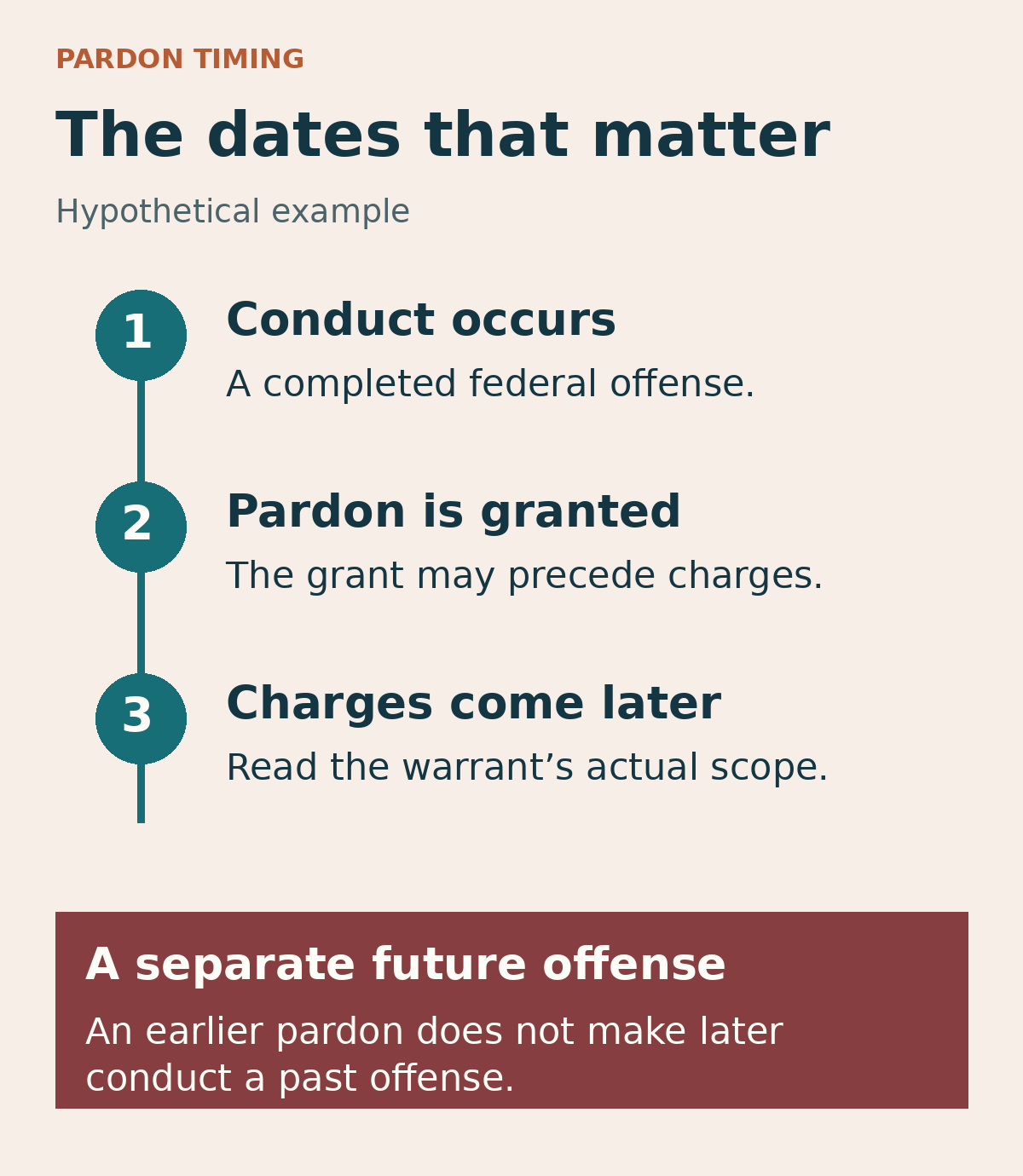
A pardon may come after an offense but before charges for it. A separate offense committed after that pardon is not transformed into past conduct merely because the same person commits it. The scope of an actual warrant and any continuing offense would require their own analysis.
An earlier pardon cannot authorize the next crime
That temporal boundary is the limit hidden inside the phrase. A pardon for past conduct is not advance immunity for whatever someone might do afterward.
This does not make pre-charge clemency trivial. Removing exposure for a completed federal offense can have substantial consequences even when an investigation is still gathering evidence. The point is to identify the protection accurately, rather than stretching it into a general permission slip.
Continuing offenses need particular care. A complicated course of conduct may raise questions about when an offense was committed, what continued after the grant and how the warrant describes its coverage. A diagram cannot settle those questions for a real defendant. It can show why they must be asked.
The same care applies to a new act during a later investigation. The existence of a pardon for earlier conduct does not, on its own, answer the legal status of that later act.
The federal boundary matters too
Article II gives the president clemency power over offenses against the United States, with an impeachment exception. The Justice Department’s guidance explains that the president cannot pardon a state offense.
That can be significant when conduct potentially falls under more than one jurisdiction. It is not a guarantee that a state has a valid case waiting to take over. State law, the evidence and the legal limits on a particular prosecution still have to be examined.
The distinction is between the reach of presidential clemency and the merits of some other proceeding. Saying the first stops at a jurisdictional boundary does not establish the second.
A pardon also does not dispose of impeachment through the president’s clemency power. The constitutional exception is explicit. Political accountability and federal criminal punishment operate through different mechanisms.
A pardon is not an eraser
Forgiveness, punishment and the historical record are easy to compress into a single idea of being “cleared.” The law does not treat them as interchangeable.
The Justice Department says a presidential pardon does not expunge the conviction. It distinguishes clemency from a finding of innocence and from expungement, a separate judicial remedy. Its guidance also identifies noncriminal civil proceedings that a pardon does not end.
Those points do not establish that every possible consequence survives every grant. They do explain why a reader should resist a sweeping claim that a pardon makes the underlying events disappear.
Records may remain relevant to public understanding, professional consequences or a proceeding outside the grant’s reach. Exactly what follows depends on the particular record and legal question. The word “pardon” cannot answer all of them at once.
Read the warrant, not just the announcement
The Office of the Pardon Attorney’s posted grants offer a starting point for distinguishing actual instruments from talk about future ones. The list and linked documents should be read with their dates; a returned web page is not a guarantee of instantaneous or exhaustive reporting.
For a named grant, look for the recipient, the conduct covered, the relevant dates and any conditions. Then ask which jurisdiction and kind of proceeding are involved. A promise to protect someone does not substitute for that examination.
Trump’s discussion of pre-emptive pardons therefore raises a real accountability question. It does not require inventing a crime by a named ally or pretending that a future grant has already been signed. The consequential story is what a particular exercise of the power could remove—and which questions its text would still leave open.