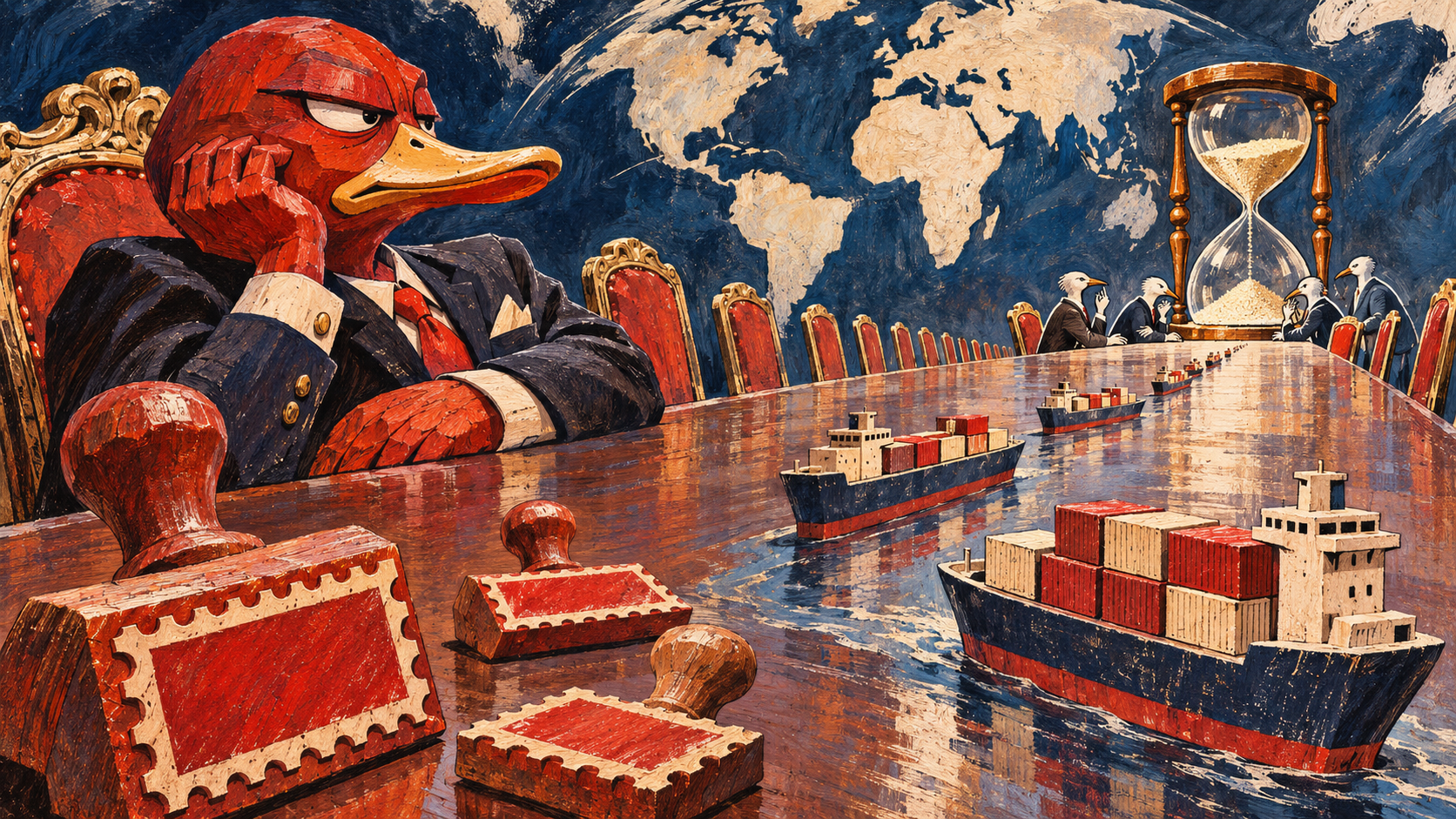
A president weakened at home can still be an expensive person to negotiate with abroad.
After the 2026 midterms, trade partners have a reason to reassess how quickly they should make concessions to Donald Trump. Waiting could preserve options, allow negotiations to develop or avoid committing money to a project they do not yet consider worthwhile. It would not, by itself, switch off the legal machinery of U.S. trade policy.
That is the tension behind the “angry duck” warning in Reuters’ post-election trade reporting. European Parliament trade committee chair Bernd Lange used the phrase to describe a possible response by a weakened Trump. It is an attributed assessment, not proof of a private plan to retaliate.
Nor is there evidence here of a coordinated post-election policy to run down Trump’s remaining term. The more revealing starting point is a documented disagreement that began before the votes were counted: what, exactly, South Korea had agreed to fund in Alaska.
An investment review became an argument about a promise
On October 1, KBS reported the Korean industry minister’s objections to Washington’s announcement of a large South Korean commitment to the Alaska LNG project. The minister said an investment depended on commercial viability and that the amount had not been agreed.
The distinction was substantial. Beginning a review of a project is different from deciding to finance it. A country can accept a negotiating framework while still examining whether a particular investment satisfies the conditions attached to it.
Two days later, KBS reported Trump’s threat to charge more if South Korea did not agree. The report also noted that he had not specified what charge he meant. That qualification matters: the remark was not itself a published tariff order, and it did not establish a rate or a lawful basis for collecting one.
The episode gives the post-midterm question some substance. A partner can insist that a proposed investment remains conditional; the president can answer with pressure. Both positions can persist after an election changes the political atmosphere in Washington.
The dispute also has a less dramatic explanation than a strategy to embarrass Trump. Alaska Public Media’s October 9 reporting described the project’s commercial hurdles and included an analyst who expected South Korea ultimately to invest. Negotiations, financing conditions and genuine interest in a project can coexist with resistance to calling it a done deal.
That is a stronger foundation for this story than assuming every delay is a secret act of defiance.
The court closed one route, not the whole tariff system
There is an equally important limit on the idea that Trump can simply answer any disagreement with any tariff he likes.
In February, the Supreme Court held in Learning Resources v. Trump that the International Emergency Economic Powers Act, or IEEPA, did not authorize presidential tariffs. A claim that Trump retains unlimited emergency tariff authority would therefore miss a central legal development of 2026.
But U.S. trade authority is spread across different laws. The failure of an IEEPA argument does not automatically erase a separate delegation Congress made in another statute. The relevant question is which law supports a particular action and whether its requirements have been met.
Section 301 of the Trade Act provides one example. It authorizes specified action by the U.S. trade representative following findings about foreign acts, policies or practices affecting U.S. commerce. Duties and other restrictions are among the tools listed in the statute, with presidential direction playing a role.
That is a legal route with conditions, not a general entitlement to punish a country for disappointing the president. A threat about an LNG investment does not supply every statutory finding needed for a tariff measure.
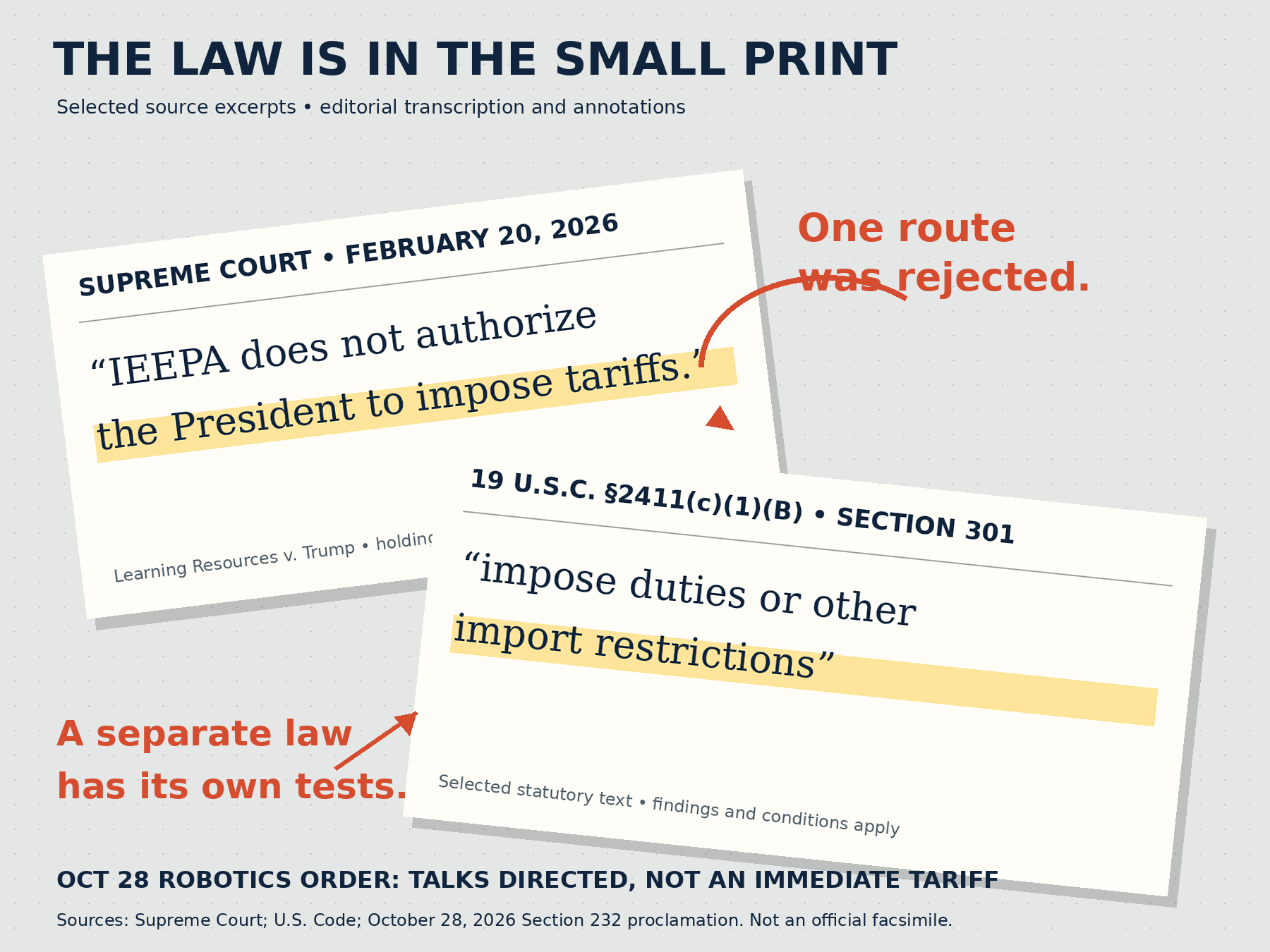
The Supreme Court rejected IEEPA as tariff authority. Section 301 provides a separate route requiring statutory findings and action. The October 28 robotics proclamation directed negotiations under Section 232; it did not immediately impose a new robotics tariff.
The paper trail shows the difference between a tool and a threat
Section 301 was more than a theoretical alternative this year. USTR announced a final action following forced-labor investigations on July 23. Its account described investigations, consultations, hearings and comments. The published Federal Register notice set out the action, its legal basis, exemptions and effective-date provisions.
The July documents demonstrate a distinct statutory process. They are not a reliable substitute for checking the current treatment of a particular product in November. Subsequent amendments, exclusions, litigation and customs instructions can matter to that answer.
A more recent example makes another distinction visible. Trump’s October 28 proclamation on robotics and industrial machinery directed Commerce and USTR to pursue negotiations under Section 232. Reading the operative instruction matters: the document did not immediately impose a new robotics tariff.
There was also an October 23 proclamation modifying the coverage of certain Canadian duties, with changes effective October 30, invoking a different law, Section 338. That is another reason to identify the actual instrument rather than treat every trade announcement as the same emergency power. Its stated findings are the administration’s account, not an independent judicial endorsement.
For a reader following the next dispute, the revealing details are usually the unglamorous ones: the statute cited, the operative clause, the covered goods, the conditions and the effective date. A statement that the president wants a higher charge is one stage of a story. A measure customs authorities are instructed to administer is another.
A Democratic Congress changes the bargaining environment
The election result gives trade partners something new to consider. A president who must negotiate with an opposition-controlled Congress faces a different political setting from one whose party controls both chambers.
That can make waiting an attractive option. A partner might want to see whether promised benefits remain politically achievable, whether a proposed investment can satisfy its domestic requirements or whether Washington settles on a stable negotiating position. These are possible incentives, not a finding that a government has adopted a specific delaying strategy.
Congress also cannot be treated as an automatic tariff cancellation service. An election result does not repeal an existing statute. The ordinary route for changing the law still requires legislation and presidential presentment. A veto can be overridden, but only with the constitutionally required support. The House’s explanation of that process is a useful antidote to the idea that a new majority can instantly deliver every promised reversal.
There is uncertainty on both sides of the table. A partner may gain room to question a commitment while finding that Washington’s president still has tools that matter. Trump may retain those tools while discovering that political resistance, statutory limits and commercial reality narrow the results he can obtain.
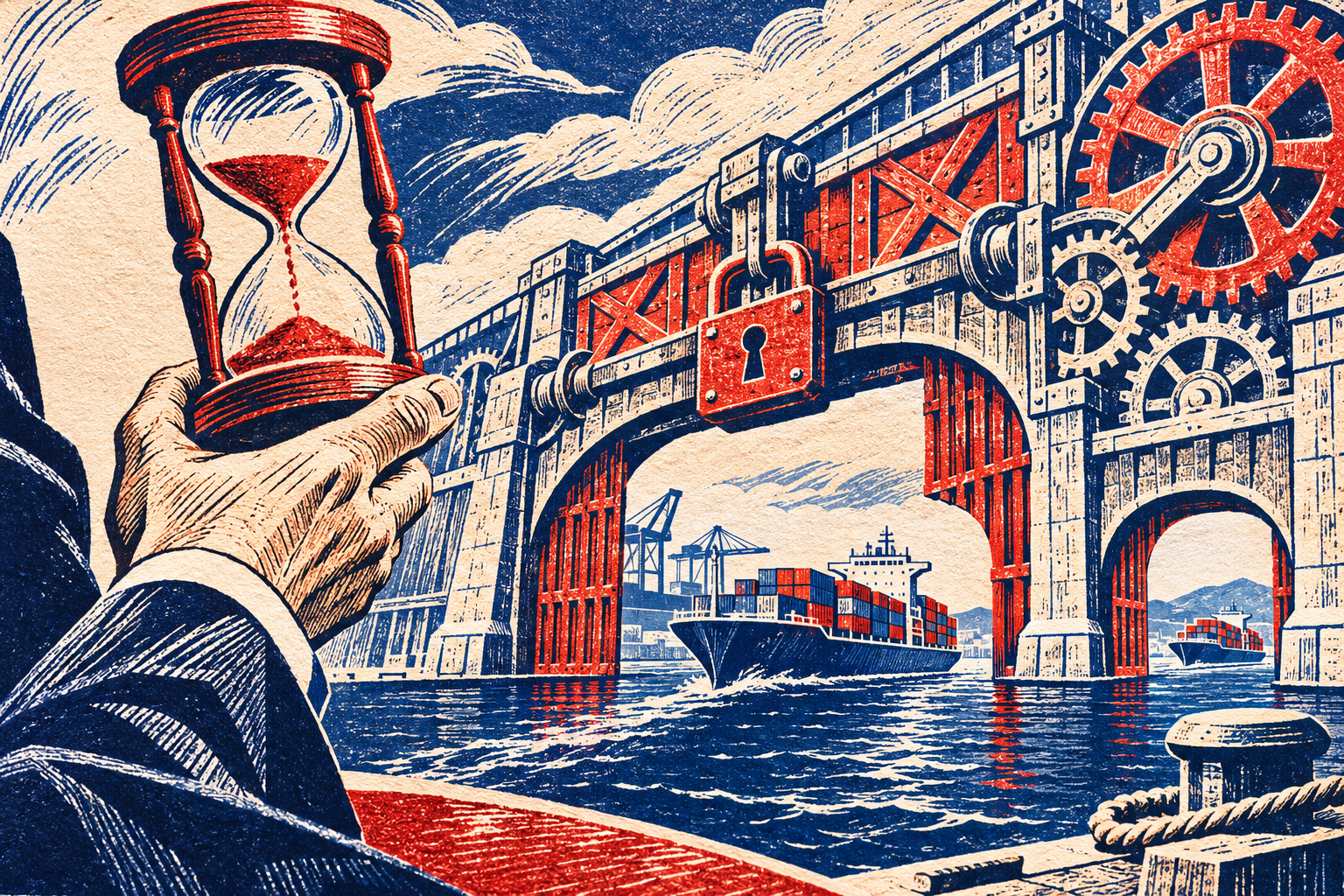
Waiting can preserve options without providing immunity
The strongest version of the “cornered duck” story is an institutional one. Political weakness and legal authority can move in different directions. Losing congressional allies can make negotiations harder without automatically removing powers granted by laws already on the books.
The countercase belongs in the same frame. Trump could pursue agreements that let both sides claim progress. A partner’s hesitation could end when a project becomes commercially acceptable. Courts could reject a particular measure. Congress could change the law if the necessary coalition forms. None of those outcomes follows mechanically from the election.
For households and businesses, that means an overnight assumption that trade costs will simply disappear is premature. The election changes the bargaining environment. Product-specific charges still turn on actual legal measures, not the political obituary of the person negotiating them.
Watch for a move from a conditional investment review to a binding commitment, or from a presidential threat to a properly specified trade action. Those transitions tell us more than trying to infer the president’s mood. Waiting may buy a trading partner time. It does not, by itself, make the next tariff legally impossible.