Troops can appear on an American street without a president declaring martial law. That is one reason the phrase can obscure the power people are trying to understand.
The more revealing questions are concrete. Who commands the personnel? Which law is being invoked? What mission have they been given? And what has a court actually allowed or prohibited?
For Donald Trump, as for another president, those questions lead to several different legal routes. The Insurrection Act is consequential because it can permit military participation in domestic law enforcement under specified conditions. It does not turn every deployment into military government or make the Constitution optional.
That distinction leaves room for serious concern. A deployment can affect civilian life without replacing civilian government. An unlawful order can also be attempted despite a legal prohibition. Understanding the machinery means examining both the authority claimed and the action it produces.
The Insurrection Act contains more than one route
The name sounds like one emergency switch. The relevant chapter of federal law contains different provisions with different conditions.
Section 251 concerns an insurrection against a state government. It permits federal assistance on the request of the state legislature, or the governor when the legislature cannot be convened. The requested assistance and the conditions of that section matter.
Section 252 addresses a different problem: unlawful obstructions or rebellion that make enforcing federal law through ordinary judicial proceedings impracticable. Its language gives the president a role in assessing those circumstances and permits the use of militia and armed forces to enforce the laws or suppress the rebellion.
Section 253 supplies additional conditions involving interference with state and federal law, including specified deprivations of constitutional rights and obstruction of federal law or justice.
The practical consequence is that “the governor did not ask” cannot, by itself, settle every federal deployment question. A state request is central to one provision. The other provisions must be assessed on their own terms. Equally, naming one of those provisions does not prove its conditions have been met.
There is also a public-document requirement worth watching. Section 254 requires a proclamation ordering insurgents to disperse when the president considers military use under that chapter necessary. Such a proclamation is evidence of a step in the process. It is not a certificate that the entire operation is lawful.
An exception to a restriction still has boundaries
The Posse Comitatus Act generally restricts using the specified federal armed services to execute domestic laws, except where the Constitution or Congress expressly authorizes it. The Insurrection Act is an important statutory exception.
An exception explains how a military law-enforcement mission could have a legal basis. It does not answer every question about the conduct of that mission.
Troops acting under a claimed authority still operate within constitutional and other applicable legal limits. Protect Democracy’s explanation emphasizes that the Insurrection Act does not suspend the Constitution or authorize a president to replace civilian law with martial law.
That is a meaningful boundary, although it cannot promise that every official will comply or that a court will resolve every dispute before an operation begins. The existence of a legal limit and the speed of enforcing it are separate practical issues.
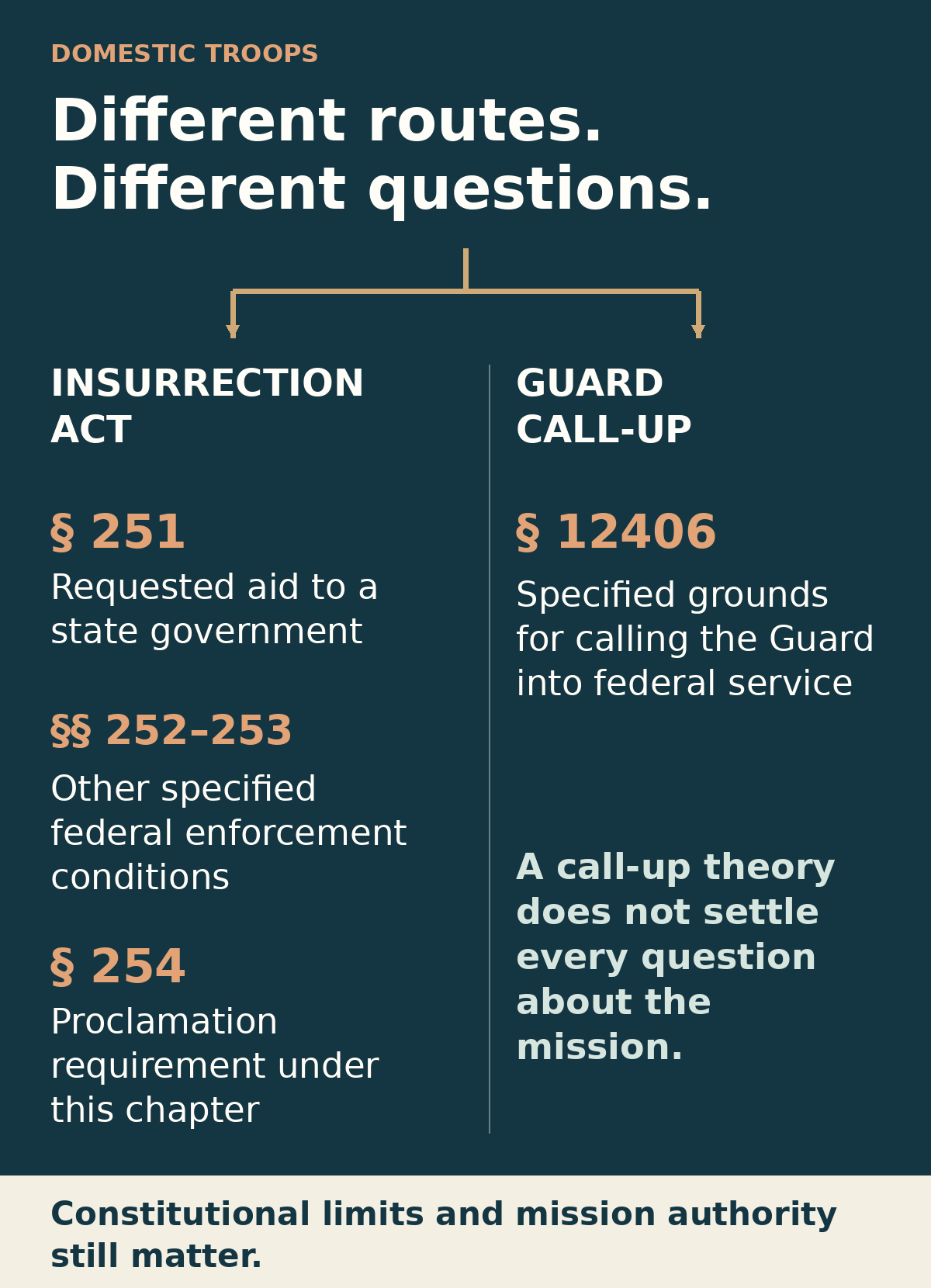
Section 251 concerns requested assistance to a state. Sections 252 and 253 provide other specified federal enforcement routes, with section 254 requiring a proclamation for military use under that chapter. Section 12406 separately concerns calling the National Guard into federal service. Identifying a call-up route does not settle every question about the subsequent mission.
The National Guard adds another layer
A uniform does not tell an observer the legal status of the person wearing it. For the National Guard, a federal call-up introduces a question distinct from what troops may then be ordered to do.
Section 12406 addresses calling the Guard into federal service under specified circumstances. It is a different statute from the Insurrection Act chapter. A claim that the president may federalize the Guard must therefore be distinguished from a claim that a particular law-enforcement mission is authorized.
This is not an academic distinction. It was central to the Supreme Court’s December 23, 2025 order in Trump v. Illinois.
The administration sought a stay in a dispute over using the Guard in Illinois. At that preliminary stage, the Court concluded that the “regular forces” language in section 12406(3) likely referred to the regular military, rather than civilian federal law-enforcement officers. It examined the government’s asserted authority to execute the laws with those forces and denied the stay.
The decision had a particular record and procedural posture. It was not a final nationwide prohibition on all domestic military activity, and it did not erase every other statutory route. Justice Brett Kavanaugh agreed with denying the stay while favoring narrower reasoning. Those distinctions belong in any accurate account of what the Court did.
Martial law is a different claim about government
The most alarming popular use of “martial law” imagines ordinary civilian government giving way to military authority. That is a larger proposition than soldiers assisting an operation under a specified statute.
This difference also matters for elections. The presence of troops, an emergency declaration or political rhetoric does not itself establish a lawful power to replace election rules or extend a presidential term. Each proposed action requires its own legal basis. One dramatic label cannot supply all of them.
It is therefore possible to investigate a deployment critically without claiming that military rule has begun. The questions may concern the asserted statutory conditions, the mission, constitutional rights, judicial orders or the use of force. Those are substantial subjects in their own right.
The documents are more revealing than the label
A useful account starts with the actual directive and its date. It identifies the personnel’s command status, the authority asserted and the mission authorized. Where the Insurrection Act is invoked, the relevant provision and proclamation deserve attention. Where litigation follows, the operative court order matters more than a headline describing the case.
Then comes implementation. What are personnel actually doing? Does that match the stated mission? Has an order been narrowed, stayed or replaced? A legal filing makes an argument; a court order has a different role; an operation on the ground may raise further questions.
The fear behind the martial-law question is understandable: how much coercive power can a president bring into civilian life? The answer is more useful when it names the route, the conditions and the limits. That is where a reader can distinguish an assertion of power from an authority that has actually been established.