The Smashed Burger Value Test: When Is a Burger Actually Worth $18?
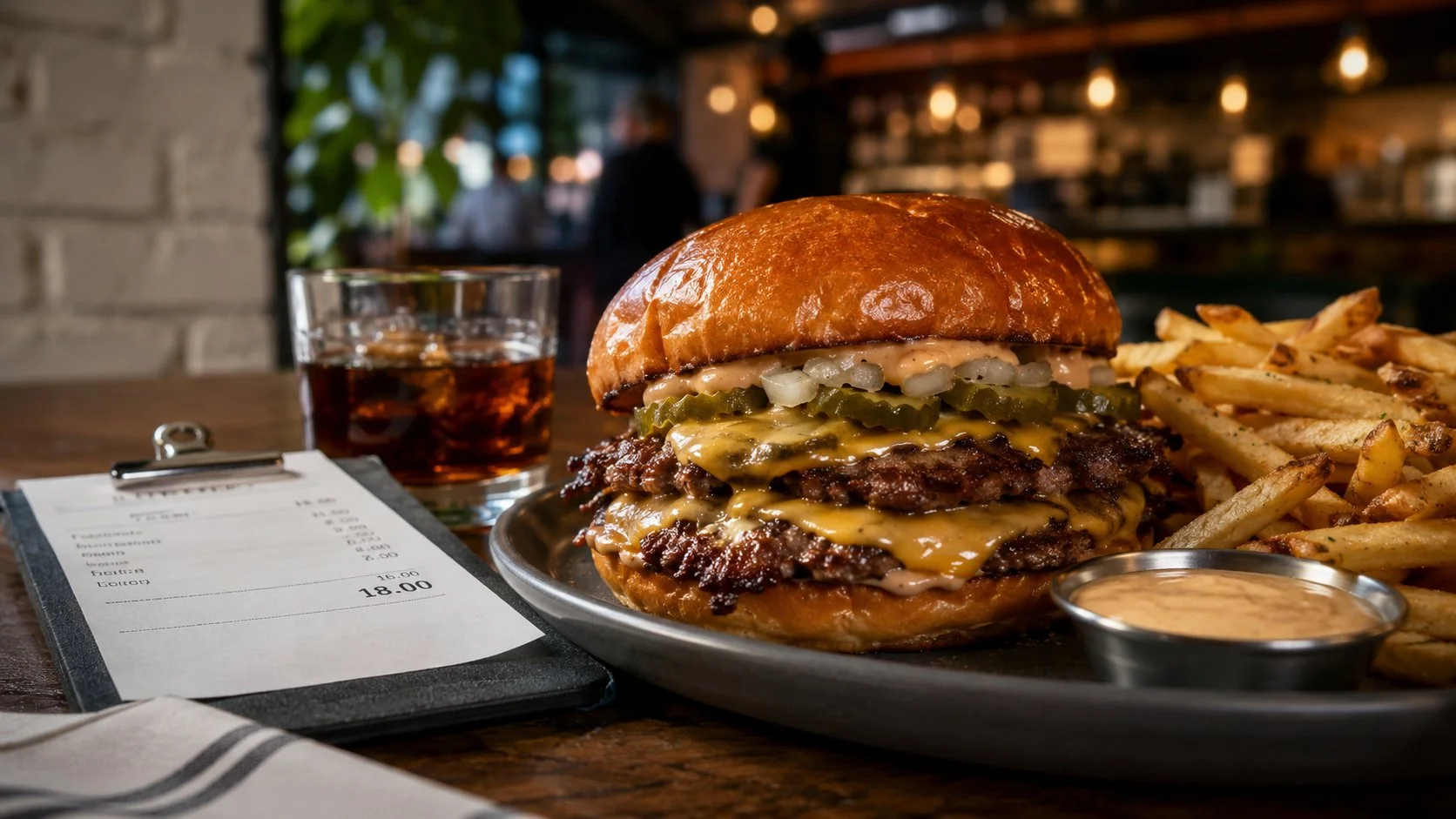
An $18 smashed burger is either a beautiful little masterpiece of crispy beef, melted cheese, toasted bun, pickles, sauce, and griddle sorcery — or it is a $7 burger wearing a beanie and lying about its childhood.
This is the central problem of the modern smashed burger. The format became popular because it is fast, delicious, craveable, and relatively easy to execute. Eater called 2024 “the year of the smash burger,” noting that smashed burgers had become a near-mandatory menu item because they are cheap to make and satisfying to eat. And that is exactly why the $18 version needs to be interrogated like it was caught sneaking out of a steakhouse with your debit card.
Because yes, restaurant costs are higher. Beef costs are higher. Labor is higher. Rent is apparently priced by goblins with MBAs. But that does not mean every smashed burger gets to charge entrée money because someone pressed ground beef with a spatula and named the sauce after the neighborhood.
So let’s build a test. A proper one. A burger courtroom. A sesame-seeded tribunal.
Why $18 for a Smashed Burger Is Not Automatically Insane
First, the boring adult part: restaurants are not charging 2009 prices because it is no longer 2009, despite what your emotional relationship with fries may suggest.
The U.S. Bureau of Labor Statistics reported that food away from home rose 3.6% over the year ending April 2026, with full-service meals up 3.8% and limited-service meals up 3.2%. Restaurant prices are still climbing, just more slowly than the inflation bonfire of earlier years.
Beef is also not exactly lounging around in the bargain bin. FRED’s BLS-based data shows average U.S. ground beef at $6.899 per pound in April 2026, while USDA ERS reported farm-level cattle prices were 17.7% higher and wholesale beef prices 14.2% higher in April 2026 than one year earlier. So yes, the cow economy is acting dramatic.
And restaurants have real pricing math. Gordon Food Service explains that profitable restaurants often land around 28% to 35% food cost, meaning the raw ingredients for an $18 item might reasonably sit somewhere around $5 to $6.30 before labor, rent, utilities, waste, taxes, insurance, card fees, repairs, and whatever it costs to replace the stolen bathroom soap dispenser every month.
So no, $18 is not automatically robbery.
But it is absolutely enough money for the burger to be good. Not “fine.” Not “solid.” Not “I guess the sauce helped.” Good. At $18, the burger needs to perform. It needs to have opinions. It needs to look you in the eye and justify itself.
What a Smashed Burger Is Supposed to Be
A smashed burger is not just a thin burger. A thin burger is a sad meat coaster. A proper smashed burger is pressed hard onto a ripping-hot griddle so the beef gets maximum contact, maximum browning, and crispy edges with actual texture.
Serious Eats explains that smashing the patties maximizes the Maillard reaction, creating the deep browned flavor that defines the style. It also notes that using two 2-ounce patties instead of one 4-ounce patty doubles the crust, while cheese between the patties helps keep things moist. That is the science. Not “vibes.” Not “chef-driven casual.” Science.
So the first rule of the $18 test is simple:
If the burger has no crust, it is not a smashed burger. It is a pressed disappointment.
A real smashed burger should have lacy edges, browned bits, melted cheese integrated into the patties, and a texture that makes you briefly forgive the restaurant for using stools instead of chairs.
Test 1: Is It a Double?
At $18, a smashed burger should usually be a double. Not always, but usually.
A single smashed patty can be great, but it has to be a very intentional burger: excellent beef, perfect crust, great bun, sharp toppings, maybe fries included. Otherwise, a single patty at $18 is just a snack with legal representation.
The double matters because smashed patties are thin by design. That is the whole point. If the restaurant charges $18 for one lonely patty hiding under American cheese like it witnessed a crime, the burger has already failed the value test.
A proper $18 smashed burger should give you one of these:
A double patty with solid beef weight.
A premium single with exceptional beef and fries included.
A smaller burger in a high-cost restaurant where the service, room, and sides justify the price.
If it is a single, no fries, no premium beef, no special technique, and no charm? Congratulations. You have purchased a meat pamphlet.
Test 2: Does the Crust Actually Exist?
This is the biggest test.
Look at the edges. Are they crispy? Browned? Lacy? Do they look like the burger had a violent and productive meeting with the griddle?
Or is the patty gray-brown, limp, steamed, and emotionally vacant?
The crust is the entire reason to order a smashed burger. Without crust, the restaurant is charging you for the act of flattening. That is not cooking. That is geometry.
A good smashed burger should have:
Crispy edges.
Deep browning.
A slightly craggy surface.
Cheese melted into the hot beef.
A little griddle grease in the best possible way.
A bad smashed burger has:
Smooth patties.
No browning.
Cold cheese corners.
A bun absorbing grease like a napkin with dreams.
The phrase “smashed burger” cannot be allowed to become a costume for any thin patty. We, as a society, have already let “artisanal” get away with too much.
Test 3: Is the Beef Good Enough to Be the Main Character?
At $18, the beef needs to taste like beef. Revolutionary, I know.
It does not have to be wagyu. In fact, wagyu smashed burgers can be deeply silly. You are smashing the beef thin and cooking it hard on a griddle. If someone is charging extra for wagyu and then obliterating it into a crispy disc, that may be less “luxury” and more “branding department found a cow word.”
Good smashed burger beef should be:
Fresh.
Properly fatty.
Well seasoned.
Cooked hot enough to brown.
Not compacted into a rubber puck.
A smashed burger lives and dies by fat and surface area. Too lean, and it dries out. Too thick, and it becomes a regular burger having an identity crisis. Too little salt, and it tastes like cafeteria beef. Too much salt, and now your tongue is being evicted.
If the meat tastes bland, the burger fails. Sauce cannot rescue bad beef. Sauce can distract from bad beef, in the same way loud music distracts from a terrible date.
Test 4: Is the Bun Doing Its Job or Just Loitering?
The bun matters more than people admit.
A smashed burger bun should be soft enough to compress, sturdy enough to survive, and ideally toasted or griddled. Potato rolls are classic for a reason. Brioche can work, but if it is too sweet or too fluffy, it turns the burger into dessert-adjacent meat furniture.
At $18, the bun should not be:
Cold.
Dry.
Too large.
Too small.
Untoasted.
Cracking like a gas-station hamburger fossil.
The bun is not just a handle. It is structural engineering. If it collapses after two bites, the burger fails. If it is so big that the patties vanish inside like beef in a bread cave, the burger fails. If it tastes like it came from a plastic bag opened during a power outage, the burger fails and should apologize.
A great smashed burger bun is not flashy. It is supportive. Like a good friend. Or a chair with a back, which restaurants apparently forgot humans enjoy.
Test 5: Is the Cheese Actually Melted?
This sounds basic, but here we are, in the age of $18 burgers with cheese slices lying on top like cold legal documents.
On a proper smashed burger, the cheese should melt into the patty. It should soften, cling, and help bind the whole thing together. American cheese works beautifully here because it melts like it was designed in a laboratory by people who understood joy and had no fear of orange.
Fancy cheese can work, but it needs to melt. Sharp cheddar that refuses to integrate is not sophistication. It is dairy stubbornness.
At $18, the cheese should not be decorative. It should participate.
Test 6: Are the Toppings Helping or Auditioning for a Different Sandwich?
A smashed burger does not need twelve toppings. It is not a salad bar trapped in a bun.
The best toppings sharpen the beef: pickles, onions, mustard, burger sauce, maybe shredded lettuce, maybe jalapeños, maybe bacon if the restaurant knows restraint and not just pork-based yelling.
Bad $18 burger toppings include:
A tomato slice thicker than the patty.
Lettuce acting as insulation.
A fried egg added because the kitchen ran out of ideas.
Onion rings stacked like edible scaffolding.
Truffle aioli, because apparently mayonnaise went to business school.
A burger becomes expensive-feeling when every ingredient has a job. It becomes stupid when every ingredient is trying to get promoted.
If the toppings bury the crust, the burger fails. If the sauce makes the bun slide around like it is fleeing a crime scene, the burger fails. If you cannot taste beef, you did not order a burger. You ordered condiment lasagna.
Test 7: Are Fries Included?
This is the part where things get violent.
An $18 smashed burger with fries included is one conversation. An $18 smashed burger alone is another conversation, and that conversation begins with, “Excuse me, is the bun made of rent?”
If fries are included, $18 can make sense more easily. You are getting a full meal. The restaurant can justify the number if the burger is well executed and the fries are good.
If fries are not included, the burger must be excellent. Not decent. Excellent.
Because once fries are $6 to $9 extra, your $18 burger becomes a $26 meal before tax, tip, and drink. At that point, the burger is competing with actual entrées. It is no longer a casual lunch. It is a financial event with pickles.
The fries also need to be good. Frozen fries are not automatically bad, but if the restaurant is charging boutique burger prices and handing you bland fries that taste like they were air-dropped from a cafeteria supplier, we have a problem.
Test 8: Is the Restaurant Experience Worth Part of the Price?
Sometimes the burger is not just the burger.
An $18 smashed burger at a nice bar with good service, comfortable seating, real plates, strong drinks, warm lighting, and a room that does not sound like a blender full of forks can be worth it.
An $18 smashed burger from a counter-service place where you bus your own tray, pay before sitting, tip on a tablet, and eat under fluorescent lighting while a speaker blasts indie rock into your fillings? That burger better be unbelievable.
This is not anti-counter-service. Counter-service can be great. But the value equation changes.
At full-service restaurants, you are paying for labor, ambiance, pacing, dishes, cleanup, and hospitality. At counter-service, the burger itself has to carry more of the value because the experience is leaner. If the room feels like a shipping container with stools and the burger is $18 before fries, the math starts wearing clown shoes.
The National Restaurant Association expects U.S. restaurant sales to hit $1.55 trillion in 2026, but notes that growth depends on people dining out “as budgets allow.” Translation: customers still want restaurants, but every meal has to earn its little place in the monthly damage report.
Test 9: Does It Beat the “I Could Make This at Home” Argument?
Every expensive casual dish faces the same annoying question: could I make this at home?
For smashed burgers, the answer is often yes. You need ground beef, a pan or griddle, buns, cheese, pickles, onions, and the willingness to fill your kitchen with smoke like you are electing a burger pope.
But restaurants can still win. They win with:
A hotter griddle.
Better crust.
Better beef blend.
Better timing.
Better bun.
Better sauce.
Better fries.
No dishes.
No smoke alarm.
No grease splatter on the backsplash that you will ignore for six weeks.
The $18 burger must beat your home version by enough that you are not sitting there thinking, “I could have done this for a third of the price and only mildly damaged my kitchen.”
If the restaurant version tastes like something you could make half-awake with supermarket beef and a spatula, it fails.
Test 10: Does It Survive the First Bite?
The first bite tells the truth.
A good $18 smashed burger delivers beef, crust, cheese, acid, salt, sauce, bun, and maybe onion in one bite. It is balanced. It is hot. It has texture. It does not require a napkin emergency team.
A bad one gives you bread first, then sauce, then a cold tomato lands somewhere, then the patty shows up late like a contractor.
The first bite should answer the price question immediately. If you need five bites to “get it,” there may be nothing to get. It is a burger, not a foreign film about grief.
When an $18 Smashed Burger Is Actually Worth It
An $18 smashed burger is worth it when most of these are true:
It is a double.
The crust is obvious and crispy.
The beef tastes fresh and properly seasoned.
The cheese is melted into the patties.
The bun is toasted, soft, and proportional.
The pickles/onions/sauce improve the burger instead of burying it.
Fries are included, or the burger is spectacular enough to stand alone.
The restaurant experience adds value.
The burger is hot, well assembled, and structurally sound.
You finish it and think, “Annoyingly, yes, that was worth it.”
That last part matters. Value is not just portion size. Food & Wine, summarizing McKinsey’s 2026 restaurant consumer research, noted that among diners who felt eating out “wasn’t worth the money,” the top complaints were food quality and portion size, with more than half citing each. People are not just mad because things cost more. They are mad because too many expensive meals are mediocre little trust falls.
When an $18 Smashed Burger Is Absolutely Not Worth It
An $18 smashed burger is not worth it when:
It is a single patty with no side.
The patty has no crust.
The beef tastes bland.
The cheese is barely melted.
The bun is cold or too big.
The sauce does all the work.
The toppings are gimmicky.
The fries cost extra and are boring.
The restaurant is counter-service but priced like full-service.
You leave hungry.
You leave annoyed.
You leave Googling “best burger near me” while still at the restaurant.
This is the difference between a premium burger and a scam in a paper wrapper.
The Worst $18 Smashed Burger Red Flags
Beware any menu that uses too many luxury words to describe a simple burger.
“Wagyu smash burger” can be suspicious.
“Truffle smash burger” is usually a cry for help.
“Signature aioli” often means mayonnaise with a witness protection name.
“Craft American cheese” is still American cheese, Kyle.
“Handheld experience” means sandwich, and we all know it.
The more the menu talks, the more nervous you should get. Great burgers usually do not need a paragraph. They need heat, beef, cheese, pickles, sauce, and execution.
If the description sounds like the burger went to a branding retreat, proceed carefully.
The Perfect $18 Smashed Burger Order
A fair $18 smashed burger looks something like this:
Two properly smashed patties.
American cheese melted between them.
Griddled onions or raw onions, depending on style.
Pickles with real acidity.
A simple burger sauce or mustard.
A toasted potato bun.
Fries included, ideally crisp and salted like someone is paying attention.
Served hot.
No tower. No nonsense. No steak knife stabbed through the top like the burger was slain in battle.
That burger can absolutely be worth $18.
Not every day. Not as a casual “whatever” lunch. But as a satisfying restaurant meal? Yes.
$18 Is Fair Only If the Burger Has the Receipts
A smashed burger can be worth $18. But it has to earn it.
The price can be justified by beef costs, restaurant overhead, labor, rent, and the fact that dining out now requires everyone to do light financial philosophy before ordering. But the burger still has to deliver the thing a smashed burger promises: crispy beef, melted cheese, hot griddle flavor, balance, and joy.
If it is a double with real crust, good beef, a proper bun, smart toppings, and fries included, pay the $18 and enjoy your little griddle miracle.
If it is one thin patty, cold cheese, no crust, no fries, and a sauce called “house aioli” doing community theatre on a stale bun, walk away.
That is not a smashed burger.
That is an edible invoice with pickles.