The “Playing at 8, Noon, and Maybe 4” Tournament Meal Timeline
Tournament brackets are where family planning goes to die in a folding chair. The schedule says your kid plays at 8 a.m., then maybe noon, then possibly 4 p.m., unless another team loses, a field runs late, the referee disappears into a golf cart, or the bracket app updates with the emotional stability of a haunted printer.
Parents love this. Nothing says “fun weekend” like packing a cooler for three possible realities while your child asks if they can just have a donut and a blue sports drink because apparently the tournament meal plan is being run by a raccoon with a debit card.
This is the problem with tournament food: the games are fixed until they are not. One win changes everything. One weather delay moves lunch into snack territory. One overtime means the carefully planned sandwich now lives in the “too close to kickoff” danger zone, where heavy food goes to become stomach regret.
So the solution is not a strict meal plan. Strict meal plans are for calm households, indoor sports, and fictional parents in granola commercials. The solution is a flexible tournament meal timeline: bigger meals when the next game is far away, lighter snacks when the next game is close, and enough cooler discipline that nobody eats a turkey wrap that has spent four hours becoming a science project.
The Tournament Food Rule: Feed the Next Game, Not the Clock
The biggest mistake parents make is feeding according to normal meal names. Breakfast. Lunch. Dinner. Cute little civilian concepts. Tournament day does not care about your meal names. Tournament day cares about how long until the next game.
That is the rule: feed the gap.
If the next game is four hours away, feed a real meal. If it is two hours away, feed a smaller meal or sturdy snack. If it is one hour away, feed easy carbohydrates. If it is 20 minutes away, stop trying to solve hunger with a deli sandwich and offer a few bites of banana, applesauce, pretzels, or water.
Nationwide Children’s recommends a meal about four hours pre-game that is high in whole-grain carbohydrates with lean protein and healthy fat, plus fluids; its one-hour pre-game guidance shifts toward a high-carbohydrate snack and away from high-protein or high-fat foods. Translation: the closer the game gets, the less you should hand your child a meatball sub and hope for the best.
The 8 A.M. Game: Breakfast Has to Be Boring and Early
The 8 a.m. game is a scheduling insult disguised as youth sports. Nobody is hungry enough, awake enough, or emotionally prepared enough to eat like an athlete at 6:15 a.m. But skipping breakfast and expecting a kid to sprint on vibes, nerves, and one sip of water is not a plan. It is a prequel to complaining.
For an 8 a.m. game, breakfast should happen early and stay familiar. Think toast with peanut butter, a bagel with cream cheese, oatmeal with banana, cereal with milk, yogurt and fruit, a turkey sandwich if your child accepts that breakfast rules are fake, or eggs with toast if they digest that well.
Do not debut new foods. Tournament morning is not the moment for chia pudding, experimental protein pancakes, or a smoothie the color of swamp moss. New foods belong on practice days, not when your kid is wearing cleats and you are trying to remember which field is “Field C,” because apparently signs are optional.
The early breakfast goal is simple: carbs for energy, a little protein for staying power, and not too much fat or fiber if the kid has a sensitive stomach before games. Johns Hopkins recommends simple carbohydrate snacks closer to competition, with examples like applesauce pouches, pretzels, banana, graham crackers, dried fruit, dry cereal, and similar easy options.
6:00–6:30 A.M.: The Real Breakfast Window
For an 8 a.m. kickoff, aim for the main breakfast around 6:00 to 6:30 if your household can manage it without turning into a hostage negotiation. This does not need to be large. It needs to be real.
Good options:
A bagel or toast with peanut butter and banana.
Oatmeal with fruit.
Cereal and milk plus a banana.
Yogurt with granola, if dairy sits well.
Egg and toast, if your kid tolerates eggs before running.
Half a turkey or peanut butter sandwich.
This is not a buffet. This is fuel. Nobody needs a breakfast platter that looks like it came from a diner trying to impress a trucker convention.
7:15–7:40 A.M.: The Top-Off Snack
If your child ate a decent breakfast, the pre-game top-off can be tiny. A few pretzels. Half a banana. Applesauce pouch. Graham crackers. Dry cereal. A few sips of water.
If your child barely ate breakfast because mornings are apparently a constitutional crisis, this top-off matters more. But keep it light. Nationwide Children’s advises athletes to eat a snack 30 to 60 minutes before working out and avoid spicy or high-fat foods right before activity. So no, the sausage biscuit is not “just a snack.” It is a stomach-shaped plot twist.
After the 8 A.M. Game: The Bracket Fork in the Road
This is where the tournament meal schedule splits.
Your kid finishes the 8 a.m. game. They may play at noon. Or maybe 11:30. Or 12:45. Or “we’ll see after the other field finishes,” the official phrase of youth sports purgatory.
The moment the first game ends, the parent needs two pieces of information: how hard was the game, and how long until the next one?
If the next game is less than 90 minutes away, do not force a real meal. Offer quick recovery snacks: fruit, pretzels, applesauce, crackers, sports drink if appropriate, and water.
If the next game is two to three hours away, go with a mini-meal: half sandwich, rice bowl, pasta salad, yogurt and granola, turkey wrap, peanut butter sandwich, or chicken and rice.
If the next game is four hours away, that is actual lunch territory. Congratulations, you briefly get to behave like time is real.
EatRight recommends that young athletes have a game-day eating pattern that includes breakfast, lunch, snacks, and a post-game family dinner with all food groups, including protein, grains, vegetables, fruits, and dairy or alternatives. This is useful as a framework, but tournament brackets require turning that nice little plan into portable food Lego.
The Noon Game: Lunch Is Not Always Lunch
The noon game is cruel because it sits exactly where lunch should be, then ruins lunch by requiring running.
If the kid plays at noon, the ideal “lunch” is not a full lunch at 11:15. That is how you get sluggish running, stomach complaints, and a child who suddenly announces they “feel weird” while you stare at the turkey wrap like it betrayed the family.
For a noon game after an 8 a.m. game, the best plan is usually:
9:15–9:45: recovery snack.
10:00–10:30: mini-meal if hungry and next game is truly noon or later.
11:00–11:30: light carb top-off if needed.
The mini-meal should be easy: half a sandwich, small rice bowl, yogurt with fruit, mini bagel, small pasta portion, turkey wrap, peanut butter toast, or banana plus pretzels and cheese. Save the heavier “real lunch” until after the noon game if there is a long break before 4 p.m.
The goal is not to fill the stomach like a gas tank at Costco. It is to give enough energy without making the next game feel like cardio inside a burrito.
Between Noon and Maybe 4: This Is the Real Meal Window
If the team wins, advances, survives, ties, or gets dragged into some bracket math created by a bored wizard, the next game might be at 4 p.m. That means after the noon game is the best window for an actual meal.
This is where parents should feed the athlete like the day is not over, because it may not be.
After the noon game, aim for a more substantial meal within the next hour if the athlete can tolerate it: sandwich, wrap, rice bowl, pasta, chicken and potatoes, bagel with protein, burrito bowl, soup in a thermos, or leftovers packed cold and safely. UChicago Medicine recommends protein after games to help with repair, and Nationwide Children’s game-day guidance also points to balanced meals around competition rather than surviving on snack debris alone.
This is not the window for a giant greasy concession meal unless the 4 p.m. game has been officially cancelled and everyone is going home to become horizontal. If there may be another game, keep lunch substantial but not ridiculous. “Enough to refuel” is good. “Enough to make the child sweat cheese during warmups” is less good.
The 2:30–3:15 P.M. Top-Off for a 4 P.M. Game
If the 4 p.m. game becomes real, the pre-game snack should return to the same rule: closer game, lighter food.
At 2:30 or 3:00, offer something easy and mostly carbohydrate-based: banana, applesauce pouch, pretzels, crackers, dry cereal, fig bar, graham crackers, small granola bar, orange slices, or a few bites of a bagel.
Do not panic because they “only ate a snack.” They had the real meal earlier. This is a top-off, not a second lunch.
If they ate a big meal at 1:30 and play at 4, they may not need much. If they barely ate after noon because heat killed their appetite, give small, frequent options and fluids. Tournament feeding is less like serving courses and more like keeping a small athletic campfire from going out.
The Cooler System: Pack by Time Gap, Not by Food Group Poster
A tournament cooler should not be a random pit of snacks, half-frozen bottles, crushed grapes, and one suspicious yogurt that has lost its will to live.
Pack by timing.
Close-game snacks: applesauce pouches, pretzels, crackers, bananas, dry cereal, graham crackers, fig bars, fruit snacks, orange slices, rice cakes.
Mini-meals: half sandwiches, mini bagels, turkey wraps, peanut butter sandwiches, yogurt with granola, cheese and crackers, rice bowls, pasta salad, hard-boiled eggs if kept cold.
Long-break meals: full sandwich, chicken rice bowl, pasta with lean protein, burrito bowl, thermos soup, potatoes and chicken, leftovers that are actually safe.
Parent survival food: coffee, water, actual lunch, and something salty so you do not become the sideline ghost who forgot to eat while lecturing a child about hydration.
FoodSafety.gov says cold foods should stay at 40°F or below, and perishable foods should not sit out more than two hours, or more than one hour if exposed to temperatures above 90°F. This is why the cooler needs ice packs and shade, not just hope and a zipper.
Use Two Coolers If You Can
One cooler for drinks. One cooler for food.
This sounds like overkill until the drink cooler gets opened every twelve seconds by children looking for “the cold one,” while the turkey wraps sit there experiencing climate change.
The drink cooler can be chaotic. Fine. Let it become a sloshing democracy of water bottles. The food cooler should stay closed as much as possible, packed with ice packs, shaded, and treated like it contains evidence.
If the temperature is above 90°F, FoodSafety.gov says food is only safe outside for one hour if not kept properly cold. That one-hour rule is not a suggestion from a nervous aunt. It is the difference between “good tournament planning” and “everyone remembers the pasta salad for legal reasons.”
Hydration: Water First, Sports Drink When the Day Earns It
Tournament days can be long, hot, and sweaty. Water should be the default. Bring more than you think, because one bottle will roll under a car, one will be left at Field 2, and one will be claimed by a sibling who “was just thirsty” and somehow drank the whole thing.
HealthyChildren.org says water is sufficient for activities under an hour, while sports drinks can help replenish carbohydrates and electrolytes for activities lasting longer than one to two hours or in very hot environments; it also warns that sports drinks are different from energy drinks, which are not recommended.
So the tournament hydration rule is: water all day, sports drink during longer hot stretches or between repeated games if needed, no energy drinks, because caffeine plus youth sports plus heat plus nerves is not “performance.” It is a family group text waiting to happen.
Pair fluids with salty snacks when the day is sweaty: pretzels, crackers, salted rice cakes, soup, or sandwiches. You do not need to turn every hydration break into a chemistry experiment. Sometimes water plus pretzels is the adult in the room.
The “Unknown 4 P.M. Game” Decision Tree
This is the part every parent actually needs.
If the noon game ends and the 4 p.m. game is confirmed:
Feed a real meal soon after the noon game. Then offer a light carb snack around 3 p.m. Keep fluids steady.
If the noon game ends and nobody knows yet:
Feed a medium mini-meal, not a giant one. Half sandwich, fruit, pretzels, yogurt, or rice bowl. This keeps the athlete from crashing but does not ruin a possible 4 p.m. warmup.
If the noon game ends and the 4 p.m. game is cancelled:
Now you can feed a bigger meal. Go home, get real food, or let the team eat together. This is the moment for the burger, pizza, tacos, or whatever post-tournament tradition exists in your family. Congratulations. The stomach is now free.
If there is a delay and the 4 p.m. game becomes 5:15:
Add another small snack around 3:30 or 4:00. Do not rely on the 1 p.m. meal to carry them forever. Tournament delays are where energy quietly leaves the building wearing cleats.
What Not to Feed During Bracket Chaos
Avoid foods that make timing harder.
Greasy concession pizza right before a game.
Huge burgers between close games.
Creamy pasta sitting in the cooler like a bacterial trust fall.
A giant smoothie 30 minutes before kickoff.
Heavy fried food when the next game time is uncertain.
Mystery convenience-store snacks that turn your child into either a rocket or a couch.
Spicy food, high-fat food, and huge portions close to activity are the usual suspects. Nationwide Children’s specifically advises avoiding spicy or high-fat items 30 to 60 minutes before working out. This is because the stomach, unlike your bracket app, does not appreciate surprises.
The Parent Packing List That Actually Works
Bring water bottles, a backup jug, ice packs, two coolers if possible, napkins, wipes, hand sanitizer, utensils, resealable bags, trash bags, and a marker for labeling bottles. Bring shelf-stable snacks separately so the cooler does not become a rummage bin.
Food ideas:
Bananas.
Applesauce pouches.
Pretzels.
Crackers.
Dry cereal.
Graham crackers.
Mini bagels.
Turkey wraps.
Peanut butter sandwiches.
Chicken and rice bowls.
Pasta salad with simple ingredients.
Yogurt tubes or cups, kept cold.
Cheese sticks, kept cold.
Orange slices, grapes, watermelon, or cut fruit, kept cold.
Hard-boiled eggs, kept cold.
Thermos soup for cooler weather.
The best foods are familiar, portable, easy to portion, and unlikely to become disgusting after one hour in a field bag. This excludes more “healthy” foods than wellness parents want to admit. A kale salad in a warm plastic container is not noble. It is compost with ambition.
The Timeline in One Clean Version
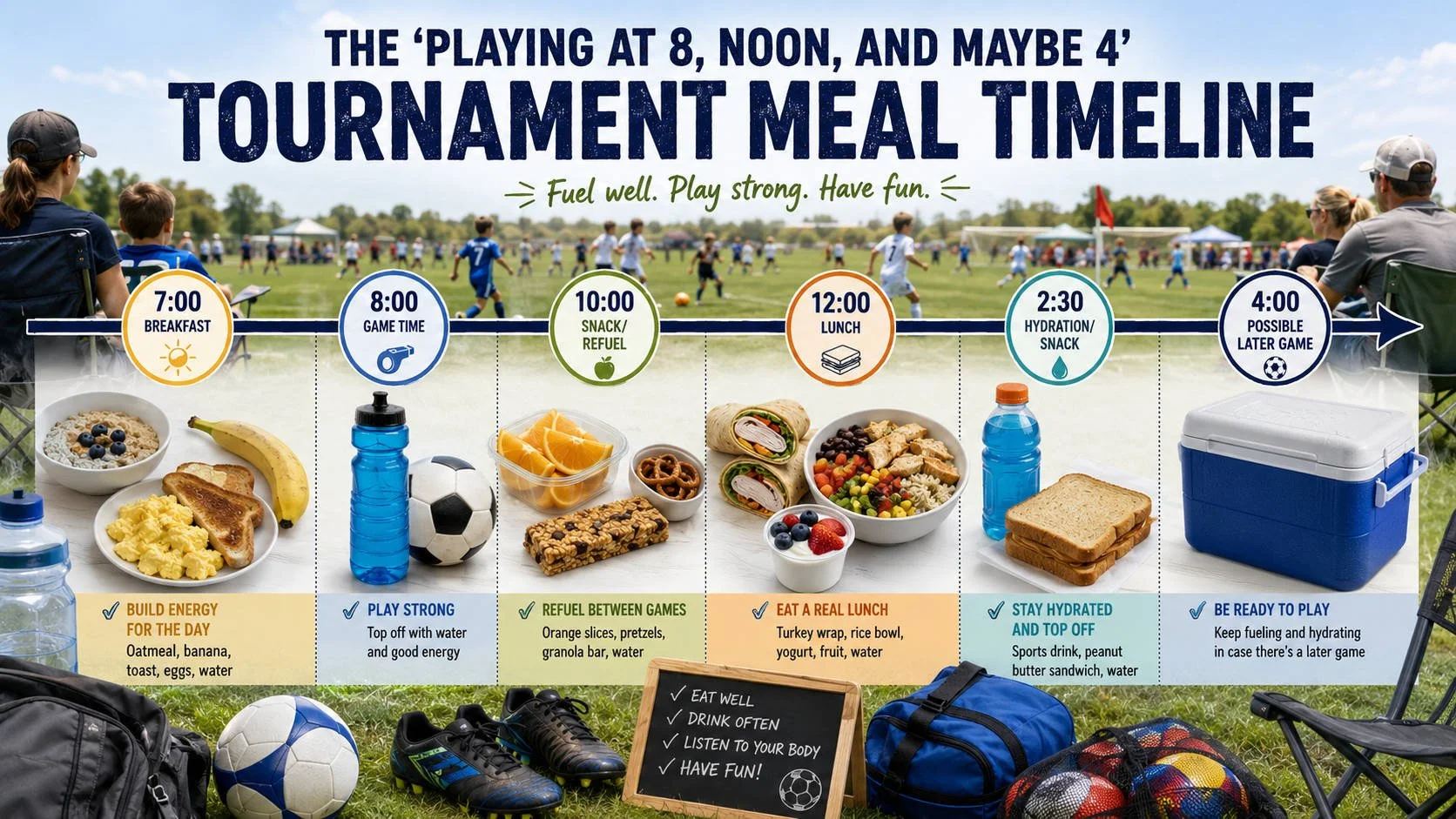
For an 8 a.m., noon, maybe 4 p.m. tournament day, here is the flexible template.
6:00–6:30 a.m.
Small breakfast: oatmeal, bagel, toast, banana, yogurt, cereal, or eggs and toast.
7:15–7:40 a.m.
Optional top-off: applesauce, banana, pretzels, crackers, water.
9:00–9:30 a.m.
After game one: recovery snack and fluids. Fruit plus pretzels. Yogurt if kept cold. Half sandwich if the next game is not too close.
10:00–10:30 a.m.
If noon game is confirmed: mini-meal. Half wrap, mini bagel, rice bowl, yogurt and granola, peanut butter sandwich.
11:15–11:40 a.m.
Light top-off if needed: banana, applesauce, crackers, pretzels, dry cereal.
1:00–1:45 p.m.
After noon game: real meal if 4 p.m. is likely or confirmed. Sandwich, wrap, chicken rice bowl, pasta, soup, burrito bowl, or balanced packed meal.
2:45–3:15 p.m.
If 4 p.m. game is on: light carb snack and fluids.
After final game
Real meal. Protein, carbs, fruit or vegetables, fluids. Not because you are running a sports science lab from a minivan, but because the athlete just played all day and deserves more than leftover pretzels and whatever melted in the snack bag.
Stay Flexible, Not Random
Tournament meal planning is not about perfect nutrition. It is about preventing the three classic disasters: the athlete plays hungry, the athlete plays too full, or the cooler becomes a food-safety crime scene with wheels.
The schedule will change. The bracket will lie. The app will update late. The coach will say “stay close” and then vanish for 38 minutes. Accept this. Build the food plan around timing gaps, not meal names.
Big gap, bigger meal. Small gap, smaller snack. Close to game, easy carbs. After hard game, refuel. Water throughout. Keep perishables cold. Use sports drinks when the heat and duration justify them. Do not let the concession stand become your nutrition director unless your goal is nachos at 10:15 a.m., which, while emotionally understandable, is not a complete tournament strategy.
Parents do not need to be perfect. They need a cooler, a plan, and the willingness to adapt when the 4 p.m. game becomes “maybe 3:30, maybe 5, check the bracket.”
That is tournament food success: not gourmet, not rigid, not Instagrammable. Just enough fuel, at the right time, to keep the kid playing and the parent from whispering threats at a sandwich.