Plain Starbucks Nitro Cold Brew gets its cascading foam from nitrogen infused at the tap. Its creamy-looking head does not, by itself, mean cream was added. On the checked US Grande menu pages, plain Nitro lists brewed coffee, while regular Cold Brew lists brewed coffee and ice.
Both standard Grande drinks list five calories and zero grams of sugar. They are different preparations with a similar name, rather than one plain drink and one automatically sweetened, dairy-topped version. Adding sweet cream or another topping creates a different comparison.
What happens at the Nitro tap
Starbucks describes its Nitro preparation as its signature Cold Brew, steeped for 20 hours, infused with nitrogen as it pours. The infusion creates microbubbles and the cascading, frothy texture.
That preparation step explains why a plain black coffee can arrive with a head that looks creamy. Appearance alone is a poor ingredient list. A pale layer can result from the gas-infused coffee, while a separately added cream topping involves additional ingredients. The two should not get folded into one vague category called “foam.”
Starbucks describes the resulting texture as smooth and velvety. That is the brand's description, not our own side-by-side tasting result. Whether you prefer it to regular Cold Brew is a question of preference; the preparation and ingredient differences are the firmer facts to compare.
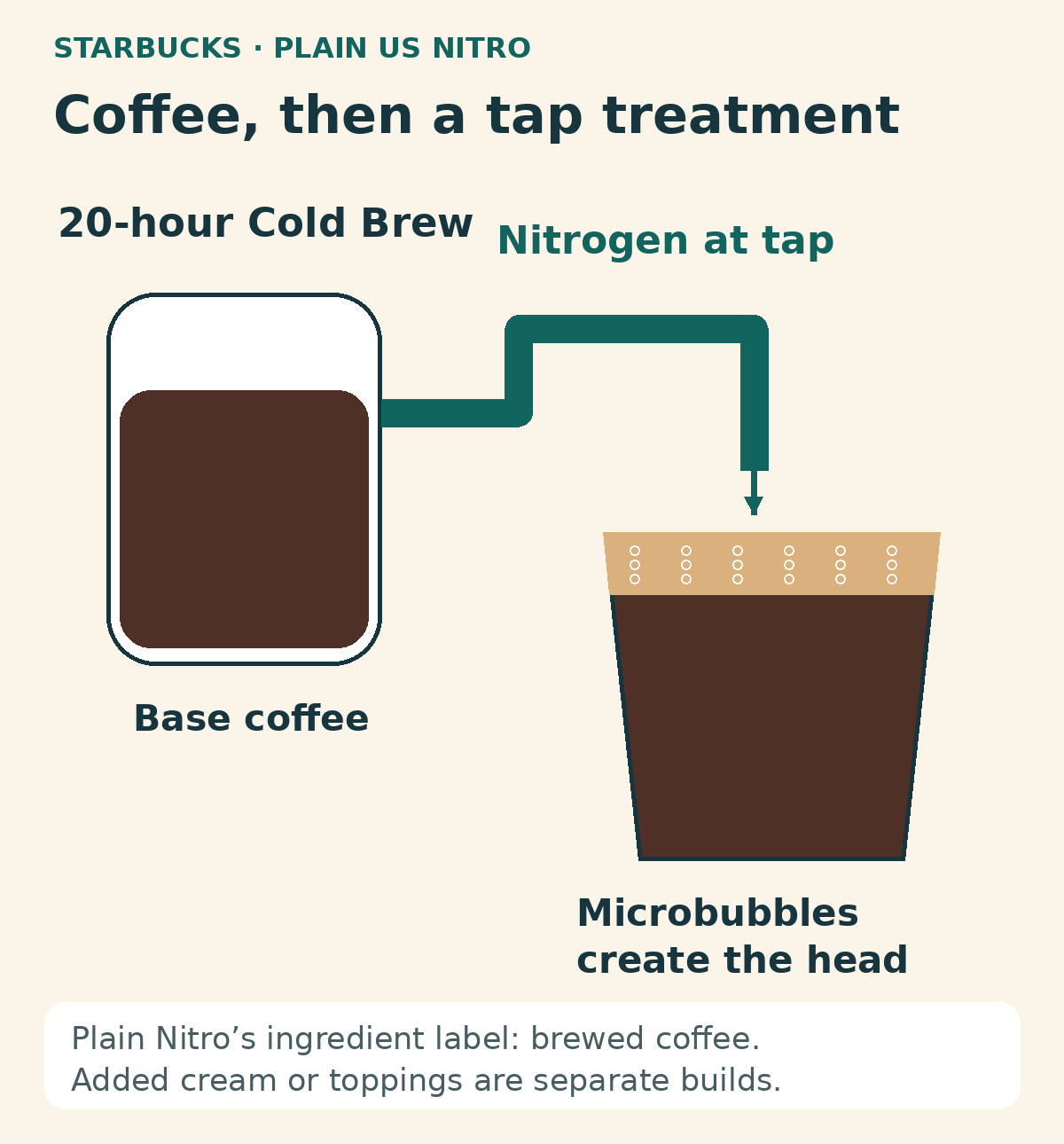
Starbucks describes its signature Cold Brew as steeped for 20 hours, then infused with nitrogen as Nitro pours from the tap. The resulting microbubbles create the cascading head of foam. The checked plain Nitro ingredient display lists brewed coffee; a separately added cream topping changes the recipe.
Compare the plain US Grande builds
These standard-recipe figures were checked on the live US Cold Brew nutrition page and Nitro nutrition page on November 8, 2026.
Plain Cold Brew, Grande (16 fl oz): The standard drink lists 5 calories, 0 grams of total sugar and approximately 205 milligrams of caffeine. Its displayed ingredients are brewed coffee and ice.
Plain Nitro Cold Brew, Grande (16 fl oz): The standard drink lists 5 calories, 0 grams of total sugar and approximately 280 milligrams of caffeine. Its displayed ingredient is brewed coffee.
The Nitro ingredient display and the separate nitrogen-infusion explanation describe different parts of the same product. The ingredient label says brewed coffee; the preparation page explains what happens to it at the tap. Reading them together is more useful than assuming either page tells the whole story by itself.
Ice is also visible in the regular Cold Brew's ingredient display. That matters when comparing size names. Two menu entries marked “Grande, 16 fl oz” do not establish that every part of their builds, including the amount of ice and liquid coffee, is identical.
The caffeine difference belongs to the recipes
At the checked size, Nitro's approximate caffeine figure is 75 milligrams higher. That is a useful difference for someone choosing between those two specific standard orders.
It is not evidence that nitrogen itself contributes caffeine. The menu pages provide finished-drink caffeine values, not a controlled experiment that assigns the difference to one preparation variable. Likewise, the presence of ice in one displayed build does not justify calculating an exact caffeine concentration or attributing all 75 milligrams to ice alone.
Treat the numbers as recipe-specific, approximate menu figures. They should not be transferred to a Canadian menu, a bottled drink, another size or a cream-topped variation. A familiar brand name and a similar cup label do not make those products interchangeable.
Plain Nitro and cream-topped Nitro answer different questions
If the question is whether plain US Nitro requires cream to make its head of foam, the checked ingredient display and preparation description answer it: the plain build is brewed coffee, and nitrogen infusion produces the microbubbles.
If the question concerns a drink with sweet cream, cold foam or another named addition, inspect that specific build. The plain drink's zero-gram sugar figure does not carry over simply because Nitro remains part of the name. Nor does “plain coffee” establish an allergy-safe preparation environment; Starbucks warns about shared equipment and possible cross-contact.
Our broader Starbucks ordering guide considers other food and drink choices. Here, the most useful separation is between the base coffee, its tap treatment and anything added afterward.
Starbucks also limits its Nitro availability statement to participating stores. A national product page is not confirmation that a particular café has it available when you arrive. Choose the texture and approximate caffeine level you want, then check the exact drink name and additions. The interesting part of plain Nitro is the transformation at the tap; a cream topping is an additional choice, not an explanation for every creamy-looking surface.