Chick-fil-A's small nugget tray contains 64 nuggets, medium contains 120 and large contains 200. The company's serving estimates are eight, fifteen and twenty-five people respectively. Each estimate works out to eight nuggets per person.
That is a useful starting point for a group order. It is not a measurement of your guests' appetites or a guarantee that nuggets alone make a complete meal. The better planning question is how many pieces you want to allow per guest, then which trays supply that total.
What the tray sizes actually contain
The official catering quantities FAQ and nugget tray product page agree on these US counts, checked November 8, 2026:
Small tray: 64 nuggets, with a company estimate of eight people. That works out to eight pieces per person.
Medium tray: 120 nuggets, with a company estimate of fifteen people. That also works out to eight pieces per person.
Large tray: 200 nuggets, with a company estimate of twenty-five people. Again, that works out to eight pieces per person.
Read “serves 25” as the company's estimate for those 200 pieces. It does not establish how much every person will eat, how substantial the other food will be or whether the tray will last through a long gathering. The piece count gives you something more concrete to work with than the size name.
Choose the portion assumption before choosing the tray
Multiply your guest count by a stated pieces-per-guest assumption. Twenty guests at eight nuggets each requires 160 nuggets. At twelve each, the same twenty guests require 240.
Neither eight nor twelve is a universal recommendation here. Eight matches the arithmetic behind the company's serving estimates; twelve is a deliberately different planning example. The useful step is making that assumption visible, especially when several people are helping place the order.
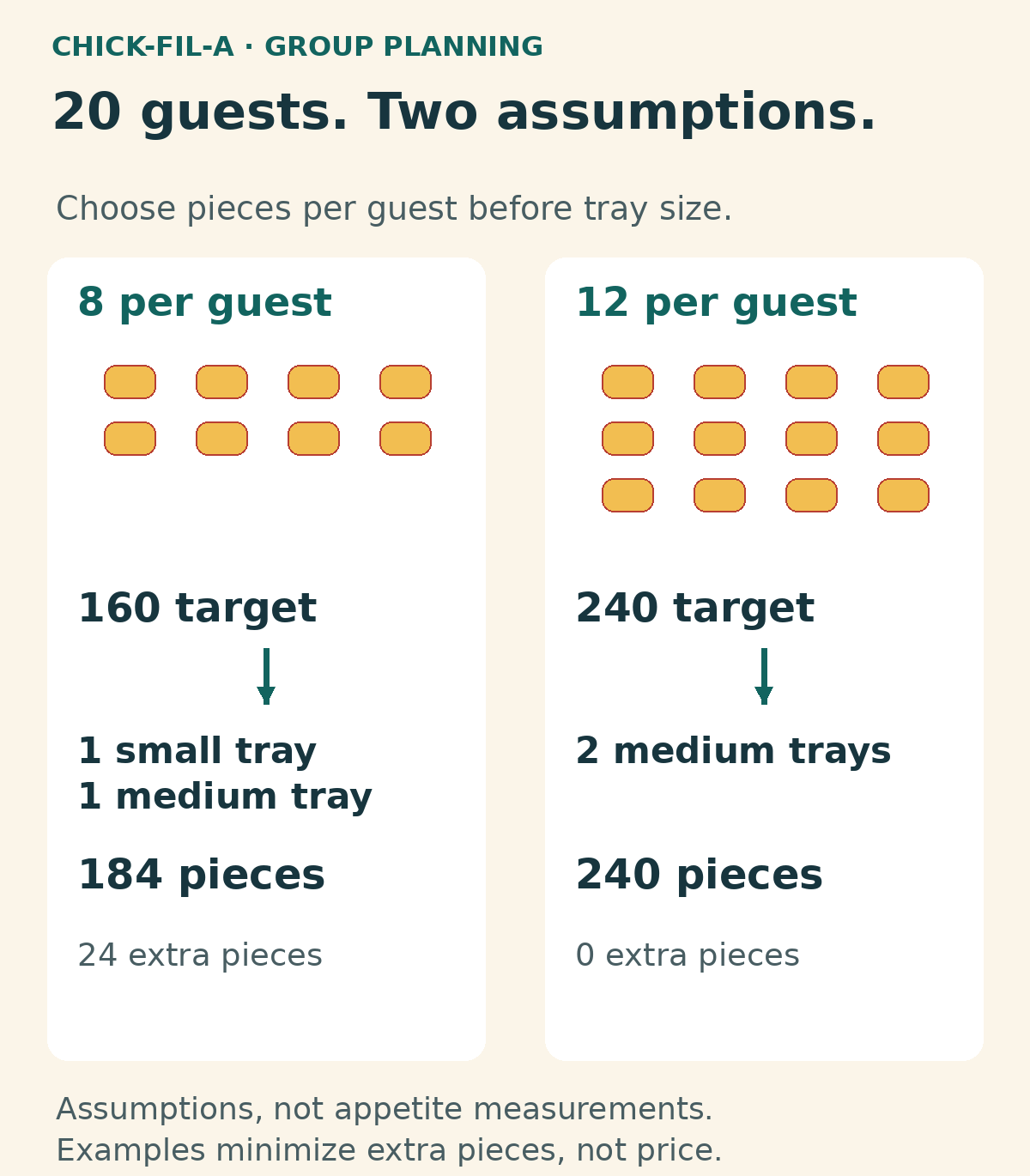
For twenty guests, assuming eight nuggets each gives a 160-piece target. One small and one medium tray supply 184 pieces, leaving 24 above that target. Assuming twelve each gives a 240-piece target; two medium trays supply exactly 240. These are planning assumptions and fewest-extra-piece examples, not measured appetites or cheapest orders.
Then compare tray combinations against your chosen total. A round-number guest count does not necessarily line up with one tray size, and combining trays can change the number of pieces above your target.
Worked orders for different group sizes
These examples minimize extra pieces above the stated target, then the number of trays. They are not a price comparison. The calculation considered combinations of up to ten trays; the sections below give the resulting examples for these group sizes.
For 10 guests
At eight pieces each, the target is 80 nuggets. One medium tray supplies 120, leaving 40 above that target.
At twelve pieces each, the target is 120 nuggets. One medium tray supplies exactly 120, with no extra pieces.
For 15 guests
At eight pieces each, the target is 120 nuggets. One medium tray supplies exactly 120, with no extra pieces.
At twelve pieces each, the target is 180 nuggets. One small and one medium tray supply 184, leaving four above that target.
For 20 guests
At eight pieces each, the target is 160 nuggets. One small and one medium tray supply 184, leaving 24 above that target.
At twelve pieces each, the target is 240 nuggets. Two medium trays supply exactly 240, with no extra pieces.
For 25 guests
At eight pieces each, the target is 200 nuggets. One large tray supplies exactly 200, with no extra pieces.
At twelve pieces each, the target is 300 nuggets. One small and two medium trays supply 304, leaving four above that target.
For 40 guests
At eight pieces each, the target is 320 nuggets. One medium and one large tray supply exactly 320, with no extra pieces.
At twelve pieces each, the target is 480 nuggets. Four medium trays supply exactly 480, with no extra pieces.
For 50 guests
At eight pieces each, the target is 400 nuggets. Two large trays supply exactly 400, with no extra pieces.
At twelve pieces each, the target is 600 nuggets. Three large trays supply exactly 600, with no extra pieces.
The twenty-person example shows why the method matters. One small and one medium tray supply 184 pieces, which is closer to the 160-piece target than one 200-piece large tray. But one large tray might be simpler to handle or differently priced. The calculation has optimized the number of extra pieces, not convenience or dollars.
“Extra” also means above an assumption, not food certain to go uneaten. If the assumption understates what the group wants, those pieces may be welcome. Arithmetic cannot turn an uncertain appetite estimate into a guarantee.
Check sauces, local prices and timing separately
The tray page describes a choice of dipping sauce and lists extra eight-ounce sauce options. That does not establish a universal number of included free bottles. Confirm the sauce choice, quantity and any additional charge with the restaurant rather than inferring them from an extras list.
Prices also vary by location. Without the prices offered for your actual order, the fewest-extra-pieces example cannot be called the cheapest. Compare the combinations locally if cost is your main constraint.
For timing, Chick-fil-A's catering lead-time guidance says orders can be placed 24 hours before an event and many restaurants offer shorter lead times. It also says lead times vary by restaurant. That is not a universal 24-hour minimum or a guarantee that every requested pickup or delivery slot will be available.
Keep the final order in pieces, trays and a confirmed collection or delivery plan. “A large tray for about twenty people” leaves room for different assumptions. “Two medium trays, 240 nuggets, using twelve per guest for twenty guests” gives everyone placing the order the same plan.