Snack Plate Survival: Why TikTok’s “Girl Dinner” Is Useful Even When It’s Ridiculous
Some dinners are planned. Some dinners are cooked. Some dinners are assembled by a tired person standing in front of the fridge like they are negotiating with a hostage taker made of condiments.
That, spiritually, is girl dinner.
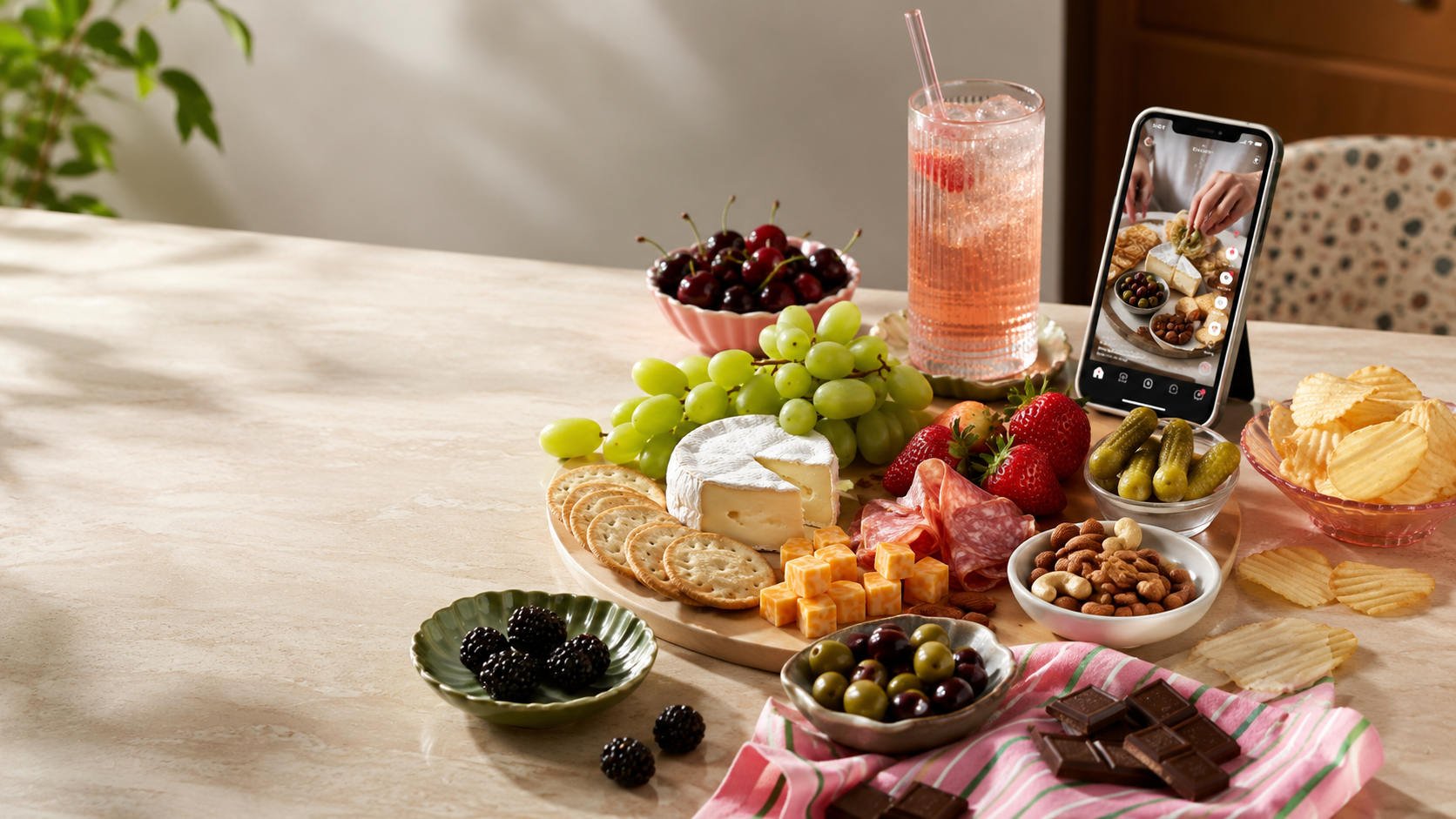
A few crackers. Some cheese. A pickle. A handful of grapes. Three olives. Leftover rotisserie chicken. Hummus. A boiled egg if ambition briefly returns from war. Maybe a piece of chocolate, because dessert is not cancelled just because dinner arrived without a pan.
Is it ridiculous? Obviously. Calling a plate of snacks “girl dinner” makes it sound like feminism was invented by a charcuterie board with student debt. But the reason the trend became huge is not because everyone suddenly forgot how meals work. It became huge because it named something people were already doing: eating what is available, low-effort, satisfying, and weirdly personal when nobody is demanding a “real dinner” with sides and a little sprig of parsley acting employed.
The phrase was popularized in 2023 by TikTok creator Olivia Maher after she posted a low-effort meal of bread, cheese, cornichons, and grapes; coverage at the time described “girl dinner” as a snack-style, no-cook plate made from foods like cheese, salami, olives, pickles, fruit, bread, vegetables, hummus, and leftovers.
What “Girl Dinner” Actually Means
At its best, girl dinner is a no-cook snack plate. It is the thing you eat when you are alone, tired, hungry, and unwilling to dirty more than one plate because the dishwasher is already holding a summit of neglect. It is dinner without performance.
This is why the trend hit a nerve. It validated the private meal. The “I’m not cooking for anyone tonight” meal. The “I need food but not a production” meal. The “everything is technically from different food groups if you squint like a dietitian in a power outage” meal.
Allrecipes described the trend as a no-cook dinner built from snacky items such as pickled vegetables, crackers, salami, cheese, cucumbers, tomatoes, olives, fruit, bread, hummus, or tapenade — basically a mini charcuterie situation without the part where someone charges $28 and calls it “grazing.”
And that is the useful part. Girl dinner says a meal does not need to be a casserole, a protein-starch-vegetable diagram, or a steaming plate presented to a family like you are auditioning for the role of Household Food Manager in a play nobody wants to see.
Sometimes dinner is a plate. Sometimes dinner is odds and ends. Sometimes dinner is cheese, apple slices, almonds, and toast, and honestly, that is still more coherent than half the “fusion” menus currently menacing hotel lobbies.
The Ridiculous Name Is Doing Real Work
Yes, “girl dinner” is a stupid name. That is part of why it worked.
A boring name like “informal snack-based meal assembled from available pantry and refrigerator items” would not go viral unless the entire internet had been replaced by municipal dietitians. “Girl dinner” is short, silly, memetic, and just gendered enough to cause immediate discourse, the internet’s favorite renewable energy source.
The name also drags in a whole suitcase full of gender baggage, then pretends it only packed pickles. Dietitians and critics have warned that the trend can imply women should eat smaller, daintier meals, especially when the plates shown are too light or nutritionally incomplete.
But the name also gave people permission to laugh at the gap between what dinner is “supposed” to be and what dinner often is. It turned a private, slightly chaotic meal into a joke people could share. And shared jokes matter because shame is a mold that grows best in private.
A woman eating crackers and cheese alone can be framed as sad. A woman posting “girl dinner” can frame the same plate as funny, chosen, and enough. Same food. Different emotional tax bracket.
It Pushes Back Against the Burden of “Real Dinner”
The useful core of girl dinner is not that women should eat tiny meals. Absolutely not. Take that idea outside and make it apologize.
The useful core is that nobody should have to perform a full domestic dinner every night just to prove they are a competent adult.
Food preparation is still gendered labor. The Bureau of Labor Statistics’ 2024 American Time Use Survey shows women averaged 0.86 hours per day on food preparation and cleanup, compared with 0.46 hours for men. Women also spent more total time on household activities overall.
So when a trend says, “Actually, dinner can be cheese, crackers, fruit, and whatever else escaped the fridge,” it is not only about food. It is about labor. It is about opting out of the nightly expectation that someone — usually a woman, because tradition remains a little goblin in an apron — must convert groceries into a respectable plated meal.
This is why “girl dinner” overlaps with the joy of solo cooking and eating. Recent coverage has framed the trend as validating casual, pleasurable solo meals, especially for women who have been taught that cooking is most valuable when it serves others.
In other words, girl dinner is ridiculous, but the exhaustion it jokes about is very real.
It Makes Solo Eating Less Sad
Many people eat alone. Not tragically. Not because their life is a black-and-white film about loneliness. Just because they live alone, work odd hours, have different schedules, or simply want peace without someone asking what’s for dinner in the tone of a citizen demanding infrastructure.
Girl dinner is useful because it makes solo eating feel less like a failure and more like a choice. Eating alone does not have to mean eating badly, sadly, or directly from the container while staring into the middle distance like a raccoon processing a divorce.
A snack plate can be a small act of attention. You can put the cheese on a plate instead of eating it like evidence. You can add something crunchy, something salty, something sweet, something fresh. You can make a meal that requires no performance but still says, “I fed myself like a person I do not actively despise.”
That is not nothing. That is dinner therapy with olives.
It Helps With Decision Fatigue
Dinner is often less about cooking and more about deciding. What do I want? What do I have? What will go bad first? What takes 20 minutes? What creates the fewest dishes? What will I regret? What will make me feel like a person and not a spreadsheet with hunger?
Girl dinner is useful because it lowers the decision threshold. You do not have to choose a recipe. You choose components. Protein, carb, fruit or vegetable, something fatty, something crunchy, something fun. That is not a recipe; that is edible scavenger logic with better branding.
This is especially useful when you are tired. A normal recipe asks you to chop, heat, stir, season, time, plate, and clean. A girl dinner asks, “Do you have crackers and a food that can be placed near crackers?” Manageable. Heroic, even, depending on the week.
The meal works because it gives permission to assemble instead of cook. The chopping board can stay asleep. The skillet can remain unbothered. The kitchen does not need to become a performance venue every night.
The Diet Culture Trap Is Real
Now for the part where the fun little plate walks into a wall.
Girl dinner gets dicey when it becomes a cute cover for under-eating. A snack plate can be balanced. It can also be a barely-there meal wearing a bow. TikTok loves aesthetics, and aesthetics love tiny portions because tiny portions photograph like restraint went to finishing school.
Health.com reported that dietitians saw both sides of the trend: a snack plate can be fine when it includes protein, carbohydrates, and healthy fats, but some versions may lack essential nutrients or reinforce the idea that women should eat small, dainty meals.
This is where the term “girl” becomes dangerous. It can make restriction look feminine, quirky, and socially approved. “Girl dinner” should not mean “women eat less.” It should mean “people sometimes assemble dinner from what they have because cooking is exhausting and life is a badly organized group project.”
A snack plate can be a satisfying meal. It can also be a way to avoid eating enough while pretending the internet made it cute. The warning sign is not whether the meal is random. The warning sign is whether you are still hungry, whether you are afraid to add more, or whether the point is to perform smallness.
If the plate leaves you fed, excellent. If it leaves you rummaging for cereal 20 minutes later while pretending not to be hungry, the plate has failed its one job. Dinner should not need a sequel unless the sequel is dessert and the dessert is voluntary.
It’s Useful for Broke Nights
Girl dinner is also practical for tight budgets because it uses scraps. Half a cucumber. The last crackers. Two slices of turkey. Leftover beans. A heel of bread. One apple. Cheese that has not yet reached “scientific specimen” status. This is pantry survival dressed as a trend.
That matters because many households are doing food math all the time. USDA data shows that 13.7% of U.S. households, or 18.3 million households, were food insecure at some point in 2024, meaning they had difficulty providing enough food because of limited money or resources.
Girl dinner does not solve food insecurity, obviously. Please do not let the internet replace social policy with cute names for eating what is left in the fridge. But as a household tactic, the format is useful. It reduces waste. It turns leftovers into something intentional. It lets one person eat without cooking a full meal. It gives dignity to “I’m using what I have,” which is better than pretending every dinner needs to arrive from a grocery haul with matching glass containers.
A broke girl dinner might be toast, peanut butter, apple slices, and yogurt. Or beans, tortilla chips, salsa, and cheese. Or rice, a fried egg, pickles, and hot sauce. Or crackers, tuna, cucumber, and fruit. Is it fancy? No. Fancy is often just expensive inconvenience wearing a linen napkin. Is it food? Yes. Does it work? Also yes.
It’s Basically Lazy Tapas, and That’s Fine
Let’s be honest: much of girl dinner is just tapas, antipasti, mezze, charcuterie, a ploughman’s lunch, or leftovers rebranded by the internet because apparently every generation must rediscover cheese and bread as if humanity did not build entire civilizations on this exact combination.
The difference is context. Tapas at a restaurant is culture. Girl dinner at home is what happens when you open the fridge and accept that dinner can be assembled from fragments. The food is similar. The social permission is different.
That permission is useful because it helps people stop seeing low-effort meals as failure. A plate with hummus, pita, cucumbers, olives, feta, grapes, and chicken is not “not dinner.” It is dinner. It just did not require a saucepan to prove itself.
That is the core of the trend at its best: dinner does not need to look like a sitcom family sat down at 6 p.m. with a roast and a moral lesson. Sometimes dinner looks like a small pile of good things, eaten quietly while wearing sweatpants that have seen history.
How to Make Girl Dinner Actually Work
A useful girl dinner has enough food to satisfy you and enough variety to carry the job. The easiest template is simple.
Start with something protein-rich: cheese, Greek yogurt, eggs, tuna, turkey, chicken, hummus, beans, tofu, nuts, smoked salmon, cottage cheese, or edamame.
Add something carby: bread, crackers, pita, rice cakes, leftover pasta, tortillas, potatoes, pretzels, or toast.
Add something fruit or vegetable: grapes, apple slices, berries, carrots, cucumbers, tomatoes, peppers, pickles, or leftover roasted vegetables.
Add something fatty or flavorful: avocado, olives, nuts, olive oil, dip, pesto, peanut butter, or dressing.
Then add something joyful: chocolate, chips, cookies, a little dessert, or whatever keeps dinner from feeling like a compliance exercise.
This is not a rigid rule. It is a rescue map. If your plate has protein, carbs, fat, fiber, and pleasure, congratulations, you have made a meal. Nobody from the Department of Dinner Legitimacy is coming to inspect your crackers.
The Bad Girl Dinner Is Just Restriction With Better Lighting
A bad girl dinner is not “snacky.” A bad girl dinner is insufficient.
A handful of pickles and one Babybel is not dinner unless you are a borrower living inside a wall. A coffee, gum, and a strawberry is not dinner. A plate arranged to look pretty while clearly providing the energy content of a nervous pigeon is not dinner. That is diet culture doing community theater.
This distinction matters. The format is fine. The portion and intention are the issue.
If you are building a snack plate because you are tired and want a low-effort meal, great. If you are building a snack plate because you are afraid of a full dinner, that deserves attention. If you are posting the smallest possible plate for applause, the internet has once again turned a useful idea into a tiny decorative prison.
The girl dinner plate should free you from dinner performance, not trap you in under-eating with better lighting.
Why TikTok Made It Bigger
Girl dinner was made for TikTok because it is instantly legible. You show the plate. You label the plate. The viewer understands the joke in three seconds. No backstory. No tutorial. No “let’s start by blooming the spices.” Just a plate and a vibe.
That is why the trend spread so easily. Anyone could make one. Everyone’s version looked a little different. The format was flexible enough to hold humor, actual meal ideas, class commentary, solo-dining validation, diet-culture criticism, and the ancient human fact that cheese and bread together remain undefeated.
This is the kind of trend TikTok loves: short, repeatable, visually clear, and easy to remix. One person posts pickles and crackers. Someone else posts sushi, berries, and a Diet Coke. Someone else posts popcorn and wine, which is less dinner and more “a cinema had a breakdown,” but fine, the night is young.
Why the Ridiculousness Helps
The ridiculousness is not a flaw. It is the delivery system.
People are more willing to admit to messy habits when the admission is funny. “I did not cook dinner; I made a girl dinner” sounds less defeated than “I ate random leftovers because I am tired.” Humor makes the habit sharable. Sharing makes it less lonely. Less lonely makes it less shameful.
That is what the trend gets right. It gives language to the in-between meal. Not quite cooking. Not quite snacking. Not quite takeout. Not quite dinner in the traditional sense. Just feeding yourself with available things, which is honestly most of human history before recipe blogs started asking us to massage kale.
Girl Dinner Is Useful Because Dinner Is Too Dramatic
TikTok’s “girl dinner” is useful even when it is ridiculous because it lowers the stakes of feeding yourself.
It says dinner does not always need a recipe, a stove, a protein centerpiece, matching sides, or the haunted approval of someone’s grandmother. It says low-effort food can still be food. It says solo meals can be pleasurable. It says leftovers and fridge scraps can become a plate instead of a private shame spiral. It says not every dinner needs to be proof that you have your life together.
The trend is flawed, of course. The name is gendered and annoying. Some versions glamorize under-eating. Some people are using it to make restriction look cute. Some plates are less “girl dinner” and more “evidence of a pantry emergency.”
But the idea itself is useful when done properly: assemble enough food, include protein and carbs and fat and something fresh if you can, add pleasure, and stop pretending dinner has to pass an audition.
Some nights, dinner is roasted chicken and vegetables. Some nights, dinner is pasta. Some nights, dinner is cheese, crackers, apple slices, hummus, olives, and chocolate eaten in pajama pants while your phone plays a video you are not really watching.
Ridiculous? Yes.
Dinner? Also yes.