What to Say When Someone Complains About Drink Prices
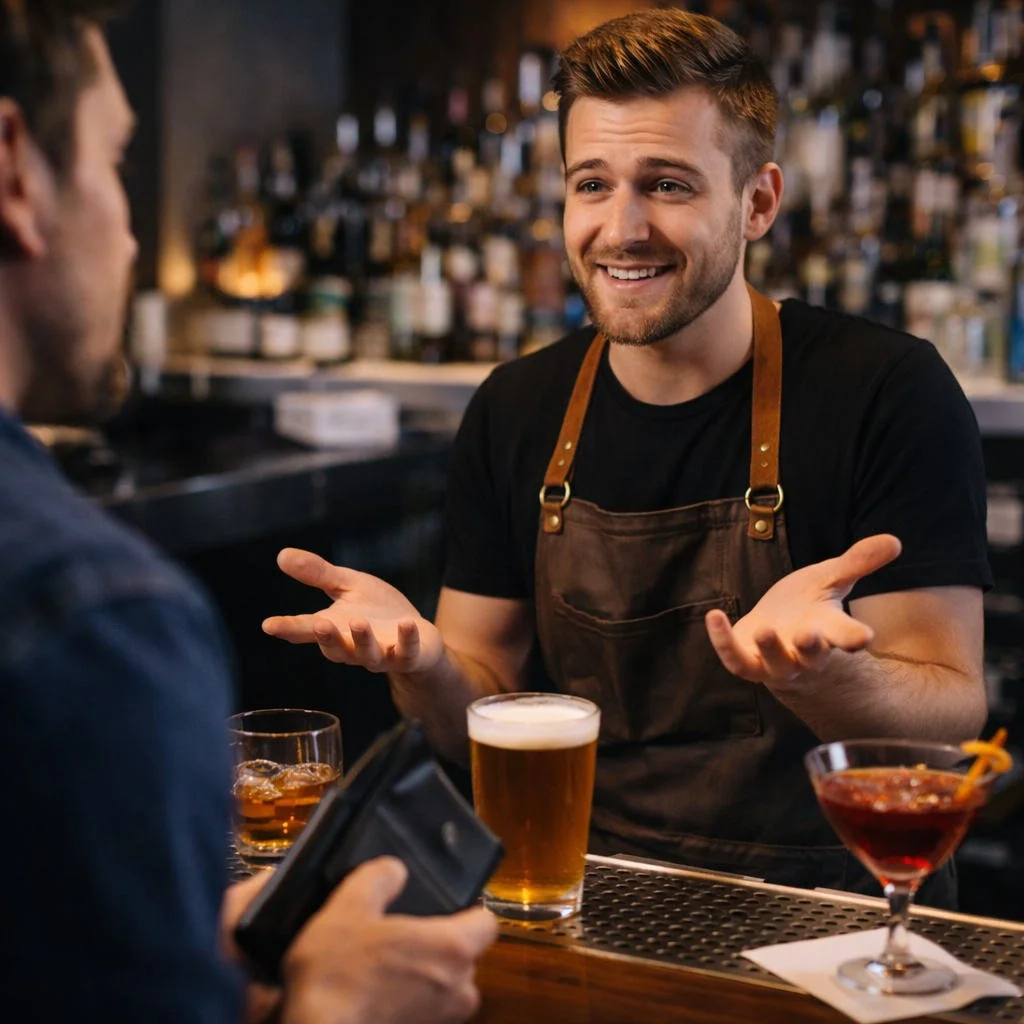
Drink price complaints happen everywhere—from dive bars to cocktail lounges. Most of the time, it’s not personal. It’s either sticker shock, a bad mood, or someone trying to “negotiate” like they’re buying a used Honda.
Your goal isn’t to win an argument. Your goal is to:
keep the interaction friendly,
protect the vibe,
and give them a simple next step (cheaper option, smaller pour, happy hour, or water).
Here are bartender-ready lines you can use immediately.
The golden rules (before the scripts)
Agree with the feeling, not the complaint.
You can validate them without admitting the price is “wrong.”Keep your tone casual and unbothered.
If you get defensive, it escalates.Offer options fast.
People calm down when they feel they have control.Don’t blame management, taxes, or “inflation” too hard.
One quick line is fine. A rant is not.
Best things to say (copy/paste lines)
1) The friendly, neutral acknowledgement
“Yeah, I hear you.”
“Totally fair—prices have jumped everywhere.”
“I get it. Want me to point you to the best bang-for-buck?”
Why it works: It acknowledges without arguing.
2) The “I don’t set prices, but I can help” line
“I get it—pricing isn’t up to me, but I can definitely help you find something cheaper.”
“I don’t control the prices, but I can steer you toward the best value.”
Why it works: It’s honest and immediately helpful.
3) The “best value” redirect (the single best strategy)
“If you want the best value, the ___ is your best bet.”
“If you’re trying to keep it cheaper, I’d do a ___ instead—same vibe, lower cost.”
“Want something simple and cheaper? Beer/highball/house wine is the move.”
Why it works: People usually want a solution more than a debate.
4) The “happy hour / specials” line
“If you’re looking for deals, happy hour is ___ to ___.”
“We’ve got specials on ___ right now—want one of those?”
Why it works: It gives them a win without changing the price.
5) The “premium ingredients” explanation (for cocktail bars)
Use this only if the vibe is calm and they’re genuinely curious.
“This one’s a bit higher because it’s a premium spirit and we’re using fresh ___.”
“That cocktail uses top-shelf ___ and fresh citrus—if you want cheaper, I can do a simpler highball version.”
Why it works: You justify the premium while offering a cheaper alternative.
6) The “pour size / upgrade” clarity line
Sometimes they think it’s a double, or they don’t realize it’s a premium.
“That’s for a 1oz/1.5oz pour of ___.”
“That price is for the premium ___—if you want, I can switch it to the rail version.”
“If you want a double, I can do it, but it’ll be ___.”
Why it works: It corrects the mismatch without sounding condescending.
7) The “good vibe” joke line (use carefully)
Only if your tone is playful and the guest isn’t aggressive.
“I know—if I could set prices, I’d be retired.”
“Yeah… my wallet misses 2019 too.”
“If complaining made it cheaper, I’d be giving these away.”
Why it works: It diffuses tension—unless the person is already angry.
8) When they push harder (“That’s ridiculous!”)
Keep it calm, short, and offer a choice.
“Totally understand. Want to switch to something cheaper?”
“No worries—what price range are you trying to stay in?”
“Fair. I can do a ___, ___, or ___ that’s cheaper.”
Why it works: It stops the argument loop by moving to decision mode.
If they’ve already ordered and now they’re mad
This is where people try to reverse the transaction. Be polite but firm.
If the drink is already made but untouched
“If you don’t want it, I can take it back, but I can’t comp it once it’s made. I can swap you to something cheaper for next one.”
If they’ve already started drinking it
“I hear you. I can definitely help you pick a cheaper option for the next round.”
Key move: Don’t apologize like you’re guilty—just offer a better next step.
What NOT to say (even if it’s true)
“Then don’t drink here.”
“Go somewhere else.”
“It’s not my problem.”
“That’s the price, deal with it.”
“Inflation, man” (as a full rant)
“You can’t afford it?” (never)
These lines might feel satisfying for one second and cost you tips, reviews, and vibe.
A simple “value menu” you can keep in your head
Have 3–5 “value steering” options ready at your bar, like:
cheapest beer
house highball
house wine
a simple cocktail that’s good value (e.g., vodka soda with lime)
a non-alcoholic option (soda water + lime)
Then when someone complains, you don’t improvise—you just route them to the value lane.
Example mini-conversations (realistic)
Scenario A: “$12 for a pint?!”
You: “Yeah, I hear you. If you want cheaper, the ___ is the best value, or I can do a simple highball for less. What do you feel like?”
Scenario B: “This cocktail is overpriced.”
You: “Totally fair. This one’s higher because it uses premium ___ and fresh citrus. If you want something cheaper, I can do a simpler version—like a ___.”
Scenario C: “I’m not paying that.”
You: “No worries at all. What price range are you trying to stay in? I can point you to the best options.”
Scenario D: “Last time it was cheaper.”
You: “I get it. Prices have changed a bit. If you want, I can help you pick something that’s the best value right now.”
Quick checklist for the bartender brain
When they complain about price, do this in order:
Acknowledge: “I hear you.”
Distance: “I don’t set prices.”
Options: “Here are 2–3 cheaper alternatives.”
Close: “What would you like instead?”
That’s the whole play.