Cement has an unforgiving reputation: once it cracks, someone has to do something about it. Researchers at Pacific Northwest National Laboratory have built a version with a repair mechanism tucked into the material itself. Break it, give it the right conditions, and a polymer phase moves toward the damage and helps the broken surfaces reconnect.
The team calls the idea “molecular Velcro.” In small laboratory cement specimens, it produced visible crack filling and partial recovery of strength after repeated damage. The result is intriguing precisely because cement seems such an unlikely home for something that can pull apart and attach again.
There is a substantial distance between that specimen and a self-repairing bridge. The study, published in Nature Communications in August 2026, tested cement paste, not reinforced structural concrete. Its most useful lesson is how an ordinarily brittle material can acquire a second, more adaptable way of holding together.
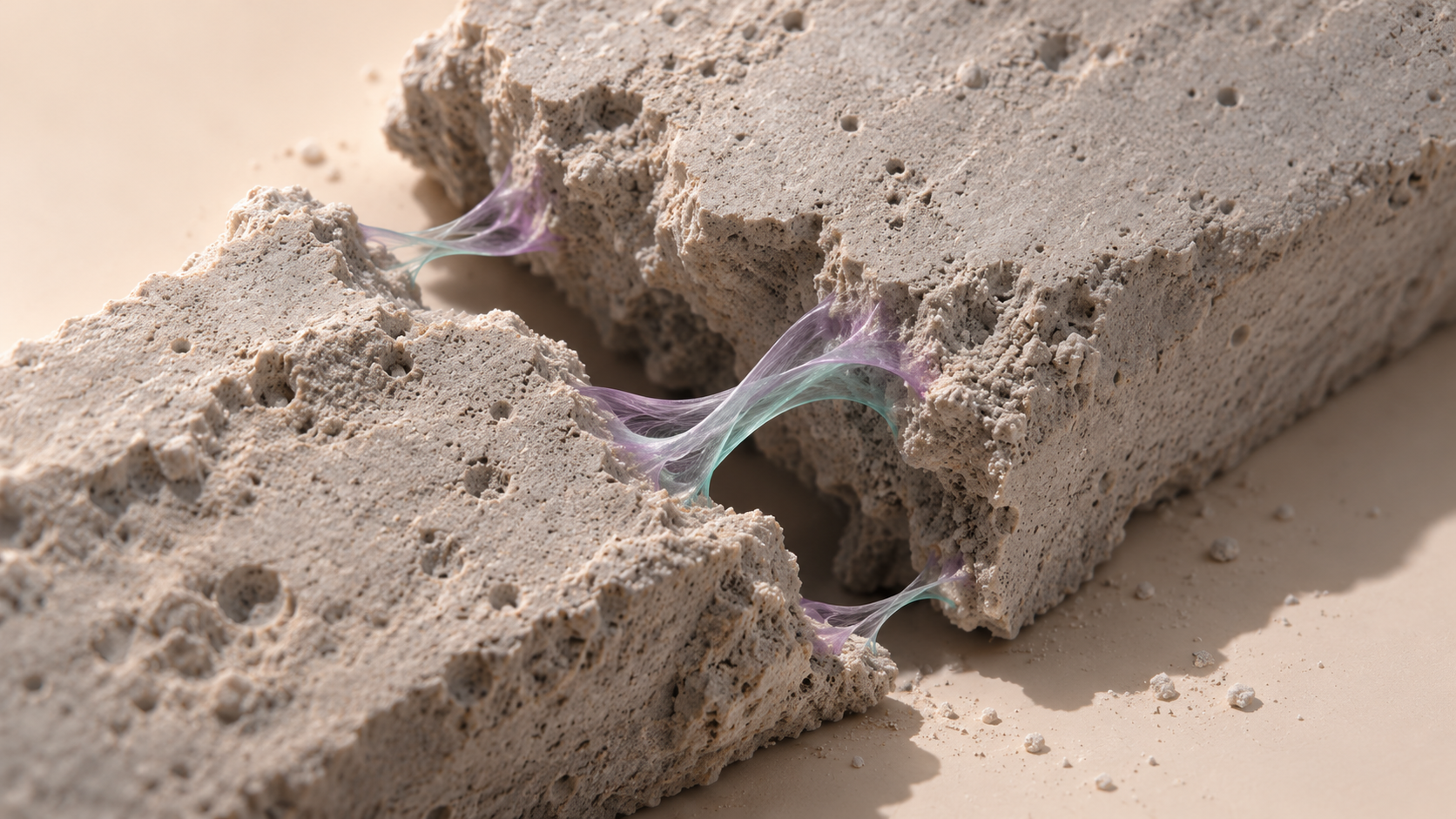
The flexible ingredient inside the rigid material
The experimental material combines Portland cement and silica fume with a complex made from three polymers: poly(acrylic acid), poly(ethylene oxide) and branched poly(ethylenimine). Their abbreviated names, PAA, PEO and bPEI, are less important than what they do together.
They form reversible interactions with one another and with the mineral products that develop as cement hardens. These include hydrogen bonding and electrostatic interactions. Some of the polymer chemistry also involves calcium in the cement’s binding phase.
“Velcro” is a useful analogy for connections that can separate and reconnect. There are no miniature hooks and loops inside the cement. Instead, many molecular interactions collectively help hold material together, while allowing some rearrangement after damage.
The researchers’ proposed mechanism starts in the pores. Polymer-containing regions act as reservoirs. Water and forces within that pore network, including capillary effects, help redistribute material toward newly exposed crack surfaces. There, the repair phase can establish new connections across the damage.
Several techniques support this picture. X-ray imaging revealed filling within fractures. Microscopy and chemical analysis found carbon-rich material emerging at damaged interfaces after humid exposure, consistent with polymer enrichment. Spectroscopy and simulations helped investigate the interactions behind it.
That evidence does not amount to a movie of every molecule finding its way home. It supports a transport-and-rebonding explanation assembled from different measurements. Ordinary cement chemistry also has a part: continued hydration and calcium-carbonate formation can contribute to healing. The polymer enables a combination of processes, rather than making the mineral chemistry irrelevant.
A deep crack can still be very narrow
One of the study’s most eye-catching results concerns a fracture about 2 millimeters deep. Polymer filling across that depth was already visible at the first X-ray computed-tomography observation, around four hours after damage.
The direction of that measurement matters. Depth describes how far the fracture extends into the specimen. Width describes the gap between its faces. A narrow slit can reach a long way into a material without becoming a wide-open trench.
In the optical specimens, the reported crack widths averaged 92 micrometers, with a spread reported as ±37 micrometers; the maximum was 140 micrometers. Those are fractions of a millimeter. The experiment therefore should not be pictured as a 2-millimeter-wide gap zipping shut.
The four-hour observation also has a specific meaning. Setting up and acquiring the scan took time, so the researchers did not continuously observe the fracture closing and stop a stopwatch at exactly four hours. They saw filling when the first scan became available. Separate optical observations followed changes at the fracture surface over 72 hours.
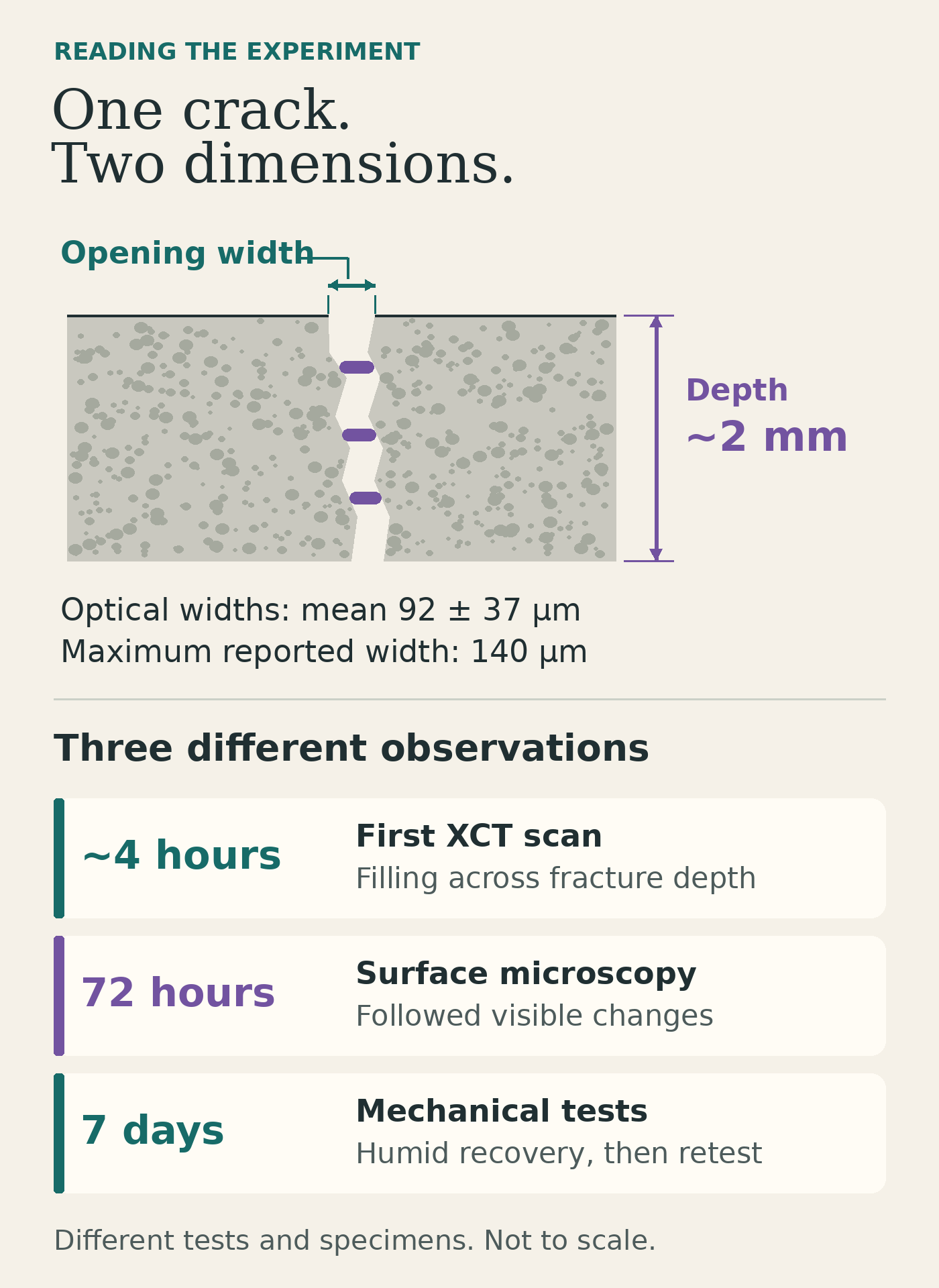
The horizontal arrow represents opening width; the vertical arrow represents depth into the material. The optical width measurements and XCT depth observation came from different measurement contexts. The three time labels describe separate tests, not successive stages of one continuously tracked repair.
Filling a crack and restoring strength are different tests
A fracture can look better without carrying its original load again. That is why the mechanical experiments are more consequential than an attractive before-and-after image.
For those tests, the researchers initially cured specimens for seven days, damaged them under controlled loading, then allowed seven-day recovery periods in a humid environment at ambient temperature. They subsequently tested how much mechanical strength had returned.
The result was partial recovery, including repeated recovery in compression. The compression sequence included an initial baseline test followed by six damage-and-healing cycles. That demonstrates repeatability under the study’s conditions, rather than a single lucky closure.
The type of force also matters. Compression pushes material together; direct tension pulls it apart. The study found stronger recovery in compression than in tension or bending. In compression, later failure can take a different path through the specimen. Direct tension is more likely to reopen the already weakened healed plane. A recovered compression result therefore cannot simply be read as proof that one particular crack is back to its original condition.
Contact helped, too. For direct-tension healing, broken pieces were brought together. A separate cut-and-heal demonstration also used contact and loading. “Self-healing” describes what the material can do when the necessary conditions are present. It does not mean detached chunks can retrieve one another.
Why the ability to reconnect matters
Self-healing cement is a crowded research idea, with several ways to give a mineral material some repair capacity. Ordinary cement can seal certain small cracks through its own chemistry. Roman-inspired work on lime clasts examines reactive mineral reservoirs. Other approaches use bacteria that promote mineral deposits or capsules carrying a healing agent.
Capsules offer an intuitive mechanism: a crack breaks one open, releasing material where it is needed. Their available supply can eventually be consumed. Reversible interactions offer a different possibility, with connections that can form again after being disturbed.
That makes the repeated recovery here interesting. It does not establish that the polymer approach is universally faster, stronger or more durable than alternatives. Different studies test different cracks, materials and environments. Comparing their headline numbers can be like ranking umbrellas by how well they perform indoors.
Nor does this paper inaugurate the entire field. A 2019 study documented a UK field application of microcapsule-based self-healing concrete. The advance worth examining is this particular reversible-polymer strategy and the laboratory evidence behind it.
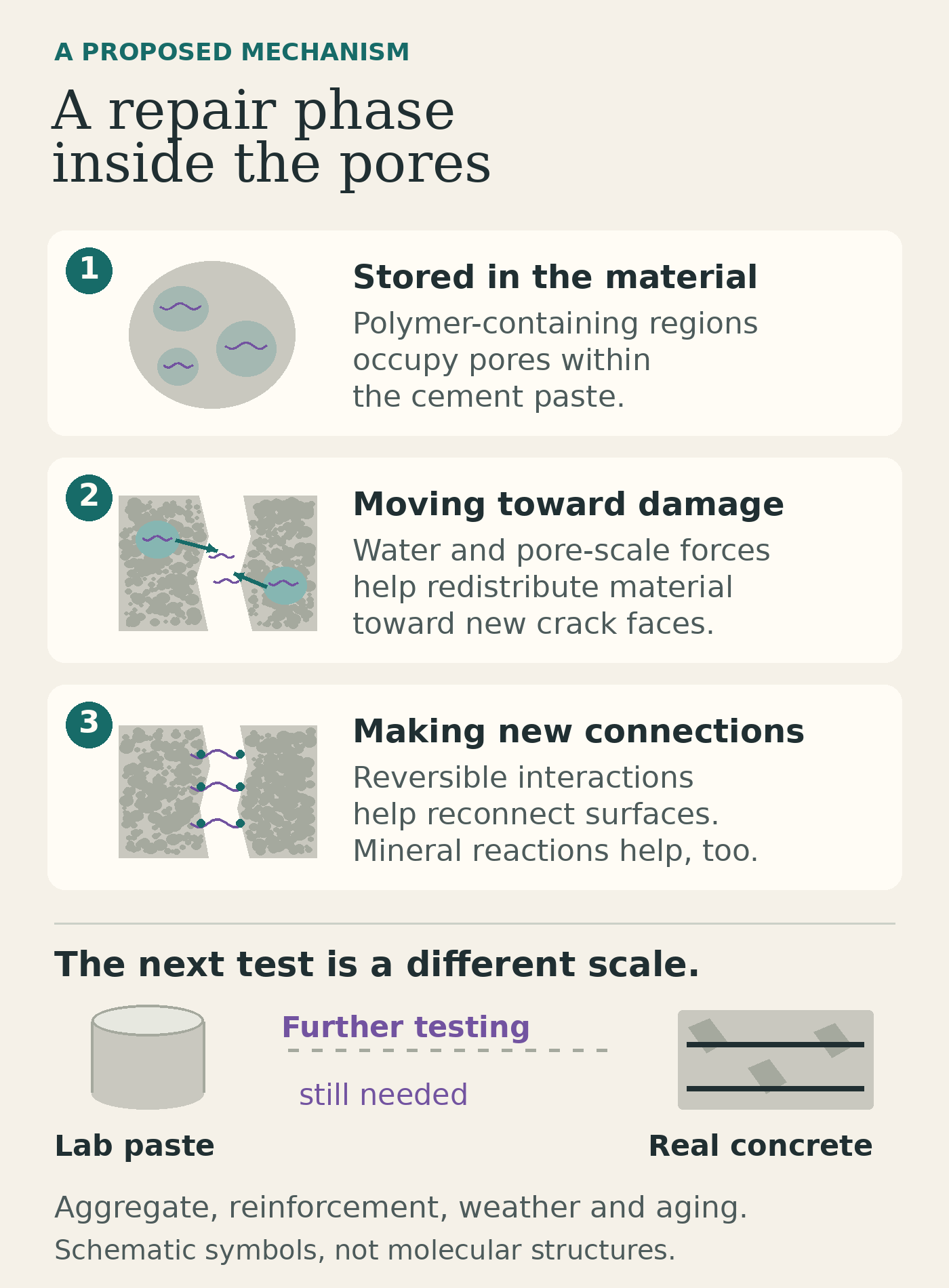
Original explanatory diagram based on the study, supplement and published peer-review responses. The polymer shapes are symbols, not atomistic models; ordinary cement reactions can contribute alongside rebonding.
Concrete has a much harder audition
Cement is the binder in concrete. Actual structural concrete adds aggregate, and often reinforcing steel, along with a far messier history of casting, curing, weather and loading than a small laboratory specimen experiences.
The imaging samples in this study were young, cured for 24 hours before being broken by hand. The mechanical samples had their own preparation and recovery schedule. Humidity helped the repair process. Those details raise practical questions about older material, drying conditions, repeated environmental changes and how well the repair phase remains available over time.
One particularly important gap appears in the published peer-review responses: the authors said they had not assessed time-based chemical aging under sustained alkaline exposure. Cement is a chemically demanding home for a polymer, so continued usefulness cannot be assumed from an early healing result.
Larger-scale testing would also need to establish what happens around aggregate and reinforcement, under repeated loads and changing wet-and-dry conditions. Whether a repaired crack limits water penetration and protects steel is another question beyond whether it looks filled. Wide gaps and missing material present still more demands.
The fresh mixture offered an encouraging compatibility signal. Its initial setting time was similar to the control mixture’s, and final setting differed only modestly. But a material can behave acceptably in a small laboratory batch and still require substantial work before it can be mixed, transported, pumped and cured reliably on a construction site. The study tested one main formulation concentration, leaving a wider optimization program for later.
What the five-year claim actually tells us
PNNL’s September announcement adds an enticing detail: a repeatedly damaged test piece reportedly kept healing over five years. That is an institutional claim about a specimen, not a five-year record of a road or bridge in service. The announcement does not provide the full protocol, environmental history or raw long-duration measurements needed to make that leap.
The laboratory is pursuing commercialization, and its PaNaCEM technology page offers a broader family of formulations for licensing. Licensing availability does not establish a stocked, field-validated construction product or a guaranteed service life for this formulation.
The paper reports Department of Energy support and declares no competing interests. PNNL also describes institutional patents and commercialization efforts, useful context when reading its promotional claims.
The compelling result is already there without a maintenance-free future attached: a hard, brittle cement material can contain a repair phase that moves and reconnects after damage. The next challenge is finding out how much of that small-scale adaptability survives the much larger, less accommodating world outside the laboratory.