Monk’s Café Is the Broke New Yorker Fantasy: Why Seinfeld’s Diner Hangout Still Works
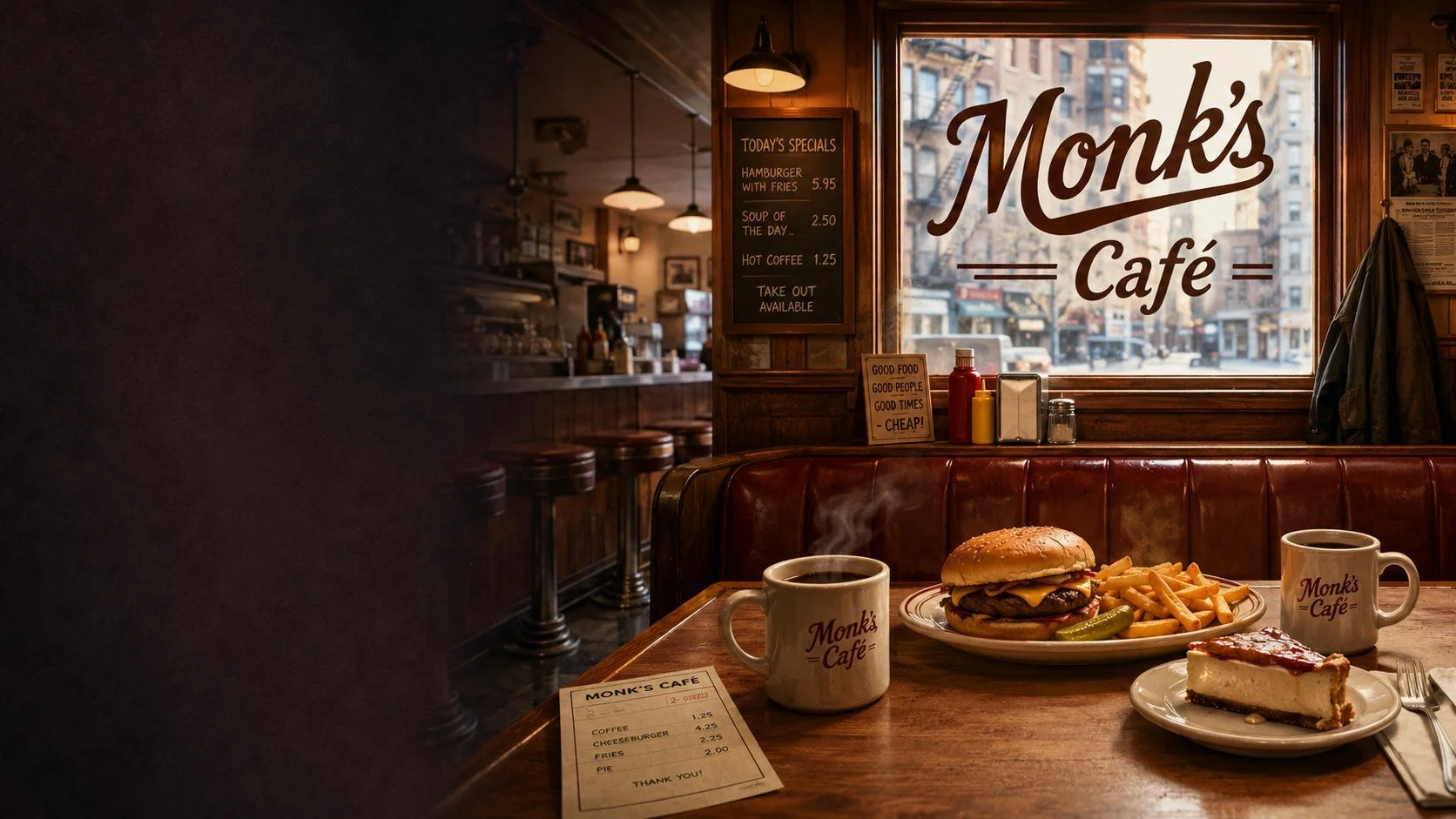
Monk’s Café is not famous because the food looks good. Let’s be serious. Nobody watched Seinfeld and thought, “My God, that toast has range.”
Monk’s is famous because it is the perfect cheap food hangout: a booth, coffee, fries, eggs, sandwiches, pie, bad lighting, mild hostility, and enough time to dissect every meaningless social interaction until it becomes a federal case. It is less a restaurant than a complaint chamber with ketchup bottles.
That is exactly why it works.
A perfect cheap food hangout does not need a chef’s tasting menu. It does not need a reservation system, a natural wine list, a hostess with cheekbones, or a bathroom sink that looks like a sculpture from a spa that judges you. It needs somewhere you can sit, order something ordinary, and linger just long enough to turn “She didn’t say hello in the elevator” into a 22-minute conversation with escalating hand gestures.
Monk’s Café is the spiritual home of broke-ish, neurotic, city adulthood. It is where friendship happens because nobody has a better plan. It is where hunger, boredom, gossip, and minor emotional damage meet over coffee. It is not aspirational. It is useful. And usefulness is much rarer than charm, especially in a city where a sandwich can cost enough to trigger a fraud alert.
Monk’s Café Works Because Nobody Is There for the Food
The food at Monk’s is important, but mostly because it is not important.
That sounds stupid, so naturally it is true. A cheap food hangout cannot have food that demands too much attention. If the burger is too good, people talk about the burger. If the soup is too weird, people talk about the soup. If the menu is too precious, someone says “locally foraged” and now everyone has to leave before civilization collapses.
Monk’s serves diner food, which is perfect because diner food is conversation furniture. Eggs. Burgers. Fries. Tuna. Soup. Coffee. Pie. Toast. Salad if someone is pretending. It gives the characters something to order, push around, complain about, and abandon while they focus on the true meal: grievance.
That is the magic. The food fills the scene without hijacking it. Nobody is waiting for the smoked duck course. Nobody is asking where the ramps came from. Nobody is explaining fermentation like a man who owns too many linen shirts. The food is there to support the talking, and the talking is the real entrée.
A great cheap hangout is not a destination restaurant. It is a place you drift into because your apartment is too small, your job is annoying, your friends are available, and eating at home would require confronting the fact that you own one egg and several condiments from 2018.
The Booth Is the Whole Point
The booth at Monk’s is basically a throne for doing nothing.
A table is fine. A counter is fine. But a booth is where people become regulars. A booth says, “Stay. Lean in. Complain professionally.” It creates a little temporary apartment inside a public space. You can sit shoulder-to-shoulder, hide from strangers, scan the room, and conduct a full investigation into whether someone’s new girlfriend laughs too loudly.
The Seinfeld booth works because it gives the group a home base outside Jerry’s apartment. Jerry’s apartment is private space. Monk’s is public-private space, the little social middle zone where everyone can meet without anyone having to host. Nobody has to clean. Nobody has to offer drinks. Nobody has to pretend they are happy you dropped by. The waitress can hate everyone equally, which is honestly more democratic.
That is what makes a cheap diner so powerful: it removes the burden of hospitality. You are not “having people over.” You are “meeting at Monk’s.” Huge difference. One requires vacuuming. The other requires pants and enough money for coffee. Barely.
Monk’s Is the Perfect Third Place, Unfortunately for Every Fancy Café With One Outlet
Sociologist Ray Oldenburg popularized the idea of the “third place”: not home, not work, but a neutral public spot where people can gather informally. Monk’s is practically a textbook example, except the textbook would probably not include George yelling about soup.
A good third place needs to be accessible, informal, low-pressure, and cheap enough that regulars can keep coming back. Monk’s checks every box. It is not trying to be exclusive. It is not trying to curate a “vibe.” It does not require a $7 matcha or a laptop sticker that implies you have a newsletter. It just exists.
The cheapness matters. A hangout only works if people can return without budgeting for it like a minor appliance. The characters can meet at Monk’s because diner food is plausible everyday food. Coffee, fries, a sandwich, eggs, soup — these are not luxury events. They are edible excuses to sit indoors.
Modern “third places” often fail because they become too expensive, too surveilled, too branded, too time-limited, or too full of people pretending to work on screenplays. Monk’s succeeds because it asks very little of its customers beyond ordering something and not starting a felony.
Low bar. High achievement.
The Menu Is Cheap Enough to Make Conversation the Main Activity
Monk’s is perfect because the food does not turn the hangout into an occasion.
If you meet friends at a nice restaurant, the meal becomes the event. You discuss the menu. You coordinate appetizers. Someone says, “Should we get a bottle?” Now everyone is suddenly acting like financial diplomats. The check arrives and destroys the mood like a beige little guillotine.
At Monk’s, the check is not the climax. The conversation is. That is the difference between a restaurant and a hangout.
Cheap food lets people waste time. This is its noblest function. When the bill is manageable, the table becomes available for rambling, complaining, scheming, and retelling an interaction from four different angles until someone finally says, “You’re insane,” and everyone agrees while continuing to discuss it.
That is the Seinfeld engine. The place is cheap enough that the characters can sit around turning nothing into something. Expensive food would ruin the show. Imagine Jerry, Elaine, George, and Kramer discussing the Soup Nazi over a $140 tasting menu. Disgusting. Illegal. The nation would have recovered, but barely.
It’s Public Enough for Weirdness, Private Enough for Repetition
A perfect cheap food hangout has to allow chance encounters. Monk’s does. Friends, enemies, dates, rivals, waitresses, strangers, old acquaintances, new disasters — they can all wander in because the diner is a public crossroads.
But it also has to feel familiar. Monk’s does that too. The group knows the room. The audience knows the room. The booth becomes part of the show’s grammar. When a scene starts there, we understand the purpose immediately: someone is about to report a grievance, confess a scheme, debate etiquette, or discover that the ordinary rules of society are somehow personally offensive.
That balance matters. If a place is too private, nothing intrudes. If it is too public, nobody belongs. Monk’s lets the gang feel both exposed and at home, which is exactly the right environment for people whose main hobby is turning social discomfort into philosophy with napkins.
Diners Are Built for the Chronically Undecided
The diner menu is a triumph of too many options and not enough consequences.
Breakfast at midnight. Soup at 10 a.m. Burger at 3 p.m. Pie because life is short and the waitress already hates you. A diner menu does not ask you to be a coherent person. It accepts that you might want pancakes while your friend wants a tuna sandwich and another friend wants only coffee and moral superiority.
That is why diners make great group hangouts. Nobody has to agree on cuisine. Nobody has to say, “I’m not really in the mood for Thai.” Nobody has to enter the group-chat hellscape of choosing between tacos, sushi, pizza, ramen, and one person’s unexplained desire for “somewhere light.”
Monk’s solves the problem by being everything and nothing. It is the beige Switzerland of food. The menu is broad enough to absorb everyone’s appetite and bland enough to avoid becoming the topic. Perfect.
The Service Is Part of the Charm, Not a Hospitality Workshop
Monk’s does not look like a place where the staff says, “How is everything tasting tonight?” in a voice trained by corporate fear.
Good.
A cheap diner hangout does not need ornate hospitality. It needs durability. Refills. Plates. Mild impatience. Someone who has seen every kind of customer and is not impressed by your omelet questions. The service should be functional, not emotionally needy.
That fits Seinfeld perfectly. The characters are too self-involved for warm hospitality anyway. If a server were overly friendly, they would immediately turn it into a problem. Elaine would analyze the tone. George would panic about whether friendliness meant interest. Jerry would find something suspicious in the refill timing. Kramer would somehow start working there.
The slightly brusque diner energy is ideal because it matches the show’s worldview: everyone is weird, everyone is annoying, and the best you can hope for is your food arriving before the next social injury.
Monk’s Is Cheap Enough for George, Which Is the Highest Test
The ultimate measure of a cheap food hangout is whether George Costanza would keep going there.
George is not paying boutique café prices to sit under a plant wall and drink coffee from a cup shaped like a plumbing fixture. George needs value. George needs refills. George needs a booth where he can complain about the world while ordering something that does not threaten his wallet or his fragile sense of masculine injustice.
Monk’s passes the George Test.
A good hangout must be affordable enough for the person in the friend group who treats every bill like a personal attack. Every group has one. If you do not know who it is, congratulations, George.
The brilliance of Monk’s is that it works for all four characters. Jerry can observe. Elaine can complain. George can spiral. Kramer can arrive as if gravity is merely a suggestion. The space holds all of them because it is cheap, casual, repetitive, and unglamorous. Basically, friendship with laminated menus.
It Lets Adults Be Regulars Without Having Goals
Modern life is obsessed with usefulness in the worst way. Every activity has to optimize something. Coffee shops are for working. Restaurants are for “experiences.” Bars are for networking, dating, watching sports, or spending $18 on a cocktail named after a weather event.
Monk’s lets people simply be regulars.
That is rarer than it sounds. To be a regular somewhere is to belong lightly. Not in a grand dramatic way. Nobody is carving your name into a booth. Nobody is hugging you at the door like you returned from war. You just show up, sit down, order your usual, and become part of the furniture in the least depressing way possible.
That is what cheap diners offer: low-stakes belonging. You do not have to be impressive. You do not have to be productive. You do not have to be dressed for a hotel lobby. You can be annoying, hungry, underemployed, overdressed, underdressed, newly dumped, pre-date, post-date, or just bored.
Monk’s accepts all of this because diners have seen worse. Much worse. Somewhere in the back, there is probably a man eating meatloaf at 9:40 a.m. and judging nobody.
The Food Is Cheap, but the Time Is the Real Value
Monk’s is a perfect cheap food hangout because it sells time disguised as food.
That is what people are really buying. Not the coffee. Not the fries. Not the sandwich. The time. The right to sit in a public place with friends and turn ordinary life into conversation. The right to linger. The right to avoid going home. The right to delay the next obligation by ordering another coffee you absolutely do not need.
Cheap food makes time affordable.
That is why diners mattered before everyone became trapped between delivery apps and $9 cold brew. They created space for informal social life. You could meet someone without planning an “experience.” You could sit without performing wealth. You could eat something hot without making it a statement about identity, values, or your relationship to seed oils.
Monk’s is the fantasy of a city where ordinary people can still afford to hang out indoors. Honestly, at this point, that is more unrealistic than Kramer’s entire physical existence.
It’s Not Instagrammable, Which Is Why It Feels Real
Monk’s is ugly in the correct way.
Not hideous. Not dirty. Just normal. Brown booths. Basic tables. Counter seating. Coffee cups. Plates that do not require explanation. Lighting that does not care about your face. This is a place built for sitting, not posting.
That makes it feel real. A cheap food hangout should not look like it was designed by a branding agency called Table & Vibe. It should not have a neon sign that says something like “Good Food Good Mood,” which is less a slogan than a cry for municipal intervention. It should not have one dramatic tile wall where everyone photographs the same latte and pretends to be surprised by foam.
Monk’s does not beg to be documented. It begs to be used. That is why it works as television. The set is memorable without shouting. It supports the characters instead of competing with them. The booth is iconic because of what happens there, not because it has a flower installation suspended from the ceiling like brunch is being attacked by a florist.
Monk’s Makes Cheap Food Feel Like Social Infrastructure
The real genius of Monk’s is that it shows cheap food as infrastructure.
Not glamorous food. Not perfect food. Not food that wins awards. Food that gives people somewhere to go. Food that creates routines. Food that makes friendship possible because it provides a location where nobody has to own a big apartment, cook a meal, or spend serious money.
That is the hidden importance of diners, cafés, coffee shops, and cheap restaurants. They are not just businesses. They are social containers. They hold the small repeated conversations that make friendships feel real. They give people a default.
Default places matter. “Meet me at Monk’s” is easier than “Let’s coordinate a meaningful social encounter.” The default removes friction. The booth does half the work. The coffee does the rest. The fries supervise.
Why Monk’s Still Feels Perfect Now
Monk’s feels even better now because so many casual hangouts have gotten worse.
Coffee shops are crowded with laptops and outlets guarded like holy relics. Restaurants want reservations, deposits, QR codes, and entrees priced as if the chicken attended private school. Bars are loud. Apartments are small. Public spaces are inconsistent. Everything wants you to buy more, leave faster, or become content.
Monk’s is the opposite fantasy: sit down, order cheap food, stay a while, talk nonsense, repeat tomorrow.
The food does not need to impress you. The staff does not need to flatter you. The décor does not need to photograph well. The point is not consumption as performance. The point is togetherness as routine.
That is what makes it the perfect cheap food hangout. It is not where you go for the best meal of your life. It is where you go because life keeps happening and you need a place to process it badly with friends.
Monk’s Café Is Perfect Because It Knows Its Job
Monk’s Café is the perfect cheap food hangout because it understands the sacred diner equation: affordable food plus booths plus coffee plus time equals friendship disguised as complaining.
It is not fancy. It is not curated. It is not trying to “elevate” anything, thank God. Nothing at Monk’s needs to be elevated. The people are already neurotic enough at ground level.
Monk’s works because it is cheap enough for regulars, ordinary enough for repeat visits, public enough for weird encounters, private enough for long conversations, and bland enough that the food never gets in the way of the real business: overanalyzing life’s tiniest irritations until they become art.
A perfect hangout does not need to be cool. Cool is expensive and exhausting. A perfect hangout needs to be there.
Monk’s is there. With coffee. With fries. With booths. With soup that may or may not contain a rubber band, because even perfection needs texture.
And if that is not the dream of cheap city living, what is?