

A missile launcher near a seaside club makes an arresting photograph. It becomes more unsettling when that club is the president’s home and renewed strikes on Iran are being discussed.
The additional air defenses around Mar-a-Lago are real. NORAD and U.S. Northern Command have confirmed a deployment requested by the Secret Service. The crucial unanswered question is what specifically prompted it.
As of November 1, the public evidence supports taking the security change seriously. It also leaves the connection to an offensive decision about Iran unresolved. The equipment can tell us something about the kind of protection being added. It cannot, by itself, tell us which threat officials identified or whether President Donald Trump has authorized another operation.
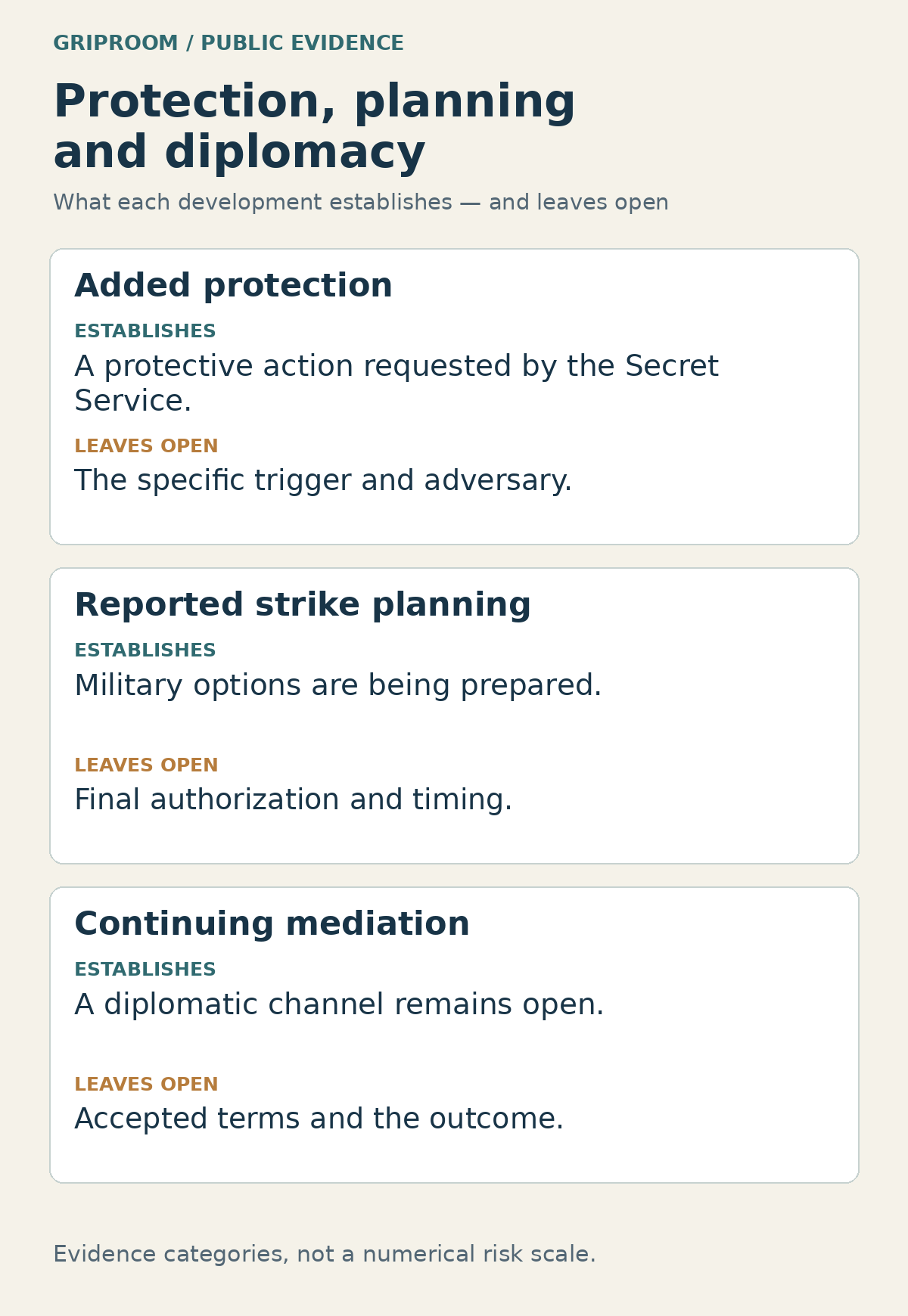
That distinction matters because three different decisions can become blurred in one dramatic image: protecting the president, preparing for possible retaliation and ordering military action. Evidence of the first does not automatically establish the other two.
What has actually been added around Mar-a-Lago
In its original report on the deployment, WPTV carried confirmation from NORAD and Northern Command that ground-based defenses had been placed around the estate at the Secret Service’s request. The station also recorded equipment at the nearby airport.
The War Zone’s subsequent reporting identifies Avenger systems and describes additional counter-drone support. Officials told the outlet the measures added another protective layer, while declining to disclose a specific reason for the deployment.
Those are meaningful confirmations. They support a story about expanded protection. They leave the intelligence behind that protection outside the public account.
It is tempting to fill that gap with whichever international crisis feels most urgent. A more useful approach is to ask what the equipment’s role can establish before attaching a motive to its arrival.
The hardware’s job gives the first clue
The Army’s description of Avenger identifies a mobile, short-range air-defense system designed to counter low-flying aircraft, helicopters, drones and cruise missiles. It combines missiles and a gun on a vehicle platform.
That description helps explain why the equipment belongs in a presidential protection operation. It adds a way of responding to an airborne danger close to the place being protected.
The list of possible targets is also a warning against reading the hardware too narrowly. A system capable of countering drones does not establish that officials have discovered a particular drone plot. The same published description covers several different airborne threats.
Nor does a general equipment handbook reveal the exact configuration, readiness or performance of the systems in Florida. Its value here is simpler: it explains the protective mission readers are seeing in the news.
The timeline starts before the newest headlines
The War Zone reproduces photograph captions dating equipment observations to October 15 at the airport and October 16 at Mar-a-Lago. WPTV later documented its own October 26 observation outside the estate.
These dates matter. A photograph becoming widely discussed in late October does not mean the equipment arrived that day. Even an early photograph establishes that something was present by that date, rather than identifying its first installation or the meeting that approved it.
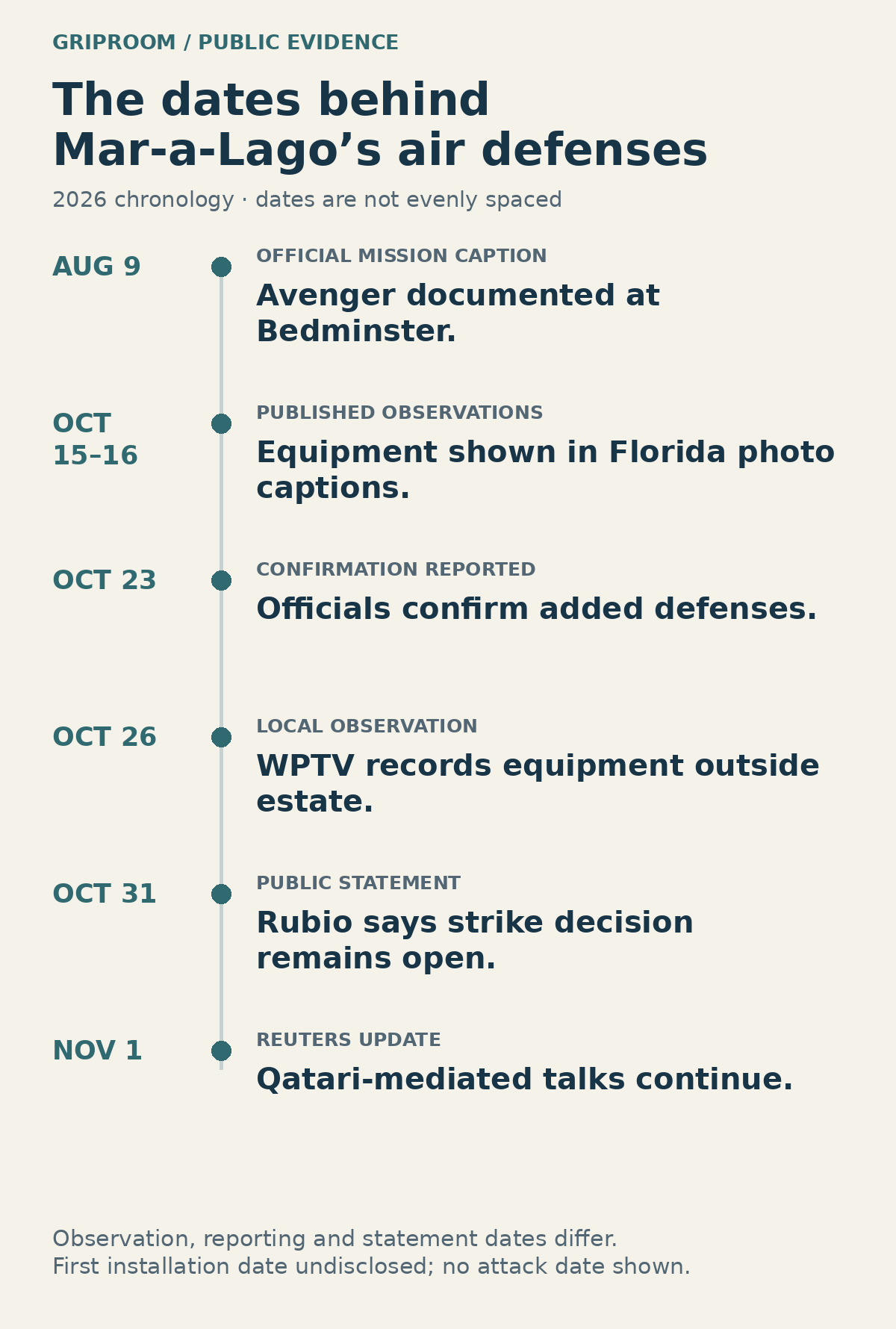
A deployment date and a news cycle are separate clocks. Confusing them can make unrelated developments look synchronized, or make an earlier precaution appear to have followed a later warning.
Iran belongs in the threat picture
There is a documented reason to examine the Iran connection. In a November 2024 charging announcement, the Justice Department described alleged Iranian-linked tasking to develop a plan to kill Trump. Those were criminal allegations, and they remain historical context for this article rather than proof of a present plot.
Axios reported an October 23 warning about Iranian threats to American officials abroad; it did not identify Mar-a-Lago.
The later warning’s date cannot tell us when the underlying intelligence emerged. It therefore neither establishes why the earlier equipment was deployed nor rules out a connection. The specific cause remains undisclosed.
Our reading is that concern about retaliation is a plausible part of the context. Establishing it as the actual reason for this particular deployment would require a more direct, attributable account.
An earlier deployment changes how unusual this looks
An official Air Force caption from Bedminster documents Army personnel operating an Avenger during a temporary-flight-restriction enforcement mission on August 9.
That gives the Florida photographs a useful comparison: this kind of equipment has already appeared in protection at another Trump property.
It does not give us a normal deployment rate. One documented example cannot establish how routine the practice is, and the August mission occurred during the same Iran conflict. It is therefore an imperfect comparison for anyone trying to isolate an Iran-related change.
The precedent cuts against treating the Florida equipment as an unprecedented signal. It leaves open whether the current threat assessment, deployment size or expected duration differs in ways officials have not disclosed.
The stronger evidence about Iran comes from the Iran reporting
ABC News reported on October 22 that U.S. and Israeli forces had drawn up plans for renewed strikes, citing two Israeli sources. Its report also carried a White House spokesperson’s statement that the United States would not attack before the November 3 midterms.
The Associated Press reported warnings to regional allies about possible renewed action and retaliation. The diplomats it cited stressed that Trump had not made a final decision.
Those reports address offensive preparations more directly than photographs of protective equipment in Florida. A promise to refrain before an election still does not schedule an attack afterward.
Diplomacy has continued alongside the preparations. Qatar’s October 27 briefing described continuing exchanges through its mediation channel. Reuters’s November 1 update reports ongoing talks and separately dates Secretary of State Marco Rubio’s public no-decision remarks to October 31.
For the broader political timeline, GripRoom’s guide to possible Iran strikes after the midterms explains the separate planning and election questions.
The next useful development would explain the decision
An attributable disclosure identifying the reason for the Mar-a-Lago deployment would answer the protective-security question more directly. An acknowledged order or actual renewed operation would answer a different question about military action. An accepted diplomatic arrangement would add more than another report that talks continue.
For now, the added protection deserves attention on its own terms. The revealing next development would be one that explains the decision behind it, rather than another photograph of equipment whose presence is already confirmed.