
How to Use ChatGPT to Create a Budget
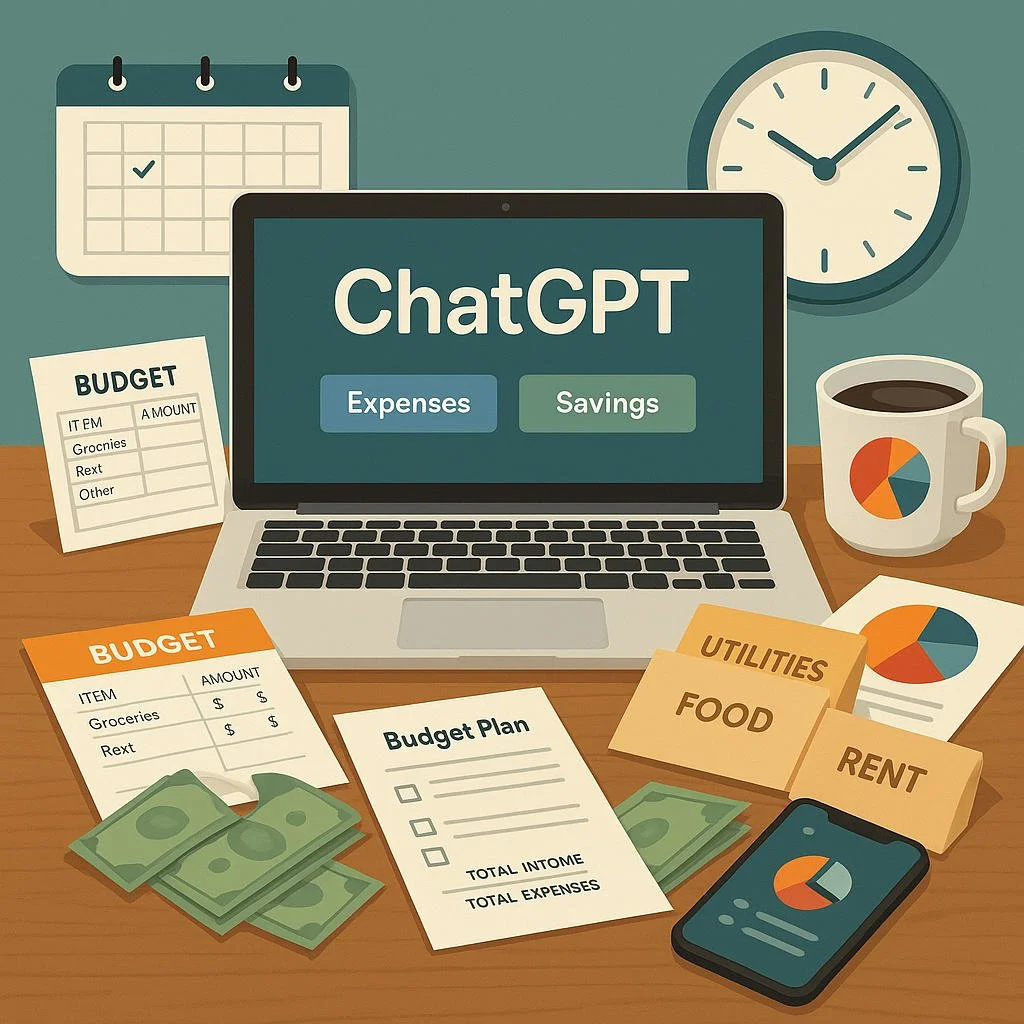
ChatGPT won’t move your money, but it will organize, calculate, and coach your plan. Treat it like a financial project manager:
Define goals and constraints.
Collect income and expenses (including the sneaky ones).
Choose a budget framework you’ll actually follow.
Allocate every dollar to jobs (savings, bills, fun).
Automate payments and track weekly.
Review monthly, adjust quarterly.
Everything below gives you prompts, examples, and ready-made templates.
Step 1 — Set goals that drive the budget
Skip vague wishes. Make the budget goal-powered.
Prompt: Goal Builder
“Help me define 3 money goals for the next 12 months. Use this format: (1) target amount, (2) deadline, (3) monthly contribution needed, (4) risk if I don’t hit it. My ideas: [emergency fund amount, debt payoff, travel, big purchase].”
Examples
Build $3,000 emergency fund in 6 months → $500/month.
Pay off $2,400 credit card at 18% in 8 months → $300/month.
Save $1,800 for summer trip in 9 months → $200/month.
Step 2 — Gather the raw numbers fast
You need the last 60–90 days of activity.
What to collect
Take-home income (paycheques, side gigs, benefits).
Fixed bills (rent, phone, insurance, subscriptions).
Variable costs (groceries, eating out, transport, fun).
Irregulars (car reg, gifts, vet, annual renewals).
Debt (balances, minimums, APRs).
Savings & sinking funds (what you’re already doing).
Prompt: Expense Extractor
“From these transactions [paste or summarize categories + amounts], summarize monthly totals by category. Identify fixed vs variable vs irregular. Highlight any duplicates and subscriptions I can cancel or downgrade.”
Step 3 — Pick a budget method that fits your brain
You don’t need the “best”—you need the one you’ll stick to.
Option A) 50/30/20 (simple ratios)
50% Needs (housing, utilities, groceries, transport, minimum debt).
30% Wants (dining, entertainment, non-essential shopping).
20% Saving/Debt (emergency fund, extra debt paydown, investments).
Best for: beginners, stable income.
Prompt:
“Using my net monthly income [$X], allocate 50/30/20. List categories under each bucket and show whether I’m over/under the targets.”
Option B) Zero-based (every dollar assigned a job)
Income − Expenses = 0 (on purpose). You plan where every dollar goes before the month starts.
Best for: tight budgets, aggressive goals, variable income.
Prompt:
“Build a zero-based budget for [$X income]. Categories: housing, utilities, groceries, transport, insurance, debt minimums, savings goals [list], sinking funds [list], fun money, buffer. Ensure the total equals income, and include a $50–$100 ‘misc’ line.”
Option C) Envelope / category caps (digital or cash)
You set caps per category and stop when an envelope is empty.
Best for: overspending on a few pain categories.
Prompt:
“Create envelope caps for groceries, eating out, transport, and fun based on my last 60 days. Recommend weekly caps and a rule for when one envelope runs out.”
Step 4 — Design sinking funds so “surprises” stop wrecking you
Sinking funds = small monthly set-asides for known but non-monthly costs.
Common funds
Car maintenance, gifts, travel, annual fees, clothing, vet, home supplies.
Amount = annual cost ÷ 12 (or months until next due date).
Prompt: Sinking Fund Planner
“List 8 likely sinking funds based on my past expenses and life events. Estimate annual amounts and compute monthly contributions. Separate essentials vs optional.”
Step 5 — Build the first draft budget (with a buffer)
Combine your method + sinking funds + goals.
Prompt: First Draft Budget
“Create a month-one budget from: net income [$X], goals [list + monthly amounts], fixed bills [list], variable categories [list], and sinking funds [list]. Include a $100 buffer for mistakes and a $0 result for zero-based.”
Pro tips
Start conservative on groceries and transport; cut later with data.
Keep one buffer line so you don’t bust the budget on day 3.
Put minimum debt in Needs; extra paydown in Saving/Debt.
Step 6 — Make cash flow bulletproof (pay dates matter)
A great monthly plan can still fail if timing is off.
Prompt: Pay-Date Cash-Flow Map
“Map my pay dates [list] and bill due dates [list]. Assign each bill to the paycheque before it. Tell me which bills to move (or split), and build a weekly cash plan with target balances.”
Moves that help
Shift due dates to cluster around pay days.
Split large bills across two cheques.
Keep a tiny chequing buffer (e.g., $200) to avoid overdraft.
Step 7 — Automate the essentials
Automation prevents “oops.”
Autopay minimums on debts and fixed bills.
Auto-transfers the day after payday:
Emergency fund → high-priority sinking funds → investments (if applicable).
Category cards: consider separate cards or sub-accounts for groceries or gas to cap overspending.
Prompt: Automation Playbook
“Turn my budget into automation instructions: transfer amounts, dates, account routing, and a checklist for verifying each autopay. Include a back-up plan if income arrives late.”
Step 8 — Weekly review in 12 minutes
Don’t wait a month to see it broke.
Prompt: Weekly Review
“Create a 12-minute weekly ritual: (1) categorize transactions, (2) compare category spend vs cap, (3) move sinking fund money, (4) adjust next week’s plan if I’m trending over, and (5) write one sentence on what to change.”
Red-flag ratios
Groceries trending > 25–30% of take-home for one person (tune for household size).
Eating out > half your grocery bill.
Transport + car + insurance crowding out goals.
Step 9 — Monthly close and reset (30–45 minutes)
Reflect, adjust, improve.
Prompt: Month-End Debrief
“Run a month-end close: show budget vs actual per category, sinking fund balances, debt change, savings rate, and cash buffer trend. Recommend 3 changes for next month.”
What to adjust
Overages: raise caps or add a sinking fund.
Unders: reduce caps and send to goals.
Goals: if behind, add a small side-income challenge or a temporary freeze on wants.
Step 10 — Special cases & upgrades
Irregular or seasonal income
Base the plan on your worst-case month.
Build a 1-month expenses buffer before anything fancy.
Prompt:
“Design a variable-income budget. Use a rolling baseline of my lowest 3 months in the past year. Prioritize expenses in tiers: must-pay, should-pay, nice-to-have.”
Debt payoff strategy (if balances exist)
Avalanche: highest APR first (fastest interest savings).
Snowball: smallest balance first (quick wins).
Either way, automate the extra payment and celebrate milestones.
Prompt:
“Given debts [balances, APRs, minimums], build both avalanche and snowball schedules. Show months to debt-free and total interest. Recommend one based on my motivation style.”
Couples & roommates
Agree on shared vs personal categories.
Use split rules (50/50, income-weighted).
Hold a 15-minute money check weekly.
Prompt:
“Create a couples budgeting framework: shared bills split [rule], separate fun money, joint sinking funds for travel/gifts, and a script for a 15-minute weekly meeting.”
Students or new grads
Keep rent + utilities under a target % of take-home if possible.
Use semester sinking funds (books, fees, travel).
Prioritize building a starter emergency fund (even $500 helps).
Prompt:
“Build a student budget on [$X/month] with rent, transit, groceries, books, and a $500 emergency fund target. Add exam-month adjustments.”
Small business / self-employed
Separate business and personal immediately.
Sinking funds for taxes and HST/GST if applicable.
Pay yourself a stable owner draw each month.
Prompt:
“Create a self-employed cash-flow plan: allocate revenue to taxes [%], operating costs, and a fixed owner draw. Add a 3-month revenue buffer goal.”
Templates you can paste
Zero-Based Budget Table (example)
Income (net): $4,000
CategoryBudgetRent & Utilities$1,650Groceries$450Transport (fuel/transit)$220Phone/Internet$120Insurance$140Debt Minimums$200Emergency Fund$300Sinking Funds (car/gifts/travel)$300Eating Out$220Fun/Subscriptions$140Misc/Buffer$60Total$4,000
Sinking Funds Snapshot (example)
Car maintenance: $600/yr → $50/mo
Gifts: $480/yr → $40/mo
Annual fees/subscriptions: $360/yr → $30/mo
Travel: $1,200/yr → $100/mo
Clothing: $300/yr → $25/mo
Vet/pet: $300/yr → $25/mo
Home supplies: $360/yr → $30/mo
Prompts for ongoing success
Category Re-tune
“I overspent $85 in eating out and $40 in apps. Reallocate from my ‘fun’ and ‘misc’ without touching savings goals. Adjust next week’s caps.”
Groceries Downshift
“Cut my grocery bill by 15% next month without losing protein. Propose a 7-day rotating menu, batch-cook plan, and a specific shopping list cap.”
Cash-Flow Squeeze
“My car repair was $450. Update sinking funds and this month’s budget to absorb it while still saving $200. Suggest what to pause for 30 days.”
Quarterly Refresh
“Do a quarterly budget reset: update income, renegotiate bills to target a 5% spend reduction, and increase goal contributions by $100 if feasible.”
Checklists (print these)
Set-up
Goals defined with amounts and deadlines
60–90 days of transactions summarized
Budget method chosen (50/30/20, zero-based, or envelopes)
Sinking funds created for irregulars
First draft budget balanced (includes buffer)
Cash-flow
Due dates aligned to pay days
Large bills split if needed
$200 chequing buffer to avoid overdraft
Automation
Autopay on fixed bills and debt minimums
Auto-transfers after payday to savings and sinking funds
Category caps set (cards/sub-accounts)
Late-income contingency plan
Review cadence
Weekly 12-minute check-in scheduled
Month-end debrief and category adjustments
Quarterly renegotiation of bills and goals
Troubleshooting (why budgets break)
“I keep busting groceries.”
Move to weekly caps and shop once; use a rotating menu and a hard list.
“Unexpected bills blow me up.”
That means it isn’t unexpected—add or enlarge the right sinking fund.
“I hate tracking every dollar.”
Switch to envelopes for 2–3 problem categories only; keep the rest broad.
“Income is unpredictable.”
Budget to your lowest recent month, then keep extra in a buffer before increasing spending.
“I never see progress.”
Automate goal transfers the day after payday and track a simple savings rate (% of take-home).
One-week sprint (from zero to budget)
Day 1: Goals and rough numbers (60–90 days).
Day 2: Choose method; draft budget with a buffer.
Day 3: Build sinking funds and recalc.
Day 4: Map pay dates vs bills; fix timing.
Day 5: Set up autopay and transfers.
Day 6: First weekly review; adjust caps.
Day 7: Write month-end debrief template and schedule reminders.
TL;DR (finally)
Pick a method you’ll follow (50/30/20, zero-based, or envelopes).
Make the budget goal-powered (emergency fund, debt, a fun goal).
Add sinking funds so irregular costs stop wrecking months.
Map pay dates to bill dates and automate: minimums, savings, and caps.
Do a 12-minute weekly review and a monthly debrief; adjust quickly.
The “perfect” budget is the one you can stick to—iterate until it fits your life.