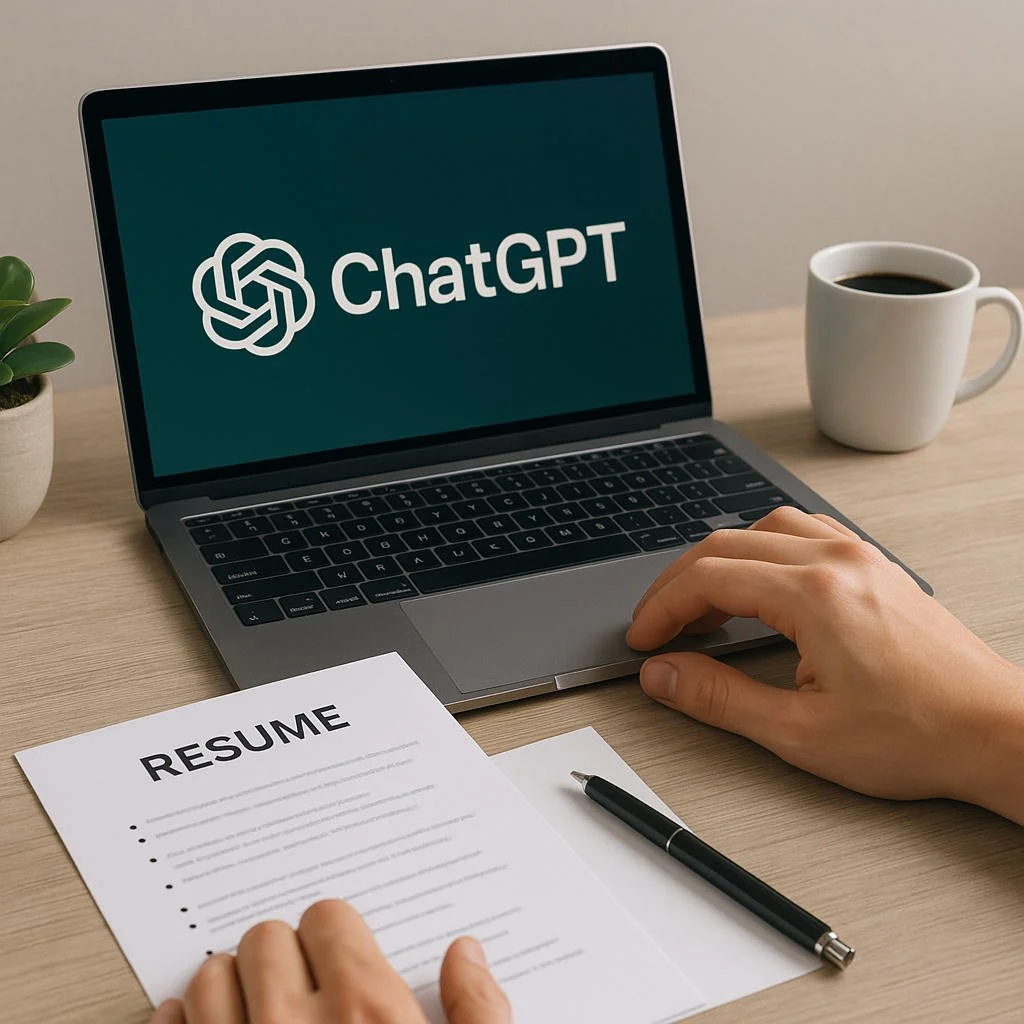
How to Use Chat GPT to Make a Resume (2025)
November 2025 update
Step 1) Start with a clean core file (your “master resume”)
Paste your existing resume (or raw work notes) and say:
“Turn this into a single-column, ATS-friendly resume. Keep section headers simple (Summary, Skills, Experience, Education, Certifications). No text boxes, tables, columns, icons, or images. Use standard fonts.”
Why: most applicant tracking systems prefer simple structure and clear headings; decorative layouts and graphics can break parsing. Keep it one column with plain section titles, and save fancy design for a portfolio.
Step 2) Translate the job posting into a skills checklist
Paste the job ad and ask:
“Extract the top competencies, tools, and outcomes. Group them as must-have vs nice-to-have. Create a keyword list to mirror in my resume (skills section + relevant bullets).”
Why: employers increasingly emphasize skills-based hiring, so your resume has to echo the role’s real requirements. In 2025, most recruiters say they’re scanning for concrete problem-solving, teamwork, communication, and technical skills—make these easy to find in your document.
Step 3) Map your experience to those skills with quantified bullets
Feed ChatGPT one role at a time (job title, dates, 3–6 raw accomplishments). Prompt:
“Rewrite these as achievement bullets using Problem–Action–Result (PAR). Put the result first with a number (%, time saved, $). Keep each to one line if possible.”
Then iterate:
“Tighten to 16–20 words.”
“Swap vague phrases for metrics (baseline → delta).”
“Emphasize collaboration when impact required multiple teams.”
Examples ChatGPT can produce (and you can tweak):
“Cut month-end close from 12 → 7 days by automating reconciliations in Excel + SQL.”
“Grew self-serve conversion +28% after shipping A/B-tested onboarding flow.”
“Resolved P1 incidents 40% faster by redesigning runbooks and on-call handoffs.”
Step 4) Build a Skills section that matches how recruiters search
Ask:
“From the job ad + my background, propose a Skills section grouped by Core Skills, Tools/Tech, and Methodologies. Use industry-standard terms and synonyms.”
Pro tip: sanity-check terminology against public skills taxonomies (e.g., O*NET in the U.S. or ESCO in the EU) so you’re using the same labels employers and ATS databases recognize.
Step 5) Make it ATS-friendly (format & file)
Tell ChatGPT:
“Audit this resume for ATS readiness. Flag anything risky (columns, text boxes, graphics, headers/footers, weird characters). Suggest a clean order of sections.”
Export guidance:
If the application specifies formats, follow that.
If not specified, a .docx is the safest default; PDFs are fine when the employer/ATS explicitly accepts them.
Use a descriptive filename:
Firstname_Lastname_Role_Company_YYYY-MM.Keep margins and spacing standard; avoid headers/footers for core content.
Step 6) Tailor in 5 minutes per application
Create a “tailorizer” prompt you can reuse:
“Given this job ad and my master resume, produce:
a targeted Summary (3 lines, role + value + proof),
a refreshed Skills list mirroring the ad,
6 tailored bullets replacing or reordering my existing ones to match the ad’s priorities. Keep all truthful and consistent with my experience.”
Paste the output back into your master file copy, review, and submit.
Step 7) Add a crisp Summary (not fluff)
Ask for two versions—one analytical, one stakeholder-friendly:
“Write a 3-line Summary that front-loads the outcome I create, the context/scale, and proof (one metric). Avoid buzzwords.”
Example: “Operations lead who reduces cost-to-serve by double digits. Scales 24/7 support from 5 to 30 agents while keeping CSAT >90%. Known for turning chaos into standard work.”
Step 8) Make bullets sound spoken (so you can discuss them)
For each bullet you’ll likely be asked about in interviews:
“Rewrite for spoken delivery (20–30 seconds) using STAR beats. Keep numbers, remove jargon. Add a one-sentence lesson learned.”
You’ll now have a resume that reads well and stories you can say out loud without rambling.
Step 9) Include modern evidence—briefly
Certifications & assessments: Add current certs, badges, and notable assessments that prove skill.
Projects/portfolio: One line per project with the outcome and tools; link if allowed in the application form.
QR code (optional): Only if the employer permits; otherwise keep URLs in plain text in a “Projects” or “Portfolio” line.
Step 10) Guardrails (ethics & accuracy)
Don’t let AI invent credentials or inflate numbers. Ask ChatGPT to highlight any assumptions it made so you can correct them.
Keep dates, titles, and employer names exact.
If your role names differ from the market, ask: “Rename my titles to market-standard equivalents while keeping accuracy (e.g., ‘Customer Success Lead’ for ‘Client Support Team 2 Supervisor’).”
Copy-and-paste prompt set (steal this)
A. Master Resume Clean-up
“Rewrite my resume into a one-column, ATS-friendly format with standard headers. Preserve facts, remove fluff, quantify where possible. No tables, text boxes, icons, or images.”
B. Job Ad → Keywords
“From this job ad, list must-haves, nice-to-haves, and top outcomes. Create a keyword bank I should mirror.”
C. Bullet Upgrades (PAR)
“Convert these tasks into result-first bullets using Problem–Action–Result. 16–20 words. Start with a number.”
D. Skills Section
“Generate a Skills section grouped as Core Skills, Tools/Tech, Methods. Use industry-standard names and synonyms.”
E. Tailoring Pass
“Using my resume and this job ad, rewrite my Summary, reorder Skills, and replace 6 bullets to match the ad’s impact areas.”
F. Spoken Answers
“Turn each key bullet into a 25-second STAR story with one metric and one lesson.”
Common pitfalls (and the quick fixes)
Over-decorated formats: Pretty templates break parsers → go single column, plain headers.
Responsibilities instead of results: Switch to PAR with numbers up front.
Keyword mismatch: Mirror job-ad phrasing (tools, frameworks, domains) in Skills and bullets.
Too long: Early-career ≈ 1 page; experienced ≈ 1–2 pages; executives as needed. Prioritize impact.
File issues: If the posting doesn’t specify, .docx is safest; only use PDF where it’s explicitly accepted.
Advanced: cross-checking skills with public taxonomies
If you’re unsure how a skill is named in your region/industry, ask:
“Show me the O*NET/ESCO terms for these abilities and tools, plus common synonyms recruiters use.”
Then weave those exact terms into Skills and relevant bullets so your resume aligns with how many systems and recruiters label the work.
Reality of 2025: resumes + assessments
Hiring teams increasingly combine resumes with skills tests and work samples. Use ChatGPT to prepare:
“I might face an aptitude or job-simulation test for this role. Generate a 7-day practice plan with 30-minute drills and debriefs.”
That way your resume’s promises match your performance when tested.
One-week resume refresh plan
Day 1: Clean the master file (Step 1).
Day 2: Mine two target job ads; build the keyword bank (Step 2).
Day 3: Upgrade 12 bullets with PAR + metrics (Step 3).
Day 4: Rebuild Skills section with industry terms (Step 4).
Day 5: Write two Summary variants (Step 7).
Day 6: Create the 5-minute tailoring workflow and save prompts (Step 6).
Day 7: Convert 6 bullets into spoken STAR stories (Step 8); record yourself.
Quick checklist (print this)
Single-column, ATS-friendly formatting
Result-first bullets with numbers (PAR)
Skills section mirrors job phrasing
Summary: who I am → what I deliver → proof
Correct file format & filename
Tailored for each posting in 5 minutes
Spoken versions ready for interviews
TL;DR (finally)
Use ChatGPT to clean structure, mine keywords, and rewrite bullets into quantifiable wins.
Mirror the job’s skills; keep format simple and ATS-friendly; export .docx unless PDF is requested.
Build a reusable tailoring prompt so every submission matches the posting in minutes.
Translate bullets into spoken STAR stories—your resume is a script for the interview.
Cross-check skills with industry taxonomies and be ready for assessments that verify what you wrote.
Once you’re done your resume, here’s how to get Chat GPT to write you a cover letter.
Did you get a call back? Here’s how to use Chat GPT to prepare for the interview.
Thanks for reading and good luck!